New Delhi | February 11, 2026
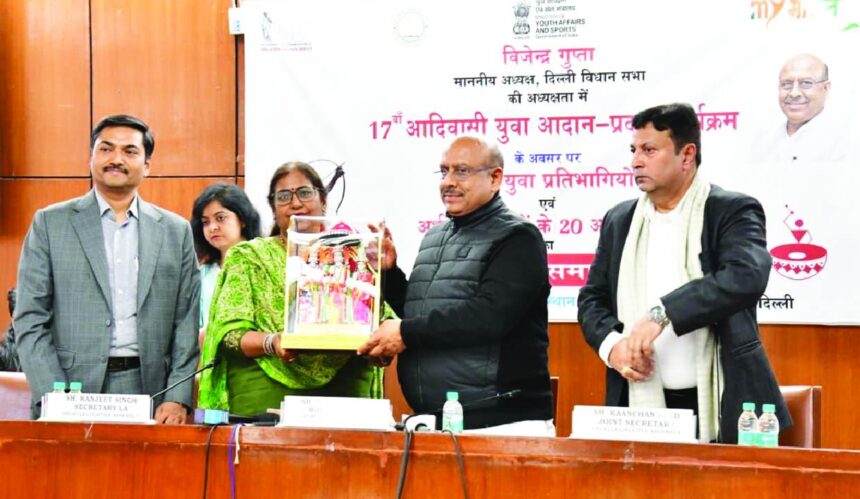
An interaction programme under the 17th Tribal Youth Exchange initiative was organized at the Delhi Legislative Assembly, aiming to connect young citizens from tribal regions with India’s democratic and constitutional framework.
Speaker Vijender Gupta stated that when youth from every region of the country move forward with confidence, the vision of a developed India becomes achievable. He urged participants to actively engage with democratic institutions and contribute meaningfully to governance and nation-building in their respective regions.
The programme saw participation from nearly 200 tribal youth representing districts of Chhattisgarh, Jharkhand, Madhya Pradesh, Odisha, and Maharashtra. The delegation was accompanied by 36 district youth officers and other officials associated with the programme.
The Speaker appreciated the journey of the 36 youth officers who had cleared the UPSC examination but could not make it to the final merit list. He emphasized that public service remains a dignified and impactful path for committed individuals driven by a sense of national responsibility.
Highlighting the role of youth in achieving the vision of a developed India, he said that constitutional awareness, social cohesion, and informed participation form the foundation of national progress. Exposure to democratic institutions, he added, inspires young citizens to play constructive roles in governance, public service, and community leadership.
Participants were given a guided tour of the Assembly Hall, where they were introduced to its legislative functions, constitutional role, and historical legacy. The Speaker underlined that the Assembly is not merely a heritage structure but a living institution that continues to shape public life through democratic discourse.
A documentary on the constitutional contributions of Vithalbhai Patel was screened, followed by discussions on a commemorative coffee table book titled Centenary Journey: Veer Vithalbhai Patel, which showcases the institutional heritage of the Assembly.
The Speaker also shared historical insights, noting that the Assembly complex witnessed key phases of India’s legislative evolution following the Morley-Minto reforms of 1909 and the transfer of the capital to Delhi in 1911. References were made to landmark debates, including those during the Rowlatt Act period and the strengthening of parliamentary traditions under Vithalbhai Patel’s leadership.
The programme was organized by the MY Bharat Centre in coordination with the Ministry of Home Affairs. The interaction highlighted the importance of structured engagement between youth and constitutional institutions in strengthening democratic consciousness and national unity.