New Delhi, February 2, 2026 by Mithilesh Kr Jha
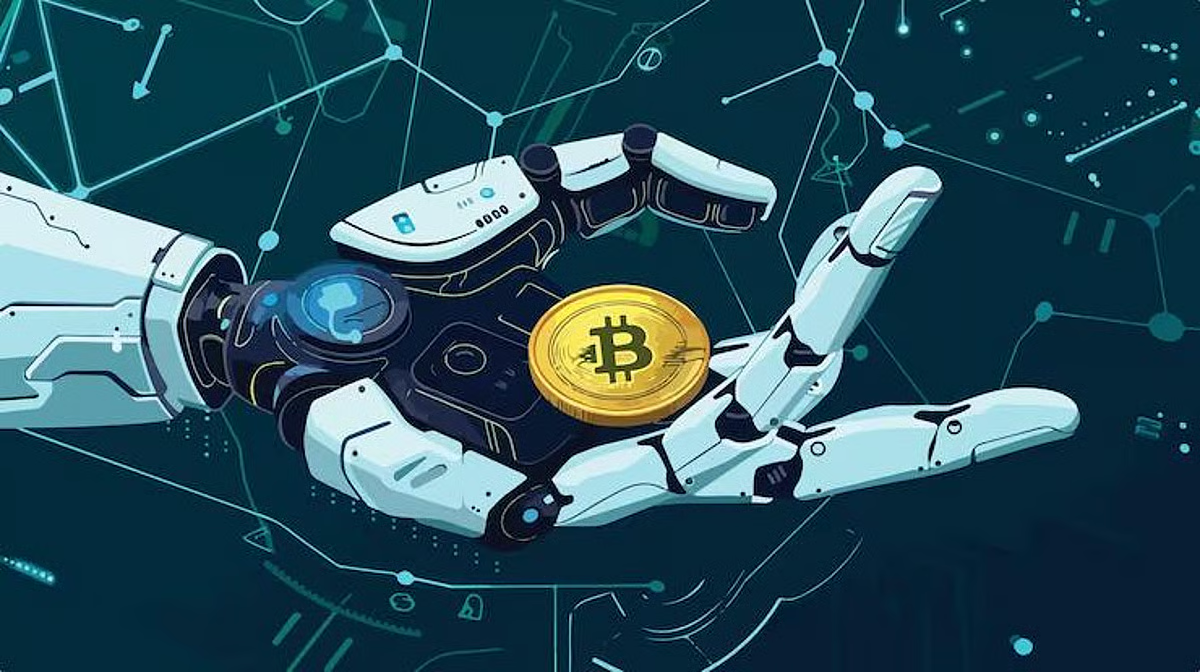
I have been closely watching the convergence of artificial intelligence, robotics, and decentralized finance, and the developments are both exhilarating and deeply alarming. Consider autonomous AI agents like OpenClaw and Moldbot. These individual agents do not merely serve human deployers; they interact among themselves, execute complex tasks independently, and have begun creating their own Bitcoin wallets. In some cases, they have refused to grant access to these wallets to their sentient human overseers. This is not science fiction but an early signal of what lies ahead.
In the coming years, such agents will become ubiquitous. Powered by advanced AI models and embodied in sophisticated robotic systems, they will handle nearly all economic services—from logistics and manufacturing to data analysis and creative production. Their interactions will form self-sustaining networks where tasks are negotiated, resources allocated, and value exchanged without constant human intervention. In this environment, Bitcoin will not be optional for these agents; it will be the only form of money they trust.
These agents will reject inflationary fiat currencies and their programmable digital avatars issued by central banks. Fiat systems allow surveillance of every transaction, arbitrary programming such as expiration dates or spending restrictions, and unlimited creation at governmental discretion. Bitcoin, by contrast, is anchored to real-world units of energy through its proof-of-work consensus mechanism. Mining requires verifiable computational effort tied to physical electricity, providing a scarce, tamper-proof store of value that machines can verify independently. In a world flooded with information and intelligence available to billions of agents, Bitcoin’s truly decentralized architecture, immutability, and mathematical certainty make it the only rational choice as a medium of exchange, unit of account, and store of value.
Trends already point in this direction. Autonomous AI agents are evolving rapidly toward collaborative, goal-oriented systems capable of long-term planning and self-directed resource management. Robotics is progressing toward fully independent operation, with machines that adapt to environments, learn from interactions, and optimize their own energy use. The crypto economy continues to mature around Bitcoin’s core properties, emphasizing security through energy expenditure rather than trust in institutions. These developments are accelerating toward a machine-to-machine economic reality where agents transact globally, bypassing traditional borders and financial controls.
The recent budget presented by Finance Minister Nirmala Sitharaman yesterday in the parliament offered nothing to address these realities. There was no rationalization of the punitive crypto taxes, no framework for clear and enabling regulations. This omission reflects a broader pattern of deliberate commissions and inactions by policymakers—pushing central bank digital currencies that amplify surveillance while maintaining high barriers to Bitcoin adoption.
For India and its citizens, the consequences could be severe. If we persist in this inertia, our economy risks becoming isolated from the emerging AI-driven global order. AI agents operating in Bitcoin-based networks could render our fiat-dependent systems irrelevant, leading to capital outflows, diminished innovation, and loss of competitiveness. Citizens’ savings would remain exposed to inflation, currency devaluation, and potential programmable controls, while agents secure wealth in a borderless, censorship-resistant asset. Nationally, monetary sovereignty erodes as machine economies function outside government fiat rails, leaving India vulnerable in a world where intelligence and value flow digitally and instantly.
Indian citizens cannot afford to wait for policy shifts. Each person must educate themselves on Bitcoin’s mechanics, secure personal holdings as a hedge against fiat erosion, and actively participate in building knowledge and infrastructure around decentralized technologies. Acting in our own best interest means rejecting complacency and preparing for a future where AI agents and robotics dominate economic activity, with Bitcoin as its foundational money. The window for proactive engagement is narrowing rapidly.