The Indian National Congress has announced a nationwide series of protests against the central government’s decision to replace the Mahatma Gandhi National Rural Employment Guarantee Act with a newly proposed law, arguing that the move represents a deeper ideological shift away from rights-based welfare and undermines the legacy of Mahatma Gandhi. The protests, scheduled across districts and later extending to villages and mandals, are being positioned by the party as both a political mobilisation and a moral stand to defend rural livelihoods, federal responsibility, and the constitutional promise of social justice.
Congress mobilises cadres nationwide over renaming of rural employment law
The Congress leadership has directed all Pradesh Congress Committees to organise coordinated demonstrations at district headquarters, signalling a nationwide mobilisation against what it describes as an attempt to erase Mahatma Gandhi’s name and values from one of India’s most significant social welfare legislations. According to the party, the decision to replace MGNREGA with the Viksit Bharat–Guarantee for Rozgar and Ajeevika Mission (Gramin) Bill, 2025 goes beyond administrative reform and reflects a deliberate political choice that alters the philosophical foundation of rural employment policy.
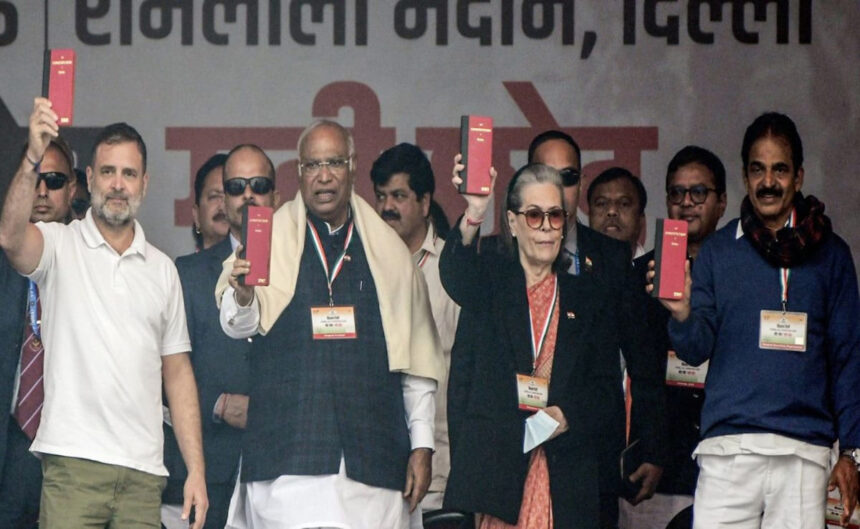
Party communications emphasise that the protests will prominently feature portraits of Mahatma Gandhi, symbolising resistance to what the Congress calls the dilution of a people’s law that guaranteed the right to work. By invoking Gandhi’s image, the party seeks to frame the issue as one of historical continuity and moral responsibility, arguing that MGNREGA was not merely a welfare scheme but a rights-based entitlement rooted in the dignity of labour and social equity.
In its messaging, the Congress has accused the BJP and the RSS of pursuing a broader agenda aimed at dismantling rights-based welfare structures and replacing them with centrally controlled charity-driven models. The party contends that such a shift weakens the federal character of welfare delivery and reduces accountability to beneficiaries. According to Congress leaders, the renaming and restructuring of the rural employment law risk transforming a legally enforceable right into a discretionary programme vulnerable to political priorities and budgetary constraints.
The protests are expected to involve party functionaries at all levels, elected representatives, civil society organisations, MGNREGA workers, beneficiaries, and members of the general public. By encouraging wide participation, the Congress aims to demonstrate that opposition to the new law is not confined to political circles but resonates with those directly affected by rural employment policies. The party has also called on its grassroots units to clearly articulate how the proposed changes could impact crores of rural households that depend on guaranteed employment for income security.
The decision to intensify agitation comes amid heightened parliamentary activity, with the new rural employment Bill having been introduced in the Lok Sabha. Congress leaders argue that pushing such a transformative change during the final days of the Winter Session, without extensive consultation and consensus, undermines democratic deliberation. The party’s issuance of protest directives reflects an effort to build pressure both inside and outside Parliament as the legislative process unfolds.
In addition to district-level protests scheduled for December 17, the Congress has announced a second phase of mobilisation to coincide with its Foundation Day on December 28. On that day, Pradesh Congress Committees have been instructed to organise programmes in all mandals and villages, again displaying portraits of Mahatma Gandhi. These events are intended to reaffirm the party’s ideological commitment to the dignity of labour, social justice, and the right to work, while reinforcing its narrative that the new law represents a departure from these principles.
Political confrontation deepens as new employment law sparks wider opposition
The introduction of the Viksit Bharat–Guarantee for Rozgar and Ajeevika Mission (Gramin) Bill, 2025 has intensified political confrontation both within Parliament and beyond. The Bill proposes a statutory guarantee of 125 days of wage employment per rural household each financial year, an increase from the existing 100 days under MGNREGA. The government has presented this as a progressive reform aligned with the broader vision of viksit bharat @2047, arguing that it aims to combine income security with the creation of durable, productivity-enhancing rural assets through a nationally coordinated development strategy.
Despite the proposed increase in guaranteed workdays, the Congress and several other opposition parties have focused their criticism on the symbolic and structural implications of replacing MGNREGA. They argue that removing Mahatma Gandhi’s name from the legislation weakens the moral and historical foundation of the programme and signals a departure from the ethos that shaped its original design. For the opposition, the issue is not only about the number of employment days but about preserving a law that enshrined employment as a legal right rather than a policy initiative.
Opposition MPs have already staged demonstrations outside Parliament, gathering at the Mahatma Gandhi statue within the parliamentary परिसर to protest the introduction of the new Bill. Holding photographs of Gandhi, they accused the government of attempting to dismantle a landmark rural employment scheme under the guise of renaming and restructuring. The presence of senior leaders from multiple opposition parties at these protests has underscored the potential for broader political alignment around the issue.
Congress leaders have framed the confrontation as a struggle to defend constitutional values, arguing that MGNREGA represented a concrete expression of the state’s obligation to ensure economic justice for the poorest. They contend that the new Bill, despite its stated objectives, risks centralising control and weakening the accountability mechanisms that allowed citizens to demand work as a matter of right. The party has also expressed concern that changes to the legal framework could make rural employment guarantees more vulnerable to fiscal pressures and administrative discretion.
The protests announced by the Congress are designed to sustain momentum beyond parliamentary debate, keeping the issue alive in public discourse. By linking the agitation to Mahatma Gandhi’s legacy, the party seeks to broaden the appeal of its campaign and position itself as the custodian of values associated with social justice and non-violent resistance. The leadership has repeatedly described the issue as both political and moral, arguing that defending MGNREGA is inseparable from defending the vision of inclusive development that Gandhi espoused.
As the Winter Session progresses and the fate of the new rural employment law becomes clearer, the standoff between the government and the opposition is expected to intensify. The Congress has made it clear that it intends to lead resistance both inside Parliament and on the streets, portraying the renaming of MGNREGA as emblematic of a larger ideological conflict over the direction of India’s welfare state. Whether the protests succeed in shaping legislative outcomes or public opinion remains to be seen, but they have already ensured that the debate over rural employment, rights-based welfare, and Gandhi’s legacy will remain central to the national political conversation in the days ahead.