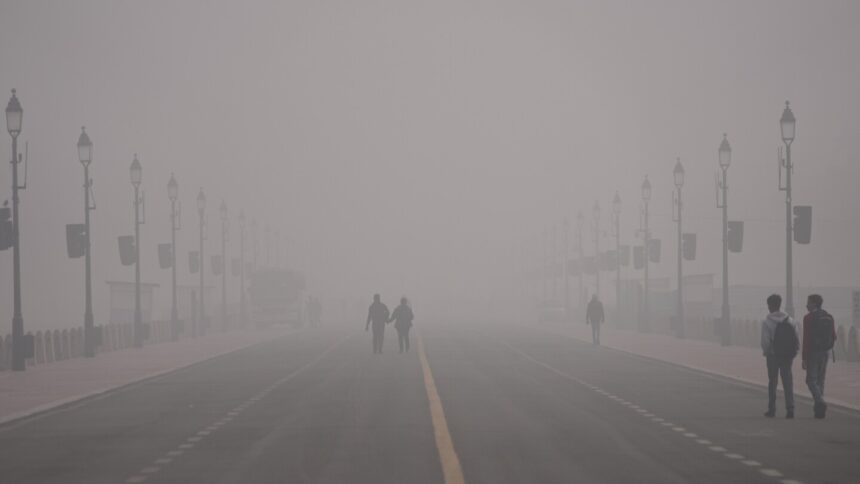
The Supreme Court is set to hear a crucial plea on December 17 concerning the worsening air pollution crisis in Delhi and the National Capital Region, as the city continues to grapple with hazardous air quality that has raised serious public health concerns. With pollution levels touching the upper end of the ‘severe’ category and repeated allegations of weak enforcement of existing measures, the court’s intervention is being closely watched amid growing anxiety over the impact on vulnerable populations, especially children and daily wage workers.
Court flags poor implementation of existing pollution control measures
A three-judge bench headed by Chief Justice Surya Kant, along with justices Joymalya Bagchi and Vipul M Pamcholi, took note of submissions highlighting that while preventive mechanisms and regulatory frameworks to curb air pollution already exist, their implementation on the ground remains deeply inadequate. The issue was raised by senior advocate Aprajita Singh, assisting the court as amicus curiae, who pointed out that authorities often fail to comply with established protocols unless the court issues explicit directions.
The Chief Justice acknowledged the concern, observing that the matter would be taken up by a three-judge bench on December 17. The court’s remarks reflected frustration over recurring non-compliance, suggesting that the problem lies less in the absence of rules and more in the lack of consistent enforcement by implementing agencies. According to the submissions, despite repeated judicial orders and clearly laid-down guidelines, responsible authorities frequently delay or dilute action, allowing pollution levels to spiral each winter.
During the proceedings, another lawyer drew attention to the continuing health risks faced by children, alleging that some schools were still conducting outdoor sports activities in violation of earlier court orders. The amicus curiae supported this concern, stating that institutions had found ways to bypass restrictions, even as the Commission for Air Quality Management continued to cite Supreme Court orders in its responses. This, the court was told, reflects a disconnect between policy directives and actual practice.
The Chief Justice indicated that the court was conscious of the complexities involved, noting that urban lifestyles and structural realities in metropolitan cities pose challenges to enforcement. At the same time, he acknowledged that the burden of pollution falls disproportionately on the poor, particularly labourers who work outdoors and lack the means to protect themselves from prolonged exposure to toxic air. The amicus emphasised that these groups are the worst affected, often forced to choose between health and livelihood during peak pollution periods.
The bench reiterated its earlier stance that air pollution cases should not be treated as routine matters limited to winter months. It had previously made clear that the issue demands year-round monitoring and sustained solutions rather than seasonal responses. To that end, the court has indicated that it intends to take up the matter twice every month to assess both short-term interventions and long-term strategies aimed at addressing the root causes of the crisis.
Delhi chokes under severe smog as health concerns intensify
The urgency of the Supreme Court’s intervention is underscored by the grim air quality situation in Delhi-NCR. On Monday, the capital was enveloped in a thick blanket of smog, with the Air Quality Index settling at 498, placing it firmly within the ‘severe’ category. Such levels are considered extremely harmful, posing serious risks to respiratory and cardiovascular health, particularly for children, the elderly, and those with pre-existing conditions.
Out of 40 monitoring stations across the city, air quality was recorded as ‘severe’ at 38 locations, while the remaining two reported ‘very poor’ conditions. Jahangirpuri emerged as the most polluted area, registering an AQI of 498, the highest among all stations. These readings reflect a citywide crisis rather than isolated pockets of poor air, highlighting the scale and persistence of the problem.
According to established air quality standards, an AQI between 0 and 50 is considered good, while levels above 401 fall into the severe category. Delhi’s recent readings represent some of the worst air quality recorded this winter. On Sunday, the AQI had climbed to 461, marking the city’s most polluted day of the season and the second-worst December air quality day on record. Meteorological factors such as weak winds and low temperatures have compounded the situation by trapping pollutants close to the surface, preventing dispersion.
The court has previously expressed concern that the recurring nature of Delhi’s pollution crisis reflects systemic failures rather than exceptional circumstances. Each year, emergency measures are announced, restrictions are imposed, and advisories are issued, yet the cycle repeats itself with alarming regularity. The Supreme Court’s decision to hear the plea again signals its intent to push for accountability and ensure that remedial measures translate into tangible improvements on the ground.
Public health experts have repeatedly warned that prolonged exposure to such high pollution levels can have lasting consequences, including reduced lung capacity in children, increased incidence of asthma and bronchitis, and heightened risk of heart disease. The continued operation of schools, outdoor activities, and routine urban life amid severe pollution has raised questions about the adequacy of current response mechanisms and the balance between normalcy and safety.
As the December 17 hearing approaches, expectations are building around the possibility of stronger, enforceable directions from the apex court. Whether through stricter compliance timelines, clearer accountability mechanisms, or more aggressive enforcement powers, the court’s intervention is seen as a critical step in addressing a crisis that affects millions of residents across Delhi-NCR. The outcome of the hearing could shape not only immediate responses to the current smog episode but also the broader framework for managing air quality in one of the world’s most polluted urban regions.