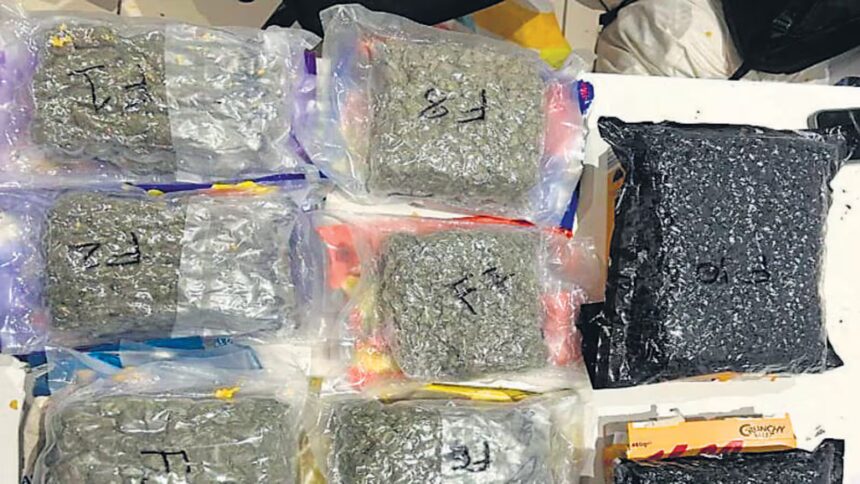
The Directorate of Revenue Intelligence (DRI) successfully dismantled a sophisticated drug syndicate smuggling hydroponic weed into India via the Rajdhani Express, seizing a total of 72.024 kilograms of high-value narcotics worth approximately Rs 72 crore, along with Rs 1.02 crore in cash. The operation, codenamed “Operation WeedOut,” targeted organized crime networks leveraging railways and social media platforms to facilitate large-scale trafficking. The Ministry of Finance confirmed that all five passengers involved, including the syndicate’s mastermind, were arrested following coordinated raids across multiple locations. This case highlights the growing sophistication of drug smuggling networks, their use of technology for recruitment and communication, and the stringent enforcement of the Narcotic Drugs and Psychotropic Substances Act, 1985, to curb such criminal activities.
Operation WeedOut: Strategic Surveillance and Railway Interventions
On the evening of August 20, 2025, DRI officers conducted meticulously planned surprise checks at two crucial railway stations — Krantiveer Sangolli Rayanna Station in Bengaluru and Bhopal Junction — focusing on passengers boarding the Rajdhani Express (train number 22691) bound for Delhi. The intelligence-driven operation aimed at intercepting drug consignments being transported via passengers. In Bengaluru, officers uncovered 29.88 kilograms of hydroponic weed in the luggage of two passengers who had just boarded the train. Almost simultaneously, in Bhopal, 24.186 kilograms of the same drug were discovered with two additional passengers who had boarded from Bengaluru a day earlier.
The DRI’s strategy involved not only checking luggage but also monitoring suspicious behavior and movement patterns, allowing them to connect dots across multiple boarding points. A significant breakthrough occurred the following morning when a passenger arriving in Bengaluru from Thailand was apprehended at a hotel, leading to the seizure of an additional 17.958 kilograms of hydroponic weed. The coordinated approach, integrating intelligence gathering, railway surveillance, and follow-up operations, allowed the DRI to prevent further transit of narcotics and disrupt a network operating across state and international lines.
Investigations revealed that the syndicate had developed a highly organized system to facilitate drug distribution. Social media platforms were used strategically to recruit college dropouts, part-time workers, and unemployed youth as couriers, offering financial incentives for transporting narcotics. This recruitment strategy highlighted the syndicate’s exploitation of economically vulnerable individuals to execute complex smuggling operations while minimizing risk to its core leadership. The network leveraged the anonymity of digital communication to coordinate transfers, maintain secrecy, and evade law enforcement, underscoring the evolving nature of organized crime in the digital age.
Legal Action and Enforcement Under NDPS Act
The Ministry of Finance emphasized that stringent action has been taken against all individuals involved in the case under the Narcotic Drugs and Psychotropic Substances (NDPS) Act, 1985. The law provides for severe penalties, including long-term imprisonment and hefty fines, reflecting India’s zero-tolerance approach toward narcotic trafficking. The arrested individuals, including the mastermind, face comprehensive legal scrutiny, and the investigation continues to map the full extent of the syndicate’s operations, including potential links to international suppliers and other domestic accomplices.
The DRI’s operation illustrates the critical role of intelligence-based enforcement in combating drug trafficking. By intercepting multiple consignments across different locations, authorities not only curtailed the immediate supply of high-value narcotics but also sent a strong message regarding the risks and consequences of participating in organized crime networks. Analysts note that such operations are essential to counter increasingly sophisticated smuggling techniques that exploit transportation systems, digital recruitment, and anonymity afforded by social media platforms.
The seizure of 72.024 kilograms of hydroponic weed, valued at approximately Rs 72 crore, along with Rs 1.02 crore in cash, represents a significant disruption to the syndicate’s operations and underscores the economic scale of the narcotics trade within India. Experts highlight that hydroponic weed, due to its higher potency and demand, has become a preferred commodity for traffickers, increasing the urgency for targeted enforcement and preventive measures.
This case also demonstrates the DRI’s capability to execute multi-location operations seamlessly, combining strategic intelligence, timely surveillance, and swift action. The operation underscores the importance of inter-state coordination, real-time monitoring, and rapid response mechanisms in effectively dismantling criminal networks that operate across conventional jurisdictional boundaries. Moreover, the utilization of railway networks as a transit mechanism illustrates the need for continuous vigilance over passenger movement and cargo, particularly in high-value corridors connecting major urban centers.
The investigation further revealed patterns in the syndicate’s operational methodology, including the selection of high-traffic railways to minimize suspicion, the staggered movement of narcotics to evade detection, and the use of intermediaries to shield leadership from direct exposure. Such insights are crucial for law enforcement agencies to anticipate future strategies employed by organized crime and to design adaptive countermeasures.
Legal experts note that the application of the NDPS Act, 1985, is pivotal in establishing both deterrence and accountability, given the severe penalties associated with trafficking controlled substances. The arrests serve as a cautionary example to other potential actors, reinforcing that involvement in narcotics trade, irrespective of scale, invites rigorous legal repercussions and long-term consequences.
Furthermore, the case has triggered discussions on the socio-economic factors contributing to drug courier recruitment. The syndicate’s targeting of college dropouts and unemployed youth underscores vulnerabilities in society that can be exploited by criminal organizations. Policy analysts recommend combining enforcement with awareness campaigns, rehabilitation initiatives, and employment programs to reduce susceptibility to criminal recruitment.
The operation’s success also emphasizes the role of coordination between federal and state agencies. Collaboration between DRI teams in Bengaluru, Bhopal, and follow-up actions across other cities demonstrates the necessity of integrated approaches to counter nationwide criminal networks effectively. Each seizure, arrest, and subsequent investigation contributes to a cumulative strategy to dismantle organized crime infrastructures.
As the investigation unfolds, authorities continue to assess the syndicate’s financial flows, international linkages, and potential involvement in other illicit activities. The operation highlights the broader implications of drug trafficking on national security, public health, and social stability. Analysts anticipate that the case will shape future enforcement strategies, particularly in leveraging technology, surveillance, and inter-agency collaboration to counter sophisticated narcotics networks.
The DRI’s Operation WeedOut, by targeting a high-value hydroponic weed syndicate, sets a precedent for comprehensive enforcement strategies that combine intelligence, field operations, and legal rigor. The arrest of all key actors, including the mastermind, signifies a decisive victory for law enforcement and a critical step in disrupting narcotics distribution channels across India.
Through coordinated surveillance, multi-city operations, and strategic follow-ups, the Directorate of Revenue Intelligence demonstrated the evolving capacity of law enforcement to respond to sophisticated criminal networks. The success of this operation underscores the necessity for continued vigilance, proactive intelligence gathering, and stringent legal measures to combat the growing threat posed by organized drug trafficking in the country.
The operation has brought national attention to the scale and sophistication of hydroponic weed trafficking, highlighting the challenges law enforcement agencies face in identifying, intercepting, and prosecuting offenders. As authorities continue investigations, the case serves as a reminder of the importance of intelligence-driven enforcement and the critical role of technology, coordination, and legal frameworks in maintaining public safety and curbing illicit narcotics trade.
By seizing Rs 72 crore worth of narcotics, the DRI not only disrupted the economic backbone of the syndicate but also sent a strong signal to other potential traffickers that law enforcement vigilance remains uncompromising. The operation highlights the ongoing challenges in policing high-value drug consignments and the necessity of sustained, adaptive strategies to counter evolving smuggling techniques.
The comprehensive enforcement action also illustrates the importance of integrating intelligence, surveillance, and legal mechanisms to tackle organized crime effectively. DRI’s meticulous planning and operational execution reinforce the role of disciplined, intelligence-led interventions in protecting national security and societal welfare.
The operation has significant implications for future narcotics enforcement, providing insights into syndicate methodologies, recruitment strategies, and transportation mechanisms. Authorities will likely continue leveraging lessons learned from this operation to refine protocols, enhance inter-agency coordination, and strengthen preventative measures.
Overall, the dismantling of this hydroponic weed syndicate via Operation WeedOut underscores the significance of proactive, coordinated, and intelligence-driven action in disrupting organized crime, safeguarding public health, and upholding the rule of law in India.