In the aftermath of the shocking bomb blast near Delhi’s Red Fort, Karnataka Chief Minister Siddaramaiah has called for a comprehensive and impartial investigation, linking the timing of the explosion to the ongoing Bihar elections and questioning the Centre’s security preparedness. The incident has ignited a political storm, with senior Congress leaders and state ministers Priyank Kharge and M.B. Patil launching sharp attacks on Union Home Minister Amit Shah, demanding his resignation over what they termed as a “massive security failure.”
The explosion, which occurred near Gate No. 1 of the Red Fort Metro Station on Monday evening, has left several people dead and many injured, sending shockwaves through the national capital. Authorities swiftly cordoned off the area and declared a high alert across major Indian cities, including Bengaluru, as intelligence agencies began tracing the origins and motives behind the blast. Political reactions poured in immediately, with opposition parties accusing the Centre of negligence and demanding accountability from top government officials responsible for internal security.
Political Reactions and Siddaramaiah’s Sharp Criticism
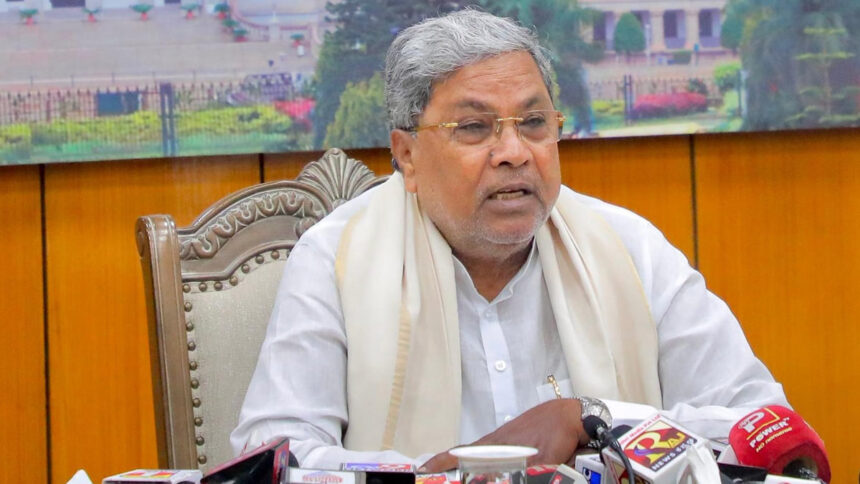
Speaking to the media in Mysuru on Tuesday, Chief Minister Siddaramaiah expressed grave concern over the timing of the explosion, suggesting that its occurrence during a politically sensitive period raised troubling questions. “Why do bomb blasts occur during elections? The Centre must investigate and answer that question,” he said after a review meeting with district officials. His remarks underscored the perception that the country’s internal security machinery may have faltered at a critical juncture.
The Chief Minister conveyed condolences to the families of the victims and called for immediate relief and rehabilitation measures for those affected. “My sympathies are with the victims of the bomb blast. There has to be an investigation to bring out the truth and to check if there was a security lapse,” he said. Siddaramaiah’s statements reflected growing frustration among state leaders regarding the Centre’s perceived inability to anticipate and prevent major security breaches despite repeated intelligence alerts in recent years.
Echoing similar sentiments, Karnataka ministers Priyank Kharge and M.B. Patil launched scathing criticisms of Union Home Minister Amit Shah, accusing him of incompetence and demanding that he step down. Kharge described Shah as “the most incompetent home minister in independent India,” claiming that repeated security failures under his tenure—from the Pulwama attack to the continuing violence in Manipur—demonstrated a pattern of negligence and misplaced priorities within the Ministry of Home Affairs.
“In any other state or country, he would have been thrown out of the Cabinet. But he is indispensable because he shares all the secrets of Mr. Modi,” Kharge said in a pointed remark, holding Shah personally accountable for the lapses that led to the Delhi blast. He added, “Whose responsibility is it to protect the borders, Mr. Gandhi’s or Mr. Kharge’s? It’s his duty as home minister.” Kharge’s remarks were aimed at countering the BJP’s frequent attempts to deflect blame toward the opposition during crises.
Minister M.B. Patil also joined in the chorus, describing the Delhi explosion as “a heinous act” and reiterating the demand for Shah’s resignation. “When the Rameshwaram Café blast happened here, resignations were sought and accountability was fixed. Now, they too must take responsibility. The home minister should resign,” Patil said. He added that whether the incident was a terror attack or a chemical explosion, it exposed a “clear failure of security,” particularly given its proximity to a high-security area that houses several important national monuments and government establishments.
Escalating Political Tensions and Demand for Accountability
The Delhi explosion has quickly escalated from a security concern to a major political flashpoint, with opposition leaders across states linking it to what they describe as systemic flaws in the Centre’s approach to national security. The fact that the blast occurred near one of the most heavily guarded heritage sites in the country has amplified the outrage, prompting many to question how such an attack could take place without prior intelligence warnings.
Patil emphasized that the government’s immediate priority should be to extend all possible support to the victims and their families while ensuring that a transparent investigation identifies those responsible. “The incident, whether a planned act of terror or an industrial mishap, signifies a grave lapse. The Centre must act swiftly to restore public confidence,” he said. His statement resonated with many citizens who have grown increasingly anxious about rising security threats amid a politically charged atmosphere.
Meanwhile, BJP leaders, while expressing condolences, sought to turn the narrative by hinting at possible foreign involvement. BJP state president B.Y. Vijayendra issued a statement expressing deep sorrow over the deaths, writing, “Deeply anguished by the tragic blast near Red Fort in Delhi that has claimed several precious lives. My heartfelt condolences to the bereaved families during this difficult time. Praying for the swift and complete recovery of those injured.” His tone contrasted sharply with that of Congress leaders, focusing on unity and calm rather than confrontation.
However, Leader of Opposition and senior BJP leader R. Ashoka introduced a provocative angle to the ongoing debate, suggesting that Pakistan-based terror groups might be involved in orchestrating the explosion. He urged the National Investigation Agency (NIA) to explore whether inmates in Bengaluru’s Parappana Agrahara Central Jail had any connection to the perpetrators. “The terrorists sitting in Parappana Agrahara are high-tech terrorists using mobile phones inside the jail. This is the result of the Congress government’s minority appeasement policy,” Ashoka alleged.
His remarks immediately drew sharp reactions from Congress leaders, who accused the BJP of politicizing a tragedy for electoral gain instead of focusing on solutions. Nevertheless, Ashoka’s statement reflected a broader concern within security circles about the increasing sophistication of terror networks operating from within Indian borders and the potential misuse of communication technology by inmates already under surveillance.
The broader political discourse surrounding the Delhi blast has thus taken on a deeply partisan tone, with each side accusing the other of failure and opportunism. For the Congress-led state government in Karnataka, the incident has provided an opportunity to question the Centre’s management of internal security, while for the BJP, it has become a rallying point to highlight the alleged inefficiencies of opposition-led states in curbing extremist elements within their jurisdictions.
As the investigation continues, intelligence agencies are reportedly exploring multiple leads, including possible links to sleeper cells and smuggling routes in the National Capital Region. Forensic teams are analyzing samples collected from the blast site to determine the composition of the explosive material. Early reports suggest that ammonium nitrate might have been used, raising suspicions about an organized network behind the attack.
Law enforcement officials have increased security around sensitive installations, airports, metro stations, and public gathering areas across several cities. In Bengaluru, additional forces have been deployed at transport hubs and government buildings following directives from the Home Department.
The Delhi Police, in coordination with the NIA and the Intelligence Bureau, has formed a special task force to oversee the investigation. Authorities are examining CCTV footage from the Red Fort Metro Station and surrounding areas to trace suspects or vehicles involved. The initial footage reportedly shows a car slowing down moments before the blast, leading investigators to believe that the device may have been detonated remotely or through a timer mechanism.
In political terms, the Delhi blast has reopened debates about the balance between civil liberties and national security. While the opposition demands accountability and transparency, the ruling party insists that premature allegations could hinder investigative efforts. Analysts suggest that the incident may have long-term implications for electoral politics, especially as the country heads toward crucial state and national polls.
Public sentiment remains tense, with citizens expressing anger and fear over what many perceive as recurring patterns of security negligence. On social media, hashtags demanding justice for the victims and accountability for lapses have trended for days, reflecting the growing frustration of ordinary Indians with the political blame game that often follows such tragedies.
For now, the demand for an impartial and thorough investigation remains at the forefront. Chief Minister Siddaramaiah’s insistence on transparency and his emphasis on linking the incident to broader systemic failures have resonated widely. His call for the Centre to “answer why such blasts always coincide with elections” continues to fuel discussions in political and security circles alike.
The Red Fort blast, occurring in the heart of India’s capital, has not only claimed innocent lives but also reignited debates about the preparedness of the country’s intelligence and law enforcement systems. As investigators piece together evidence and the political discourse grows increasingly charged, one thing remains clear: the incident has exposed deep fissures in India’s political and security landscape—fissures that demand urgent and collective attention before they deepen any further.