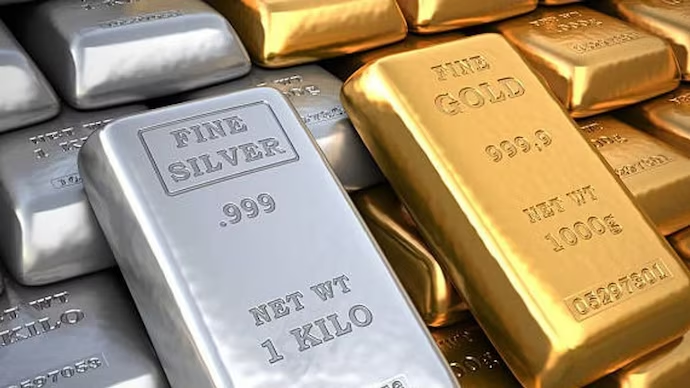
The rise in gold and silver prices reflects a combination of international market strength, investor preference for safe assets, and ongoing volatility in global economic conditions. In India, one of the world’s largest consumers of precious metals, both retail and wholesale demand has remained steady, especially ahead of the festive and wedding season. Analysts note that fluctuations in the US dollar, geopolitical tensions, and expectations around interest rate movements are playing a key role in driving bullion prices higher. The domestic market is also responding to supply-side pressures and import-related uncertainties, which are adding further upward momentum.
Global Cues Drive Bullion Rally
International market trends remain the primary driver behind the recent surge in gold and silver prices. Precious metals have gained support from weakening dollar indices and expectations of softer monetary policy from major central banks. Gold, traditionally seen as a safe-haven asset, tends to perform well during periods of uncertainty, and recent geopolitical developments have strengthened investor interest in bullion.
Silver has also shown strong momentum, driven not only by investment demand but also by its growing industrial usage in sectors such as electronics, solar energy, and electric vehicles. This dual demand structure has contributed to higher volatility but also stronger long-term price support. In global markets, analysts highlight that silver’s performance has recently outpaced expectations due to tight supply conditions and increasing industrial consumption.
In India, domestic prices are closely linked to international benchmarks and import costs. Any movement in global rates quickly reflects in local bullion markets, affecting retail buyers and jewellers across major cities. With festive demand periods approaching, buying activity is expected to remain active, keeping prices firm in the short term.
Domestic Market Trends and Investor Sentiment
In the Indian market, gold and silver rates have been influenced by both investment demand and jewellery consumption. Investors continue to view gold as a hedge against inflation and currency depreciation, which supports sustained buying interest even at elevated price levels.
Silver, meanwhile, is gaining attention among retail investors due to its relatively lower entry cost and higher percentage gains during volatile market cycles. However, price fluctuations remain sharper in silver compared to gold, making it a more speculative asset in the short term.
Recent market trends indicate that bullion prices in India are also being impacted by import dynamics and supply chain conditions. India depends heavily on imports to meet domestic demand, making local prices sensitive to international trade flows and currency exchange rates.
Experts suggest that while short-term corrections may occur, the broader outlook for precious metals remains positive, driven by macroeconomic uncertainty and sustained investment demand. However, they also caution that volatility is likely to persist due to global financial conditions and policy shifts.
The outlook for gold and silver remains cautiously optimistic. Gold is expected to maintain its position as a stable store of value, especially if global economic uncertainty continues. Silver’s outlook is more mixed but potentially stronger in the long term due to its industrial applications and supply constraints.
Market participants are closely watching central bank signals, inflation trends, and geopolitical developments, all of which are likely to influence bullion movement in the coming weeks. In India, seasonal demand and investment interest are expected to provide additional support to prices.
Overall, both metals continue to attract attention as key components of diversified investment portfolios, particularly during uncertain economic cycles.