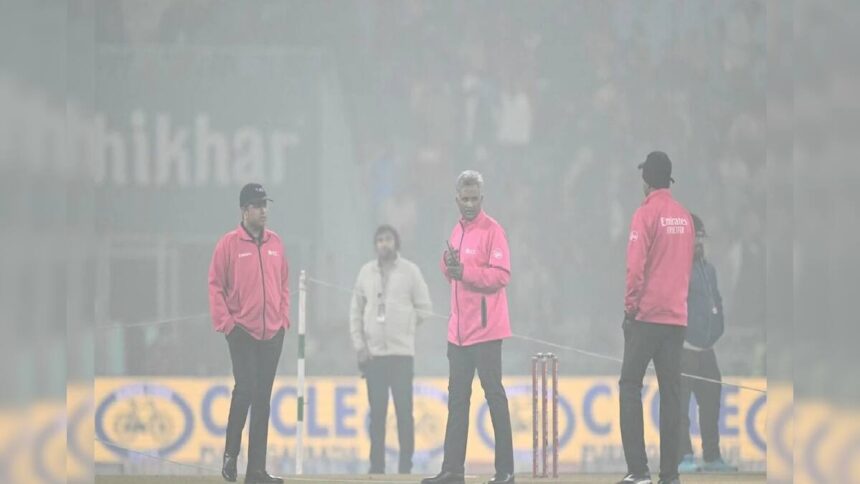
The fourth T20 International between India and South Africa in Lucknow was abandoned without a toss on Wednesday night after dense smog engulfed the stadium, severely reducing visibility and raising safety concerns, reigniting debate over the scheduling of international matches in northern India during peak winter months.
The much-anticipated match at the Bharat Ratna Shri Atal Bihari Vajpayee Ekana Cricket Stadium was called off following prolonged delays as thick smog settled over the city, making playing conditions unsafe for cricketers and officials alike. Fans who had filled the stands in large numbers were left disappointed as officials made repeated attempts to assess conditions before eventually abandoning the game. The incident once again placed the Board of Control for Cricket in India under scrutiny, particularly its Tours and Fixtures Committee, over the choice of venues and timing for international fixtures during a season when fog and air pollution have frequently disrupted play.
From the early evening onward, visibility continued to deteriorate, prompting concerns about player safety, especially for fielders required to track the ball under floodlights. With no clear improvement despite hours of waiting, the officials took the difficult decision to call off the match, resulting in an anticlimactic end to what was expected to be a crucial contest in the T20I series.
Smog, safety concerns, and repeated inspections at the Ekana Stadium
The problems began well before the scheduled toss time as a thick blanket of smog descended over Lucknow, gradually reducing visibility across the stadium. Floodlights struggled to cut through the haze, and from certain sections of the stands, even the central pitch was barely visible. Match officials delayed the toss in the hope that conditions would improve, but the smog showed no signs of lifting as the evening progressed.
On-field umpires conducted as many as six inspections over a span of more than three hours, closely monitoring visibility and overall playing conditions. Each inspection ended with the same conclusion: the smog was too dense to allow safe play. Fielding under such conditions posed a significant risk, as players would have struggled to spot the ball, particularly during aerial shots and high catches. The umpires were also mindful of the health implications of prolonged exposure to poor air quality.
Air quality levels in Lucknow were reported to be hazardous by several online platforms, with some readings suggesting that the Air Quality Index had crossed 400 during the evening. These figures intensified concerns among fans, players, and commentators, further justifying the cautious approach adopted by match officials. However, the Uttar Pradesh government later disputed these readings, stating that the AQI in Lucknow stood at 174, which falls in the moderate category. The government also claimed that exaggerated figures circulating on social media and other platforms were sourced from private air quality applications and were misleading.
Despite the differing claims over exact AQI numbers, there was little dispute about the on-ground reality at the stadium. The smog was visibly dense, and conditions were clearly unsuitable for professional cricket. Even with floodlights at full strength, visibility remained poor, reinforcing the umpires’ decision to prioritise safety over spectacle.
For the spectators, the experience was frustrating. Thousands of fans had arrived early, hoping to witness an exciting contest between two top international sides. They waited patiently through multiple announcements and inspections, only to be told late in the evening that the match had been abandoned without a single ball being bowled. The disappointment was evident as crowds slowly exited the stadium, many expressing frustration over factors they felt could have been anticipated.
Scheduling criticism, fan reactions, and broader implications for Indian cricket
The abandonment of the Lucknow T20I immediately sparked criticism of the BCCI’s scheduling choices, particularly the decision to host a day-night international match in northern India during December. Over the past several years, winter months have repeatedly seen matches disrupted by fog and smog in cities across north and east India, leading many fans and experts to question why fixtures continue to be allotted to these regions during this period.
Social media was flooded with reactions from cricket fans who criticised the BCCI for ignoring predictable weather and pollution patterns. Many pointed out that December evenings in cities like Lucknow, Delhi, Kanpur, and Kolkata have often been affected by fog and poor air quality, making them risky choices for night games. Some fans argued that southern and western cities, where winter conditions are generally clearer, should be preferred for international fixtures at this time of year.
The criticism was not limited to fans alone. Former players and commentators also weighed in, suggesting that while expanding cricket to newer venues is important, it should not come at the cost of player safety and match integrity. The Ekana Stadium in Lucknow has been promoted as a modern venue capable of hosting high-profile matches, but the timing of fixtures has increasingly come under question as environmental conditions worsen during winter.
The issue of air pollution and visibility has become a recurring challenge for Indian cricket. In recent seasons, several domestic and international matches have faced delays, shortened play, or complete abandonment due to fog and smog. These disruptions not only affect teams and fans but also broadcasters, sponsors, and the overall credibility of scheduling decisions.
For the Indian team and South Africa, the abandonment meant a lost opportunity to gain momentum in the series. Players from both sides were left frustrated, having prepared extensively only to see the match called off without any action. While such decisions are ultimately necessary for safety, repeated occurrences raise concerns about long-term planning and adaptability in the face of environmental challenges.
The incident also highlighted broader questions about climate, pollution, and sport in India. With air quality issues becoming more severe in several urban centres during winter, sports administrators may need to rethink traditional scheduling windows and venue allocations. Balancing the desire to take international cricket to different regions with the need to ensure reliable and safe playing conditions is becoming increasingly complex.
As fans reflected on the abandoned match, many called for clearer guidelines and contingency planning. Suggestions included avoiding night matches in high-risk cities during winter, building flexibility into schedules, and improving coordination with environmental agencies to assess risks well in advance. While cricket has always been influenced by weather, the growing impact of pollution adds a new layer of unpredictability that administrators can no longer afford to overlook.
The abandoned fourth T20I in Lucknow thus became more than just a washed-out game. It served as another reminder of the challenges facing modern cricket in an era of environmental uncertainty, and of the need for proactive, data-driven decision-making to protect players, fans, and the integrity of the sport.