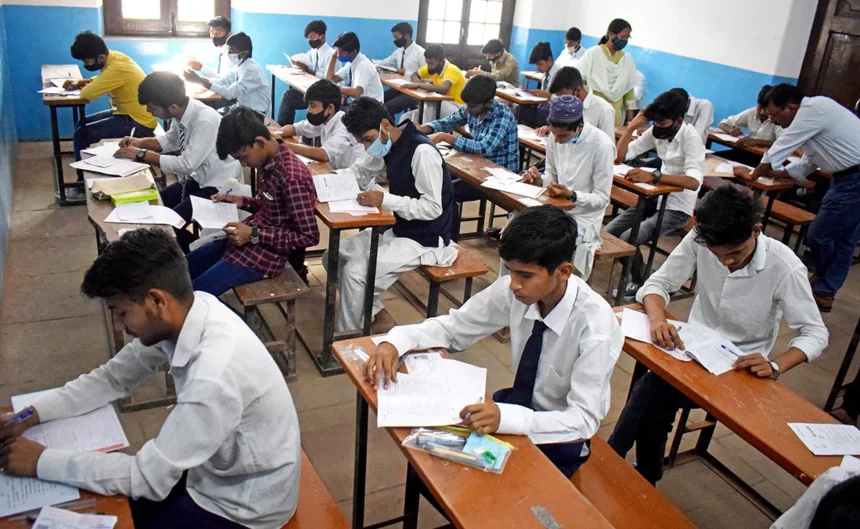
The CBSE Class 10 and Class 12 board examinations 2026 officially commenced on February 17, 2026, marking a crucial academic milestone for millions of students across India and abroad. According to the Board’s official timetable, exams are being conducted in a single morning shift from 10:30 am to 1:30 pm. Approximately 43.6 lakh students are appearing for Secondary and Higher Secondary examinations this year, reflecting the continued importance and scale of CBSE assessments in the Indian educational system. The first papers in Class 10 include mathematics, available in both basic and standard levels, while Class 12 candidates are beginning with biotechnology, entrepreneurship, shorthand, and language exams in both English and Hindi.
The examinations are taking place against the backdrop of the ongoing AI Impact Summit in Delhi, necessitating additional arrangements to ensure smooth travel for candidates. Delhi Police has issued special advisories to prioritize students’ movements amidst restricted traffic in central areas near Bharat Mandapam. Officers have been instructed to facilitate student transit to examination centres, with particular assistance provided to those carrying admit cards and date sheets. These measures aim to prevent delays and ensure students can focus on their examinations without logistical stress.
CBSE has provided detailed guidelines for candidates to maintain examination integrity and uniformity. All students must carry a hard copy of their admit cards, as entry will be denied to anyone without it. Proper school uniform and valid school identity cards are mandatory for verification purposes. Candidates are advised to reach centres at least 25–30 minutes before the start of their exams to avoid last-minute issues and ensure readiness. Electronic gadgets, including mobile phones and smart watches, are strictly prohibited within exam halls. Any violation may result in disqualification. Only personal stationery is allowed, with students instructed to bring pens, pencils, and other necessary items. Transparent water bottles are permitted, while only blue or black ink pens should be used throughout the examination. A fifteen-minute reading period is provided at the start of each exam for students to review the question paper and plan their answers.
The 2026 exams also introduce several procedural innovations. For Class 10, the dual-board examination system introduced last year continues to allow students to reappear in certain papers to improve their scores. This ‘improvement option’ gives students an opportunity to address gaps in their understanding and ensures merit-based outcomes without delaying overall evaluation schedules. Class 12 students, meanwhile, will experience the new On-Screen Marking (OSM) system for the first time. This digital assessment system replaces traditional physical evaluation of answer sheets, allowing for faster, more accurate, and standardized marking across the 120 subjects in which over 18 lakh students are registered. The Board anticipates handling more than 1.04 crore answer sheets, including those submitted at international centres, demonstrating the enormous scale and logistical complexity of the examination process.
The OSM system aligns with CBSE’s broader vision of integrating technology to enhance transparency, efficiency, and consistency in student evaluation. It minimizes human errors and ensures standardized scoring across regions, providing students with confidence in the fairness of the process. The digital evaluation system is also a strategic response to the increased number of students and subjects, as well as the need to maintain uniform assessment practices at both national and international levels. CBSE officials have highlighted that the introduction of OSM marks a significant step toward modernizing India’s examination system while addressing administrative challenges effectively.
From a logistical perspective, the Board has coordinated closely with law enforcement and local authorities to ensure that students traveling to examination centres experience minimal disruptions. The ongoing AI Impact Summit in Delhi has prompted the implementation of traffic management strategies and priority passes for students carrying valid admit cards or schedules. These measures reinforce the government’s commitment to uninterrupted academic assessment and highlight the importance of CBSE examinations in the broader educational and administrative landscape.
Academically, the 2026 examinations reflect rigorous adherence to curriculum standards while providing flexibility for students through structured improvement mechanisms. Mathematics remains the foundational paper for Class 10, while Class 12 students tackle specialized subjects such as biotechnology, entrepreneurship, and shorthand. The Board emphasizes that examination procedures, including pen usage, prohibited items, and punctuality, are designed to maintain a level playing field and ensure that all candidates have equal opportunity to perform to the best of their abilities.
In addition to procedural and technological innovations, student safety and well-being have been prioritized. With traffic disruptions anticipated due to high-profile events in Delhi, the police have issued specific guidance to facilitate the movement of students to examination centres. Personnel have been instructed to extend assistance, ensuring that candidates are not delayed by traffic challenges. This dual approach of administrative facilitation and procedural rigor underscores CBSE’s holistic planning for board examinations, blending academic, logistical, and technological considerations seamlessly.
The dual-board system for Class 10 and digital evaluation for Class 12 signify a broader strategy to balance tradition with modernization. Students benefit from both the opportunity to improve scores and the assurance of standardized, technologically enhanced evaluation. These innovations are aligned with CBSE’s commitment to excellence, efficiency, and fairness, allowing students to demonstrate their knowledge effectively while adapting to contemporary educational trends. The digital shift in assessment also aligns with global best practices, preparing Indian students for a technologically integrated evaluation framework.
Throughout the examinations, candidates are expected to maintain strict adherence to rules, including the use of only permitted pens, avoidance of prohibited gadgets, and observance of uniform protocols. Students are advised to manage their time effectively, utilize the reading period judiciously, and maintain focus during the examination hours. These measures reflect both procedural discipline and the need for academic fairness, ensuring that the performance of each candidate is evaluated solely on merit.
The 2026 examinations highlight CBSE’s ability to handle large-scale assessments while integrating modern technology, emphasizing administrative efficiency, safety, and academic integrity. By implementing OSM and retaining the dual-board system, the Board ensures that candidates have both opportunities for academic improvement and confidence in fair evaluation. These examinations, attended by millions of students, serve as a critical platform for assessing academic achievement and reinforcing the importance of structured learning and disciplined preparation in Indian education.
By coordinating with law enforcement, educational authorities, and examination staff, CBSE has created an environment that balances student safety, procedural compliance, and technological integration. The examinations are not only an academic milestone but also a reflection of effective national educational administration, highlighting the importance of strategic planning, real-time coordination, and innovation in handling high-stakes evaluations at a national scale.
The start of the 2026 CBSE examinations also underscores the growing emphasis on digital literacy and adaptation to technology within education. By implementing OSM, the Board is setting a precedent for large-scale digital evaluation while retaining traditional examination rigor. Candidates are encouraged to comply with all guidelines, focus on time management, and maintain academic integrity, ensuring that the results accurately reflect knowledge and understanding.
CBSE’s approach in 2026 demonstrates a balance between academic rigor, technological modernization, and student welfare. From the dual-board system to digital evaluation, these innovations highlight a commitment to excellence, fairness, and procedural efficiency. The examinations also reinforce India’s position as a country capable of administering high-quality, large-scale educational assessments that incorporate both traditional and modern approaches.