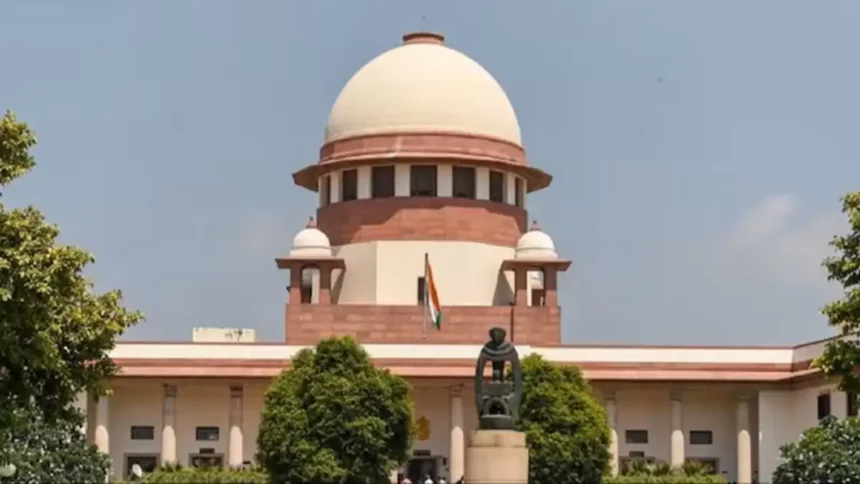
The Supreme Court of India on Monday made notable oral observations on premarital relationships while hearing a bail plea in an alleged rape-on-false-promise-of-marriage case, raising broader questions about consent, trust, and personal responsibility within intimate relationships formed outside marriage.
While considering the plea, the court remarked that before marriage, a man and a woman are essentially strangers and cautioned against entering physical relationships without due circumspection. The observations, made during arguments and not forming part of any final judgment, have drawn attention for their wider social and legal implications, particularly in cases where allegations of deception intersect with claims of consensual intimacy.
Judicial observations during bail hearing and factual background of the case
A Bench comprising Justice BV Nagarathna and Justice Ujjal Bhuyan was hearing a Special Leave Petition filed by a man seeking bail in a case alleging rape on the false promise of marriage. The accused is charged with inducing a 30-year-old woman into a physical relationship by assuring her of marriage, despite being already married at the time and later marrying another woman.
During the hearing, the Bench made pointed oral remarks reflecting concern over the nature of premarital relationships and the expectations attached to them. Justice Nagarathna observed that, regardless of the depth of a relationship, a man and a woman remain strangers before marriage and must therefore exercise caution. The judge acknowledged that the view might appear old-fashioned but emphasized the importance of being careful and not placing unquestioning trust in assurances made prior to marriage.
The Bench clarified that these remarks were made in the context of arguments on bail and did not constitute findings of fact or law. Nonetheless, the observations came amid a detailed examination of the complainant’s conduct, the accused’s alleged misrepresentations, and the broader legal principles governing consent obtained on the promise of marriage.
According to the prosecution, the complainant met the accused through a matrimonial website in 2022. The two began communicating with the stated intention of marriage. The prosecution alleges that during this period, the accused engaged in physical relations with the woman in Delhi, assuring her that marriage would follow. It is further alleged that he later persuaded her to travel to Dubai, where he again had physical relations with her on the same assurance.
The complaint further alleges that while in Dubai, the accused recorded intimate videos of the woman without her consent and later threatened to circulate them. The woman has claimed that these acts were part of a continuing deception, reinforcing her belief that marriage was imminent while allegedly subjecting her to exploitation and coercion.
The woman later discovered that the accused had married another woman on January 19, 2024, in Punjab. This revelation, according to the prosecution, confirmed that the promise of marriage was false from the outset, rendering her consent invalid under law.
During the hearing, Justice Nagarathna questioned why the complainant chose to travel abroad with the accused before marriage. When government counsel responded that the two had met on a matrimonial platform and were planning to marry, the judge observed that if the woman was particular about marriage, she should not have undertaken such travel prior to it. The Bench suggested that individuals must bear some responsibility for their choices, particularly in intimate matters formed outside the bounds of marriage.
The court also indicated that it might consider referring the matter to mediation, noting that cases involving consensual relationships complicated by subsequent disputes may not always be suited for prolonged criminal trials. The matter was listed for a further hearing to explore the possibility of settlement through mediation.
Legal trajectory, High Court findings, and questions on consent and deception
Before reaching the Supreme Court, the accused had unsuccessfully sought bail from both the Sessions Court and the Delhi High Court. On November 18, 2025, the Delhi High Court denied bail, holding that the allegations prima facie suggested that the promise of marriage was false from the beginning. The High Court placed significant emphasis on the fact that the accused was already married at the time he allegedly made assurances of marriage to the complainant and that he later went on to marry another woman.
Relying on established judicial precedents, the High Court observed that consent obtained on the basis of a false promise of marriage may be considered vitiated if the promise was made in bad faith and without any intention of being fulfilled. The court noted that such deception strikes at the root of voluntary consent, particularly where the promise of marriage is central to the complainant’s decision to engage in a physical relationship.
The High Court’s reasoning reflected a consistent judicial approach in cases involving allegations of rape based on false promises of marriage. Courts have repeatedly drawn a distinction between a genuine promise that subsequently fails due to unforeseen circumstances and a promise that is false from inception, made solely to obtain sexual consent. In the latter category, consent is often held to be illusory, exposing the accused to criminal liability.
The accused, challenging the High Court’s refusal of bail, approached the Supreme Court through a Special Leave Petition. Before the apex court, the defence argued that the relationship was consensual and that the criminal law should not be invoked to punish failed relationships. It was contended that differences arising after a consensual relationship should not automatically translate into allegations of rape, particularly when both parties were adults capable of making informed choices.
The prosecution, however, maintained that the accused’s marital status and subsequent second marriage demonstrated that the promise of marriage was never genuine. According to the prosecution, these facts distinguished the case from those involving mere breach of promise and instead pointed to deliberate deception designed to exploit the complainant.
The Supreme Court’s oral observations during the bail hearing appear to reflect an attempt to balance competing considerations. On one hand, the court acknowledged the seriousness of allegations involving deception, coercion, and non-consensual recording of intimate material. On the other, it questioned the extent to which criminal law should intervene in cases involving consensual relationships between adults, particularly where questions of personal judgment and responsibility arise.
By suggesting mediation, the Bench signalled openness to alternative dispute resolution mechanisms in such cases, especially where prolonged criminal proceedings may not necessarily serve the interests of justice. At the same time, the court made it clear that it had yet to take a final view on the grant of bail, and that the matter required careful consideration of facts, intent, and applicable legal principles.
The case thus sits at a complex intersection of evolving social norms, individual autonomy, and established criminal law doctrines. It raises enduring questions about how courts should assess consent in intimate relationships, the legal consequences of broken promises, and the appropriate limits of criminal prosecution in deeply personal disputes. As the Supreme Court continues to hear the matter, its eventual decision on bail is likely to be closely watched for its implications on similar cases across the country.