New Delhi:
The Commission for Air Quality Management in NCR and Adjoining Areas (CAQM) conducted an extensive inspection drive in Noida on January 5, 2026, to assess the status of road cleaning, mechanical sweeping operations and overall maintenance of road stretches under the jurisdiction of the Noida Authority. The inspection was carried out as part of CAQM’s continuous monitoring, review and enforcement actions under the statutory framework of the prevailing Graded Response Action Plan (GRAP).
The inspection covered a total of 142 road stretches maintained by the Noida Authority. The primary objective of the exercise was to evaluate the on-ground implementation of dust mitigation measures and to identify issues related to visible road dust, accumulation of municipal solid waste (MSW), construction and demolition (C&D) waste, and instances of open burning. The drive was aimed at ensuring compliance with GRAP directions and strengthening preventive measures to curb dust pollution, which is a major contributor to deteriorating air quality in the National Capital Region.
To carry out the inspection, ten dedicated teams were deployed, comprising officers from the Uttar Pradesh Pollution Control Board and members of the CAQM flying squad. During the inspections, geo-tagged and time-stamped photographic evidence was collected at each location. This data was subsequently compiled and submitted to the Commission as part of a consolidated inspection report, ensuring transparency and accuracy in the assessment process.
The findings of the inspection present an overall encouraging picture with regard to dust control measures on Noida Authority roads. Out of the 142 road stretches inspected, only four stretches were found to have high levels of visible dust. Twenty-four stretches recorded moderate dust levels, while 66 stretches showed low dust intensity. Notably, 48 road stretches were found to have no visible dust at all, indicating effective implementation of road cleaning and dust suppression measures in a significant portion of the inspected areas.
However, the inspection also identified certain areas that require focused attention. The limited number of road stretches exhibiting high visible dust were, in some cases, associated with the accumulation of municipal solid waste and construction and demolition waste. Such issues were particularly observed at vulnerable locations, including areas under flyovers, along metro corridors and on specific arterial road segments. These findings underline the need for targeted and location-specific interventions to prevent the re-accumulation of dust and waste in identified hotspots.
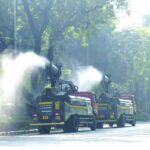
CAQM emphasized that while the overall performance is satisfactory, sustained and intensified efforts are essential, especially in vulnerable and high-risk locations. The Commission highlighted the importance of regular and effective mechanical sweeping, timely lifting of collected dust and waste, and their scientific disposal. It also stressed the need for adequate and frequent water sprinkling on road surfaces to suppress dust, particularly during dry weather conditions.
In addition, CAQM called for strict measures to prevent illegal dumping of waste and open burning, both of which contribute significantly to localized air pollution and dust generation. The Commission noted that enforcement against such violations must be consistent and stringent to ensure long-term improvements in air quality and road cleanliness.
The inspection drive forms part of the larger ‘Operation Clean Air’ initiative, under which inspection and enforcement activities will continue to be carried out regularly across the National Capital Region. These drives are aimed at ensuring strict compliance with statutory directions issued by CAQM and effective implementation of GRAP measures, particularly those related to dust mitigation and the prevention of open burning.
CAQM reaffirmed its commitment to working in close coordination with all concerned agencies across the NCR on a war footing to address air pollution challenges. The Commission emphasized that maintaining clean, green, dust-free and well-maintained road stretches is a shared responsibility and a critical component of the overall strategy to improve air quality in the region.
Through continued monitoring, targeted corrective measures and coordinated enforcement, CAQM aims to ensure that gains achieved through such inspections are sustained and further strengthened, contributing to a healthier environment and improved quality of life for residents of Noida and the wider NCR.