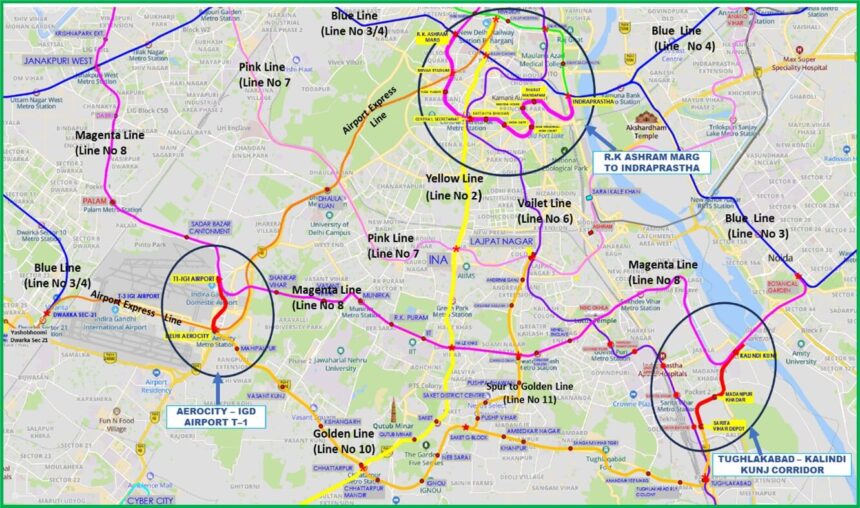
New Delhi, 24 December 2025: The Union Cabinet, chaired by Prime Minister Narendra Modi, has approved three new corridors as part of the Delhi Metro Phase V (A) project, aiming to enhance connectivity within the national capital. The approved corridors include: 1) R.K. Ashram Marg to Indraprastha (9.913 km), 2) Aero City to IGI Airport Terminal-1 (2.263 km), and 3) Tughlakabad to Kalindi Kunj (3.9 km). The total length of this expansion is 16.076 kilometers, and the project will be financed at a total cost of ₹12,014.91 crore through contributions from the Government of India, the Delhi Government, and international funding agencies.
The Central Vista corridor, part of this expansion, will provide direct connectivity to all key office buildings in the area, making commutes easier for both employees and visitors. It is expected to benefit approximately 60,000 office-going employees and over 200,000 visitors daily. The corridors are also projected to reduce pollution and the use of fossil fuels, contributing to a cleaner and more sustainable urban environment.
Details of the New Corridors
The R.K. Ashram Marg – Indraprastha section will extend the existing Botanical Garden – R.K. Ashram Marg corridor and provide metro connectivity to the redeveloped Central Vista area. The Aero City – IGI Airport Terminal-1 and Tughlakabad – Kalindi Kunj sections will extend the Aero City – Tughlakabad corridor, enhancing airport connectivity to southern parts of Delhi, including Tughlakabad, Saket, and Kalindi Kunj.
The expansion will include a total of 13 stations, of which 10 will be underground and 3 elevated. Upon completion, the R.K. Ashram Marg – Indraprastha corridor will significantly improve connectivity between western, northern, and central Delhi. The Aero City – IGI Terminal-1 and Tughlakabad – Kalindi Kunj corridors will link southern Delhi areas to the domestic airport, facilitating faster travel and easing road congestion.
Boost to Metro Network and Urban Mobility
These Phase V (A) expansions will extend metro coverage in central Delhi and up to the domestic airport, strengthening the city’s transport infrastructure and providing economic benefits. Extensions on the Magenta Line and Gold Line are expected to reduce vehicular congestion, thereby decreasing pollution from road traffic.
The R.K. Ashram Marg – Indraprastha section will include stations at R.K. Ashram Marg, Shivaji Stadium, Central Secretariat, Kartavya Bhawan, India Gate, War Memorial – High Court, Baroda House, Bharat Mandapam, and Indraprastha. The Tughlakabad – Kalindi Kunj section will have stations at Sarita Vihar Depot, Madanpur Khadar, and Kalindi Kunj, while the Aero City station will connect to IGI Terminal-1.
Ongoing Phase IV Construction
Meanwhile, construction work for Phase IV, which spans 111 km with 83 stations, is progressing steadily. As of now, civil construction for the three priority corridors under Phase IV is approximately 80.43 percent complete. These corridors are expected to be operational in phases by December 2026.
Delhi Metro: A Growing Lifeline of the Capital
Currently, Delhi Metro serves an average of 6.5 million passengers daily, with a record single-day ridership of 8.187 million passengers on 8 August 2025. The network has become a symbol of punctuality, reliability, and safety, establishing itself as the lifeline of the city.
At present, the Delhi Metro Rail Corporation (DMRC) operates 12 metro lines covering nearly 395 km with 289 stations across Delhi and the NCR region. Delhi Metro is now the largest metro network in India and ranks among the largest in the world.
The approval of these new corridors under Phase V (A) is expected to further enhance the city’s urban mobility, reduce reliance on road transport, lower pollution levels, and provide efficient, sustainable commuting options for residents and visitors alike.