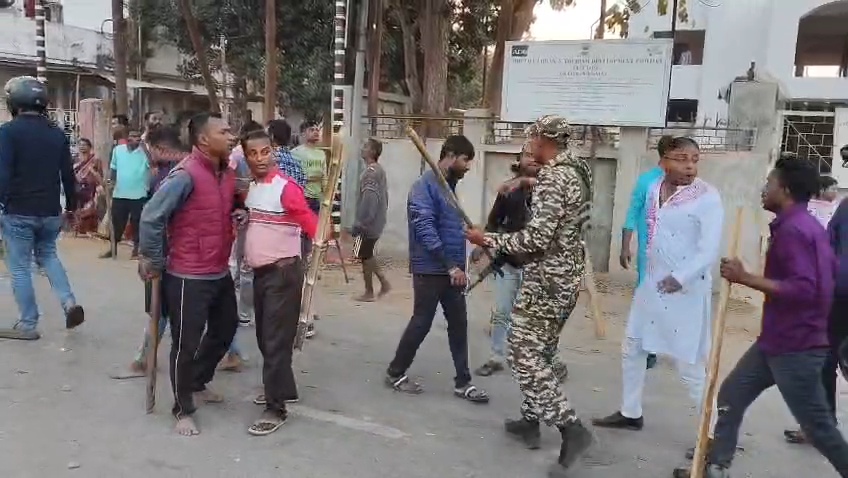
A major political confrontation broke out in Kolkata outside the office of the Election Commission of India, where supporters of the Bharatiya Janata Party (BJP) and the Trinamool Congress (TMC) engaged in a violent clash that led to police intervention and lathicharge.
The incident, which occurred amid rising political tensions ahead of the 2026 West Bengal Legislative Assembly election, quickly escalated from verbal confrontation to physical violence, with reports of stone-pelting and chaos outside the Election Commission premises.
What Triggered the Clash
The immediate trigger for the clash was a dispute over the alleged bulk submission of Form 6 applications, which are used for voter registration. The TMC had raised concerns that large numbers of such forms were being submitted, allegedly by BJP-linked individuals, raising fears of voter list manipulation.
TMC supporters gathered outside the office to protest what they termed as “illegal entry” and suspicious submission of voter applications. They demanded action against those responsible and called for greater transparency in the electoral process.
In response, BJP workers arrived at the scene, accusing TMC activists of obstructing legitimate processes and trespassing into restricted areas. The situation soon turned confrontational, leading to heated arguments and eventually physical clashes between the two groups.
Violence Escalates, Police Step In
As tensions spiralled, clashes intensified with reports of stone-pelting and scuffles between party workers. The situation became volatile enough to require immediate intervention by law enforcement authorities.
Police forces, along with central security personnel, were deployed to control the crowd. When attempts to disperse the gathering failed, authorities resorted to a lathicharge to restore order.
Prohibitory measures were also imposed in the area to prevent further escalation, and several individuals involved in the incident were detained. The swift police action helped bring the situation under control, although tensions remained high.
Political Context: High-Stakes Bengal Elections
The clash comes at a time when West Bengal is gearing up for a crucial assembly election, scheduled in multiple phases in April 2026. The political contest between the ruling TMC and the opposition BJP has intensified significantly, with both parties accusing each other of electoral malpractice.
The issue of voter registration has become a major flashpoint in the campaign, with allegations of irregularities and attempts to influence voter lists dominating political discourse.
Chief Minister Mamata Banerjee had earlier written to the Election Commission raising concerns over large-scale submission of voter forms, suggesting possible manipulation of electoral rolls.
On the other hand, BJP leaders have dismissed these allegations, accusing the ruling party of creating unnecessary controversy to gain political advantage.
Form 6 Controversy Explained
Form 6 is used by eligible citizens to apply for inclusion in the electoral roll. While the process is routine, the scale and manner of submissions in this case have raised questions.
TMC leaders alleged that thousands of applications were being submitted in a short span of time, potentially indicating coordinated efforts to influence voter lists. Some claims suggested that applications were linked to individuals already registered in other states.
The Election Commission has acknowledged the concerns and initiated an inquiry into the matter. Officials have emphasised the need to maintain transparency and ensure that electoral processes remain fair and unbiased.
Growing Pattern of Political Violence
The clash in Kolkata is not an isolated incident. West Bengal has witnessed several instances of political violence in the lead-up to elections, reflecting the intense rivalry between major parties.
Recent reports indicate multiple confrontations, injuries, and even administrative actions against officials over failure to control such incidents. This pattern underscores the volatile nature of electoral politics in the state.
The Election Commission has taken steps to enhance security arrangements, including deployment of central forces and strict monitoring of sensitive areas, to ensure peaceful conduct of elections.
Role of Election Commission
The Election Commission plays a crucial role in maintaining the integrity of the electoral process. In this case, it has been actively addressing concerns raised by political parties and ensuring that procedures are followed correctly.
Officials have clarified that there are no restrictions on submitting voter applications at designated offices, but emphasised that all submissions must comply with deadlines and verification procedures.
The ongoing inquiry into the Form 6 issue is expected to provide clarity and address allegations from both sides.
Implications for Voters and Democracy
Incidents like the Kolkata clash raise concerns about the impact of political violence on democratic processes. For voters, such घटनाएँ can create an atmosphere of fear and uncertainty, potentially affecting participation.
Ensuring free and fair elections requires not only robust institutional mechanisms but also responsible behaviour from political stakeholders. The Election Commission’s efforts to maintain order and transparency are critical in this context.
At the same time, political parties are expected to adhere to democratic norms and resolve disputes through lawful means rather than resorting to confrontation.
The clash between BJP and TMC supporters outside the Election Commission office in Kolkata highlights the heightened political tensions ahead of the West Bengal assembly elections. Triggered by allegations surrounding voter registration processes, the incident escalated into violence, requiring police intervention and lathicharge.
As the election approaches, maintaining peace and ensuring transparency in the electoral process will be crucial. The developments also underscore the importance of institutional oversight and responsible political conduct in safeguarding democratic values.