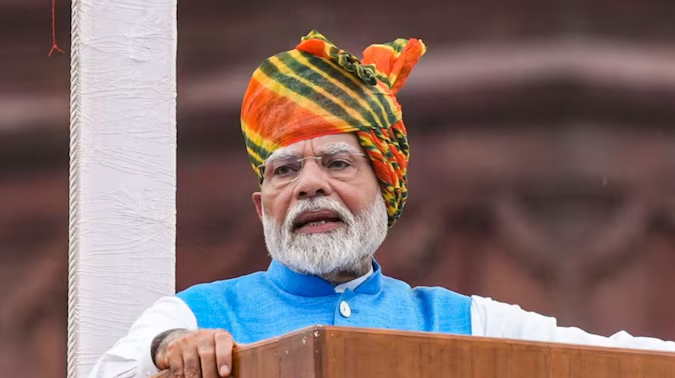
Narendra Modi has declared the ongoing decade as “India’s Techade,” underscoring the country’s growing influence in emerging technologies such as artificial intelligence, semiconductors, and digital infrastructure. His remarks came during the inauguration of a semiconductor facility and multiple development projects in Gujarat, reflecting India’s ambition to position itself as a global technology powerhouse.
Speaking at the inauguration of the OSAT (Outsourced Semiconductor Assembly and Test) plant by Kaynes Semiconductor in Sanand, Gujarat, the Prime Minister highlighted how India’s technological advancements are not only transforming the domestic economy but also contributing to global innovation ecosystems.
He stressed that India is rapidly emerging as a trusted partner in the semiconductor supply chain, a sector that has become strategically vital in the modern digital economy. With increasing global demand for chips powering everything from smartphones to electric vehicles and AI systems, India’s entry into semiconductor manufacturing is seen as a major milestone.
The Prime Minister noted that initiatives in artificial intelligence are playing a transformative role across sectors such as healthcare, education, agriculture, and governance. He emphasised that India’s approach to AI is inclusive and development-oriented, aiming to create solutions that benefit not just its citizens but also the wider global community.
India’s growing capabilities in AI are supported by a combination of policy initiatives, startup innovation, and expanding digital infrastructure. The government has been actively promoting research, development, and adoption of AI technologies, positioning India as a key player in the global AI landscape.
The semiconductor push is equally significant. For decades, India has relied heavily on imports for semiconductor needs. However, recent policy measures, including production-linked incentives and infrastructure development, aim to reduce this dependence and build a robust domestic ecosystem.
The OSAT plant inaugurated in Sanand represents a critical step in this direction. Such facilities focus on packaging, testing, and assembling semiconductor chips, forming an essential part of the semiconductor value chain. By establishing these capabilities domestically, India aims to strengthen its position in global supply chains and attract further investment.
Later in the day, the Prime Minister inaugurated and laid the foundation stone for development projects worth around ₹20,000 crore in the Vav-Tharad region of Gujarat. These projects span multiple sectors, including infrastructure, energy, and connectivity, reflecting a broader strategy to drive economic growth alongside technological advancement.
He also inaugurated the Samrat Samprati Museum in Koba, Gandhinagar, highlighting the government’s commitment to preserving cultural heritage while advancing modern development.
Addressing concerns about global instability, particularly the ongoing conflict in West Asia, the Prime Minister stated that India has managed to maintain stability and protect its citizens from external disruptions. He emphasised that proactive governance and strategic planning have ensured that the impact of global challenges remains limited within the country.
The reference to the West Asia conflict is significant, as global geopolitical tensions have affected supply chains, energy prices, and economic stability worldwide. Despite these challenges, India has continued to focus on growth and innovation, reinforcing its position as a resilient economy.
The concept of “India’s Techade” encapsulates a broader vision of transforming the country into a technology-driven economy. This includes expanding digital infrastructure, promoting innovation, and fostering a startup ecosystem that can compete globally.
India’s digital transformation has already achieved significant milestones, including widespread adoption of digital payments, expansion of internet connectivity, and the development of platforms that support governance and service delivery. These achievements provide a strong foundation for future advancements in technology.
The government’s focus on semiconductors is particularly noteworthy given the global shortage experienced in recent years. By investing in domestic manufacturing and attracting global players, India aims to secure its supply chain and reduce vulnerabilities.
In addition to economic benefits, the semiconductor initiative is expected to create employment opportunities, boost research and development, and encourage collaboration between industry and academia.
Artificial intelligence, another key focus area, is expected to play a crucial role in driving productivity and innovation. From improving healthcare diagnostics to enhancing agricultural practices, AI has the potential to address some of India’s most pressing challenges.
The Prime Minister’s emphasis on global benefits reflects India’s approach to technology as a tool for collective progress. By sharing innovations and collaborating with other nations, India aims to contribute to solving global issues such as climate change, healthcare access, and sustainable development.
The idea of a “Techade” also aligns with India’s aspirations to become a $5 trillion economy. Technology is seen as a key enabler of this goal, driving efficiency, innovation, and competitiveness across sectors.
As India continues to invest in technology and infrastructure, the coming years are expected to witness significant advancements in areas such as 5G, AI, semiconductor manufacturing, and digital services.
The Prime Minister’s remarks highlight a shift in India’s development narrative—from being a consumer of technology to becoming a creator and exporter of technological solutions.
This transformation is supported by a young and dynamic workforce, a growing startup ecosystem, and a policy environment that encourages innovation and investment.
The inauguration of major projects in Gujarat further reinforces the state’s position as a hub for industrial and technological development. With initiatives spanning manufacturing, infrastructure, and innovation, Gujarat continues to play a key role in India’s growth story.
In conclusion, the declaration of this decade as “India’s Techade” reflects a bold vision for the country’s future. By focusing on technology, innovation, and global collaboration, India aims to not only transform its own economy but also contribute to the progress of the world.