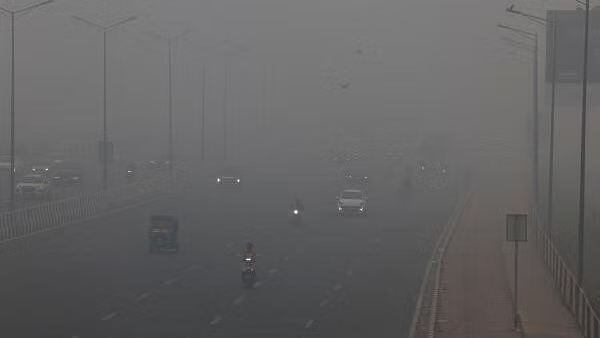
Delhi and its neighboring National Capital Region (NCR) continue to grapple with severe air pollution as a thick blanket of smog enveloped the area for the second consecutive day. On Saturday, the air quality index (AQI) breached the 400 mark, which is categorized as ‘severe’ according to the System of Air Quality and Weather Forecasting and Research. This level of pollution has created hazardous conditions for the residents of the national capital, with the air quality affecting daily life and increasing health risks.
Visibility across Delhi and NCR has dropped significantly, with the range falling between zero and 200 meters in several areas, causing major disruptions, especially in transportation. The low visibility has impacted flight operations, leading to possible delays. The Delhi Airport issued a morning advisory to passengers stating, “Low visibility procedures are in progress at Delhi Airport. All flight operations are presently normal. Passengers are requested to contact the airline concerned for updated flight information.” However, the advisory also noted that flights that do not comply with Category III (CAT III) standards may be affected. Passengers were urged to confirm their flight details directly with airlines. Despite the ongoing challenges, both landings and take-offs at Delhi Airport are continuing.
Trains have also been affected by the deteriorating weather conditions, with officials confirming that at least 26 trains were running late as of Saturday morning. This follows the delays faced on Friday, where over 100 flights were delayed at the Indira Gandhi International (IGI) Airport, and around 30 trains faced delays. The visuals of Delhi’s skyline being covered in smog illustrate the scale of the problem and the challenges the city is facing.
In response to the worsening air quality, the Centre’s panel on Delhi-NCR’s air quality has re-imposed Stage 3 of the Graded Response Action Plan (GRAP). This stage involves strict measures aimed at curbing pollution, including a ban on private BS III petrol and BS IV diesel vehicles. The government has issued a stern warning that violators will face hefty penalties under Section 194(1) of the Motor Vehicle Act, 1988, which could result in fines of Rs 20,000. These measures are expected to have a direct impact on reducing pollution, although the ongoing challenges require long-term solutions.
The weather department has also forecasted heavy rainfall for the region over the weekend. The India Meteorological Department (IMD) has predicted thunderstorms, lightning, and dense fog conditions in the national capital on Saturday and Sunday, further complicating the visibility issues. These weather conditions are expected to affect not only Delhi but also parts of neighboring regions such as east Uttar Pradesh, Himachal Pradesh, Punjab, Haryana, and west Uttar Pradesh. The IMD’s forecast indicates that dense to very dense fog is likely to affect isolated places in these regions.
The continuing adverse weather and air quality conditions underscore the need for urgent measures to address the pollution crisis and improve public health and safety in the capital. With rain on the horizon, there is some hope for relief from the smog, but the city must prepare for further challenges in the coming days.