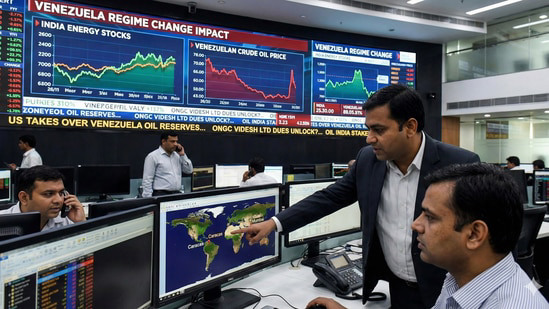
Indian equity markets have entered a phase of heightened volatility after dramatic geopolitical developments involving the United States and Venezuela sent shockwaves through global financial systems. The capture of Venezuelan President Nicolás Maduro during a US-led operation under President Donald Trump triggered a sharp reassessment of risk among investors, with Indian benchmarks bearing the brunt of the uncertainty. Over the past two trading sessions, the Sensex has lost nearly 700 points, eroding investor wealth by more than ₹1.19 lakh crore, as concerns over oil supply disruptions, geopolitical escalation, and global capital flows weighed heavily on sentiment. The sell-off highlights how deeply interconnected Indian markets have become with international political events, particularly those linked to energy-producing regions and strategic power shifts.
The reaction on Dalal Street underscores a familiar pattern: when geopolitical shocks emerge suddenly and involve key global players, investors tend to retreat from risk, reassess exposure to vulnerable sectors, and seek clarity before committing fresh capital. In this instance, oil marketing companies, heavyweight conglomerates, and select financial stocks found themselves at the centre of selling pressure, even as some defensive pockets showed resilience. The broader market narrative, however, remained one of caution, shaped by fears that the Venezuela episode could have longer-lasting consequences for global stability and commodity prices.
sensex and nifty slide as oil stocks and heavyweights drag benchmarks
The immediate impact of the US operation was visible in the sharp decline of India’s benchmark indices. The Sensex closed at 85,063.34, falling 376.28 points on January 6, while the Nifty ended the session at 26,178.70. This marked the second consecutive day of losses, extending the cumulative fall to nearly 700 points since news of the raid broke. For investors, the numbers translated into a significant erosion of market capitalisation, reinforcing the perception that global uncertainty had once again overridden domestic fundamentals.
Oil marketing companies emerged as the primary drag on the indices. The prospect of heightened instability in Venezuela, one of the world’s major oil producers, raised fears of supply disruptions and price volatility. For Indian oil firms, which operate in a delicate balance between global crude prices and domestic pricing mechanisms, such uncertainty tends to amplify risk. As crude-linked stocks declined, their heavy weight in the indices ensured that the broader market followed suit.
Other large-cap names also contributed to the downturn. Shares of major conglomerates, banking stocks, and consumer-facing companies saw profit booking as investors opted to reduce exposure. Among the top losers on the Nifty were stocks such as Trent, Reliance Industries, Kotak Mahindra Bank, Indigo, and ITC, each reflecting different facets of market anxiety, from consumption outlooks to financial sector sensitivity. The selling was not indiscriminate, but it was broad enough to keep benchmarks under pressure throughout the session.
Despite the overall decline, the market was not entirely without support. Select stocks in healthcare, private banking, and consumer staples posted gains, suggesting that investors were selectively reallocating capital rather than exiting equities altogether. Apollo Hospitals, ICICI Bank, Tata Consumer Products, HDFC Life, and Bajaj Auto featured among the day’s top gainers, benefiting from perceptions of relative stability or long-term growth visibility. This divergence within the market highlighted a shift toward defensive and quality plays amid uncertainty.
Foreign institutional investors added another layer to the story. While daily flows fluctuated, the broader trend over recent months has seen foreign investors remain cautious, with intermittent selling reflecting sensitivity to global risk factors. On January 5, foreign investors sold shares worth ₹3,268 crore, while domestic institutional investors stepped in with net purchases of ₹1,479 crore, once again underscoring the crucial role played by domestic capital in cushioning market declines. Over December and November, domestic institutions had consistently offset foreign selling, reinforcing the narrative that Indian markets currently enjoy strong local support even when global sentiment turns adverse.
The contrast with global markets was striking. While Indian indices struggled, several Asian markets ended the day on a positive note. South Korea’s KOSPI, Japan’s Nikkei, Hong Kong’s Hang Seng, and China’s Shanghai Composite all closed higher, reflecting region-specific optimism and differing interpretations of the geopolitical fallout. In the United States, the Dow Jones Industrial Average gained more than 1%, while the S&P 500 also advanced, even as the Nasdaq slipped modestly. These mixed global cues suggested that India’s sharper reaction was partly driven by its sensitivity to oil dynamics and the weight of energy-linked stocks in its indices.
global geopolitics, investor psychology, and the road ahead for indian markets
The Venezuela episode has highlighted how geopolitical developments can rapidly reshape investor psychology, often overshadowing domestic economic indicators and corporate fundamentals. The capture of a sitting head of state by a major power represents an extraordinary escalation in international affairs, raising questions about the future of diplomacy, sanctions, and global energy markets. For investors, such events introduce layers of uncertainty that are difficult to quantify, prompting a defensive posture until clearer signals emerge.
Oil sits at the heart of this uncertainty. Venezuela’s role in global crude supply means that any disruption, real or perceived, can influence price expectations. For an oil-importing country like India, rising crude prices have implications for inflation, fiscal balances, and corporate profitability. Even the anticipation of volatility can trigger sell-offs in oil-related stocks, as seen in the recent sessions. Market participants are acutely aware that sustained increases in crude prices could complicate the outlook for interest rates and economic growth, adding to the caution already evident in equities.
At the same time, the reaction of global markets underscores the complexity of modern financial systems. While some investors viewed the US action as a potential catalyst for political change in Venezuela, others focused on the risks of escalation and retaliation. This divergence in interpretation explains why markets in different regions responded differently, reflecting local priorities, sectoral compositions, and exposure to energy markets. For India, where oil sensitivity remains high, the negative interpretation dominated.
The role of domestic investors has become increasingly significant in this environment. Over the past year, domestic institutional investors have emerged as a stabilising force, absorbing selling pressure from foreign investors and providing depth to the market. This trend reflects the growing maturity of India’s investment ecosystem, driven by rising participation in mutual funds, insurance-linked investments, and retirement savings. While domestic flows cannot entirely insulate the market from global shocks, they have helped prevent sharper corrections and provided a measure of resilience.
Looking ahead, market participants will be closely watching several factors. Developments in Venezuela and any further statements or actions from Washington will remain critical, particularly for their impact on oil prices. At the same time, investors will assess how global central banks and policymakers respond to renewed geopolitical risk, especially if it begins to influence inflation expectations or financial stability. Corporate earnings, which have so far provided support to Indian equities, will also come under scrutiny as analysts reassess forecasts in light of potential macroeconomic headwinds.
Short-term volatility is likely to persist as markets digest these competing signals. However, many analysts believe that the medium-term outlook for Indian equities remains intact, supported by structural growth drivers, improving corporate balance sheets, and sustained domestic investment. The challenge lies in navigating the near-term noise without losing sight of long-term fundamentals, a task that requires both discipline and perspective from investors.
The recent sell-off serves as a reminder that Indian markets, while increasingly robust, are not immune to global shocks. Geopolitical events, especially those involving energy-producing regions and major powers, can quickly alter risk perceptions and capital flows. For now, caution prevails, but the presence of domestic support and selective buying in defensive sectors suggests that confidence has not evaporated entirely. As clarity emerges on the global front, markets are likely to recalibrate once again, reflecting the ever-evolving balance between risk and opportunity.