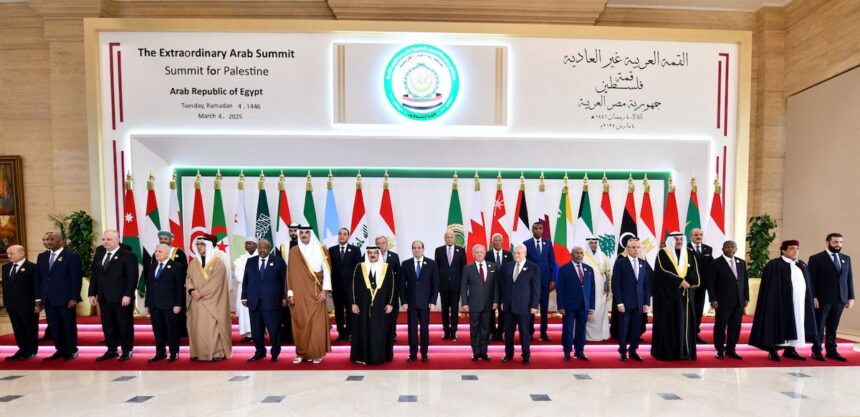
Arab leaders have endorsed an Egyptian-led initiative to rebuild Gaza, allocating $53 billion for reconstruction while ensuring that Palestinians remain in their homeland. The move counters a vision proposed by former U.S. President Donald Trump, which was perceived as advocating a mass displacement of Palestinians under a redevelopment plan for the region.
The decision was announced at a summit in Cairo, where Egyptian President Abdel Fattah al-Sisi confirmed broad support for the proposal. The plan received backing from Hamas but was met with strong criticism from Israel. Sisi expressed optimism that a peaceful resolution to the conflict could still be achieved, despite ongoing tensions in the Gaza Strip.
One of the major challenges in Gaza’s post-war landscape is governance. Questions remain about who will administer the enclave and how the massive financial support will be managed. Egypt, in collaboration with Palestinian representatives, has suggested forming an independent administrative committee composed of professional Palestinian technocrats. This committee would oversee humanitarian aid and governance in Gaza for a temporary period until the Palestinian Authority (PA) assumes full control.
Hamas, which has governed Gaza since 2007, welcomed the proposal but insisted on retaining influence over the committee’s agenda and structure. While the PA has expressed support for the plan, Hamas remains a contentious issue. The militant group, which initiated the recent conflict with Israel on October 7, 2023, has been a major point of contention in the negotiations.
Egyptian Foreign Minister Badr Abdelatty confirmed that the names of the committee members had been finalized. Palestinian President Mahmoud Abbas endorsed the Egyptian initiative and urged international support, emphasizing that the plan does not involve the displacement of Palestinians. Abbas also reiterated his willingness to conduct presidential and parliamentary elections under favorable conditions.
Israel has rejected the proposal, criticizing its reliance on the PA and arguing that it fails to address Hamas’s continued presence in Gaza. Meanwhile, funding for reconstruction is expected to come primarily from Gulf nations, including Saudi Arabia and the UAE, which have expressed differing views on the disarmament of Hamas. Saudi Arabia has raised concerns about Hamas’s armed presence, aligning with U.S. and Israeli objections.
The Egyptian plan, spanning 112 pages, includes comprehensive redevelopment strategies featuring residential projects, commercial hubs, and infrastructure improvements such as a port, airport, and technology hub. However, Israeli officials insist that any plan must ensure the complete demilitarization of Hamas before moving forward.
With more than 48,000 casualties reported by Palestinian health authorities, the humanitarian crisis in Gaza remains dire. The international community now faces the challenge of balancing security concerns with urgent reconstruction needs, as efforts to broker a long-term peace continue.