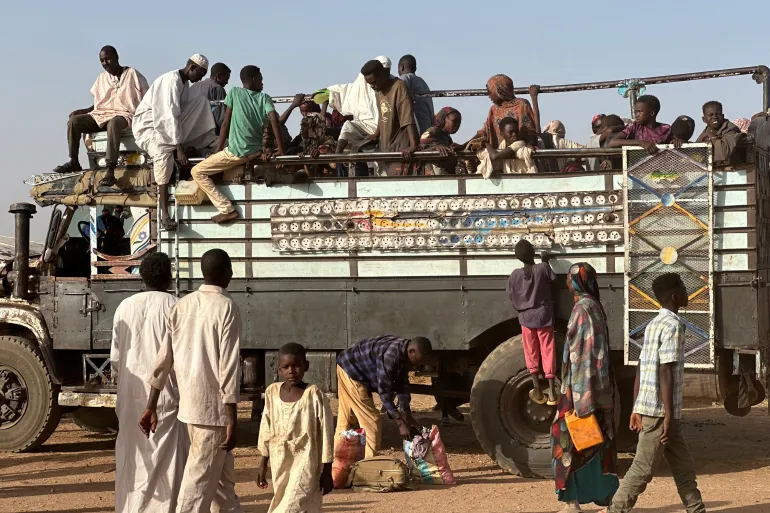
As Washington-led ceasefire talks collapsed following the abrupt withdrawal of the United Arab Emirates (UAE), Sudan’s paramilitary Rapid Support Forces (RSF) stormed the strategic North Darfur city of el-Fasher on Sunday. The assault shattered one of the last hopes for peace in the region and marked a catastrophic turning point in Sudan’s two-year civil war. Eyewitnesses and sources confirmed that the RSF captured key military positions, raising fears of mass killings, widespread human rights abuses, and further fragmentation of the war-torn country.
For over 500 days, el-Fasher had remained under siege, surrounded by RSF forces who cut off aid and movement in and out of the city. Around 260,000 civilians, including displaced families from other parts of Darfur, were trapped with dwindling food and medical supplies. The city’s fall now effectively divides Sudan into two separate spheres of control — the Sudanese Armed Forces (SAF) dominating the east from Port Sudan and the RSF consolidating its grip over western territories from Nyala.
Collapse of Washington Peace Talks
Hopes for a diplomatic breakthrough had risen briefly last week when U.S.-sponsored negotiations in Washington brought together representatives from the SAF and RSF. The talks, supported by the so-called “Quad” — the United States, UAE, Egypt, and Saudi Arabia — aimed to broker a ceasefire and facilitate humanitarian access to besieged regions such as el-Fasher. However, the discussions quickly unraveled after the UAE refused to engage in any meaningful dialogue over the city’s humanitarian crisis.
Diplomatic sources told Middle East Eye that Emirati representatives, despite being one of RSF’s main patrons, declined to classify the situation in el-Fasher as a siege. The UAE reportedly insisted that both the SAF and RSF were equally responsible for the ongoing atrocities, effectively blocking any consensus. This stance infuriated the Sudanese Armed Forces delegation, which viewed the UAE not as a neutral party but as an active belligerent supplying the RSF with weapons, funding, and mercenaries.
The Sudanese Foreign Minister Mohi al-Din Salem, who attended the talks, made his government’s position clear after the breakdown of negotiations: “If there is to be any dealing with the UAE, it will be as an enemy, not a mediator.” His words underscored growing resentment in Khartoum over Abu Dhabi’s deep involvement in Sudan’s internal conflict — an involvement that Western diplomats have long described as destabilizing.
Washington’s mediator, Massad Boulos, the Donald Trump administration’s special envoy for Arab and African affairs, had been engaged in parallel discussions with Sudanese army chief Abdel Fattah al-Burhan since September. Sources said Boulos pressed Burhan to curb Islamist influence in his forces, halt arms imports from Iran, support the Abraham Accords, and reduce Russian and Chinese influence in Sudan. In return, Burhan demanded that the U.S. dismantle the RSF, end Emirati interference, and lift sanctions imposed on Sudanese officials.
When no side yielded, the talks collapsed on Saturday. By the following morning, RSF forces launched their full-scale assault on el-Fasher, signaling both a military and diplomatic defeat for U.S.-led peace efforts.
The Fall of El-Fasher and Humanitarian Fears
According to accounts from local fighters and pro-democracy activists in the city, RSF fighters stormed el-Fasher from the east after overwhelming front-line defences. The paramilitaries reportedly used heavy artillery, drones, and armored vehicles, forcing SAF troops and local resistance groups to retreat northward toward the al-Daraga neighborhood.
One fighter told Middle East Eye that the intensity of Sunday’s fighting was unlike any previous assault. “Serious fighting has erupted in el-Fasher in the past few days, with all kinds of weapons used — both sides using drones especially,” he said, speaking anonymously for security reasons. “The RSF’s heavy firing allowed them to enter the city through its eastern side after crushing our front checkpoints, barricades, and trenches.”
The RSF later claimed full control of the city, describing its capture as a “decisive turning point” in the war. The group’s media released videos showing Abdul-Rahim Dagalo, brother of RSF leader Mohammed Hamdan Dagalo (known as Hemedti), addressing troops at the captured Sixth Infantry base. However, independent verification of these videos has been difficult due to severe communication blackouts in the region.
For months, residents of el-Fasher had relied on Starlink internet connections to contact the outside world. Even those links have now been disrupted in several areas, making it almost impossible to confirm reports of atrocities. Several unverified videos circulating online appear to show RSF fighters detaining civilians, forcing them to chant slogans in praise of Hemedti, and then opening fire. Other clips allegedly show paramilitaries firing at fleeing residents — though none of these could be independently confirmed.
Human rights organizations and local activists have warned that the fall of el-Fasher could trigger massacres on a massive scale, similar to earlier RSF operations in other parts of Darfur. The group has previously been accused of genocide, mass rape, and looting across the region. Reports from humanitarian agencies suggest that RSF fighters have mined the city’s outskirts, blocked aid convoys, and attacked displacement camps sheltering thousands of refugees.
In his statement on Sunday, UN Secretary-General António Guterres urged all nations providing weapons to warring parties in Sudan to immediately cease their involvement. “All countries that are interfering in this war, and that are providing weapons to the parties to the war, must stop doing that,” he said. His remarks appeared to be a thinly veiled criticism of the UAE’s role in arming the RSF.
### Sudan’s Deepening Divide and Global Implications
The capture of el-Fasher marks a historic shift in the balance of power in Sudan’s war. Once the last major city in Darfur held by the Sudanese Armed Forces, its fall effectively bisects the country into two rival administrations. In the east, General Burhan’s military-backed government rules from Port Sudan, maintaining control over Red Sea trade routes and official diplomatic channels. In the west, Hemedti’s RSF now governs vast swaths of Darfur, positioning itself as a de facto parallel government.
The division has not only intensified internal instability but also deepened the international complexity surrounding Sudan’s war. The conflict, which erupted in April 2023 over plans to integrate the RSF into the national army, has killed tens of thousands and displaced more than 13 million people. The humanitarian fallout is staggering: famine conditions, rampant disease, and mass displacement have created one of the world’s worst crises.
Washington’s failed attempt to mediate peace exposes growing fractures among international stakeholders. The UAE, once seen as a key partner for regional stabilization, now stands accused of fueling the conflict for strategic and economic gain. Abu Dhabi’s alleged deployment of mercenaries, financing of RSF operations, and arms transfers via Libya and Chad have drawn mounting criticism. Meanwhile, Egypt and Saudi Arabia, both members of the mediation “Quad,” have grown increasingly uneasy with the UAE’s actions, fearing spillover instability.
U.S. envoy Massad Boulos, in a post on X following the failed talks, initially tried to project optimism by announcing the creation of a “Joint Operational Committee” to coordinate humanitarian and political priorities among Quad nations. But his tone shifted dramatically after the RSF assault on el-Fasher. “The world is watching el-Fasher and the RSF’s actions with deep concern,” he wrote the following day, urging the group to protect civilians and prevent further suffering.
The assault also places Washington in a difficult position diplomatically. The Donald Trump administration has sought to rebuild U.S. influence in Africa, particularly by promoting the Abraham Accords and countering Chinese and Russian expansion. However, the Sudan crisis has revealed the limitations of American leverage when key regional players like the UAE pursue conflicting interests.
Within Sudan, the RSF’s latest offensive has emboldened Hemedti’s forces, who now control a vast stretch of western Sudan, including critical resource-rich areas. Analysts believe this could lead to the formalization of two rival governments, further entrenching the country’s division and complicating any future peace initiative.
The human cost of this geopolitical game remains devastating. El-Fasher, once a symbol of resistance and humanitarian resilience, now stands at the heart of a tragedy defined by betrayal and global indifference. As the RSF tightens its grip and international diplomacy falters, millions of Sudanese civilians remain caught in a war where every ceasefire collapses before it begins — and every promise of peace fades into another night of shellfire.