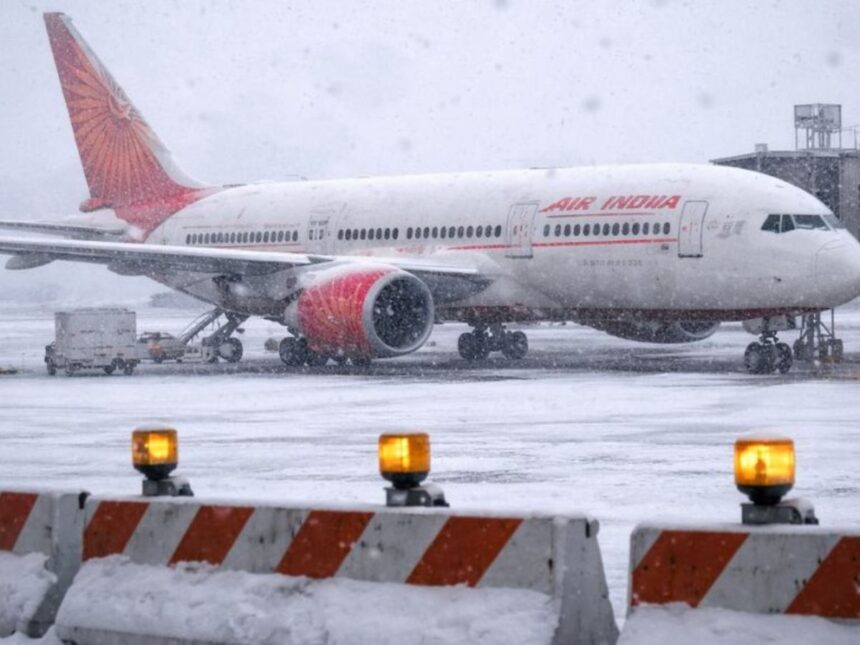
Air India has cancelled all flights to and from New York and Newark scheduled for February 24 after a powerful blizzard and heavy snowfall severely disrupted airport operations across the US East Coast, prompting widespread transport shutdowns and travel advisories affecting millions of passengers.
Air India suspends operations to New York and Newark citing safety concerns
India’s national carrier, Air India, announced on February 23 that it would cancel all flights operating to and from New York and Newark on Tuesday, February 24, due to extreme weather conditions triggered by a massive winter storm. The airline issued a travel advisory stating that airport operations in both cities had been significantly affected by a blizzard that brought heavy snowfall and dangerous conditions.
In its official communication, Air India emphasized that the decision was taken in the interest of passenger and crew safety. The advisory noted that airport infrastructure and flight movements in New York and Newark were disrupted as snow accumulated rapidly, making safe operations increasingly difficult. The airline reiterated that safety remains its highest priority and that suspending services was necessary under the circumstances.
Air India also assured affected passengers that ground teams would provide assistance and support to those booked to travel on February 24. The airline indicated that customer service representatives would help with rebooking options, refunds, and alternative travel arrangements where possible. The announcement was shared across digital platforms to ensure that passengers were informed well in advance of their scheduled departures.
For passengers seeking updated information, Air India advised them to contact its 24-hour call center at +91 11 69329333 or +91 11 69329999. Travelers were also encouraged to check their flight status directly on the airline’s official website, where real-time updates are provided. The airline urged passengers to avoid unnecessary travel to airports and to monitor official channels for further announcements.
The cancellations come amid broader disruptions across the US aviation network. Data from flight tracking platforms indicated that nearly 9,900 flights into and around the United States had been cancelled through Tuesday, with the majority originating from or destined for major East Coast hubs including New York, Boston, and Philadelphia. The cascading effect of the storm has strained airline operations, airport logistics, and passenger connectivity nationwide.
Air India’s move reflects a wider trend among global carriers adjusting operations in response to extreme weather. Airlines typically suspend services when airport runways, taxiways, and ground operations are compromised by heavy snowfall or low visibility. In this case, forecasts of record-breaking snow accumulation and sustained blizzard conditions made normal operations untenable.
The airline’s advisory aligns with precautionary measures implemented by other carriers. Delta Air Lines, for example, announced that it expected to suspend operations at New York’s LaGuardia and John F. Kennedy International airports, as well as Boston Logan International Airport, into Tuesday. Such coordinated suspensions highlight the severity of the storm’s impact on aviation infrastructure.
Historic winter storm paralyzes East Coast transportation networks
The flight cancellations are part of a much larger disruption caused by a powerful winter storm sweeping across the US East Coast. According to meteorological forecasts, as many as 41 million people faced blizzard conditions stretching from Pennsylvania to Maine. The storm has been described as potentially one of the worst in recent memory for New York City and surrounding regions.
Forecasts suggested that New York City could receive more than 20 inches of snow, with some areas potentially seeing up to 28 inches. Meteorologists warned that snowfall exceeding 14.8 inches within 24 hours would place the storm among the city’s top ten most severe snow events on record. The largest single-day snowfall in New York’s history remains 27.3 inches, recorded on January 23, 2016. The possibility of approaching such levels underscores the extraordinary scale of the current weather event.
City officials moved swiftly to mitigate risks. New York Mayor Zohran Mamdani announced that highways, bridges, and streets leading into the city would close at 9 p.m. on Sunday. Schools were ordered to remain shut on Monday as authorities sought to reduce travel and limit exposure to hazardous conditions. Emergency services were placed on heightened alert, with additional high-water rescue teams activated in anticipation of potential flooding or infrastructure strain.
The storm severely impacted rail and bus services across the region. Transport networks from Philadelphia to Maine experienced significant interruptions due to snow accumulations estimated between 18 and 20 inches. Public transit systems struggled to maintain schedules as crews worked to clear tracks and roadways.
Weather officials characterized the event as a full-fledged blizzard, marked by sustained strong winds, blowing snow, and near-zero visibility in some areas. Forecasters warned that “no one is going into or out of New York City” during the peak of the storm, emphasizing the seriousness of the travel restrictions. Conditions in New Jersey, Long Island, and southern New England were expected to bear the brunt of the heaviest snowfall.
The scale of the storm has revived comparisons to major historic winter events. Urban planners and emergency responders noted that New York City had not experienced a storm of this magnitude in the last decade. The accumulation of snow combined with freezing temperatures posed risks to power lines, transportation corridors, and residential neighborhoods.
For airlines, the combination of closed highways, restricted airport access, runway closures, and crew displacement created an operational gridlock. Aircraft and crews positioned in affected cities faced delays, while connecting passengers encountered cascading disruptions across domestic and international routes. The interconnected nature of airline networks means that a severe weather event in one region can ripple across the entire system.
Passengers scheduled to travel during the affected period were advised to monitor airline communications and avoid unnecessary airport visits. Aviation authorities stressed that safety protocols would guide all operational decisions, even if it meant prolonged disruptions.
The suspension of Air India’s New York and Newark services reflects the global reach of the storm’s impact. As international carriers adjust their schedules in response to local weather crises, travelers worldwide experience the consequences of regional disruptions. The February 24 cancellations serve as a reminder of the aviation industry’s vulnerability to extreme weather and the importance of coordinated crisis management across borders.