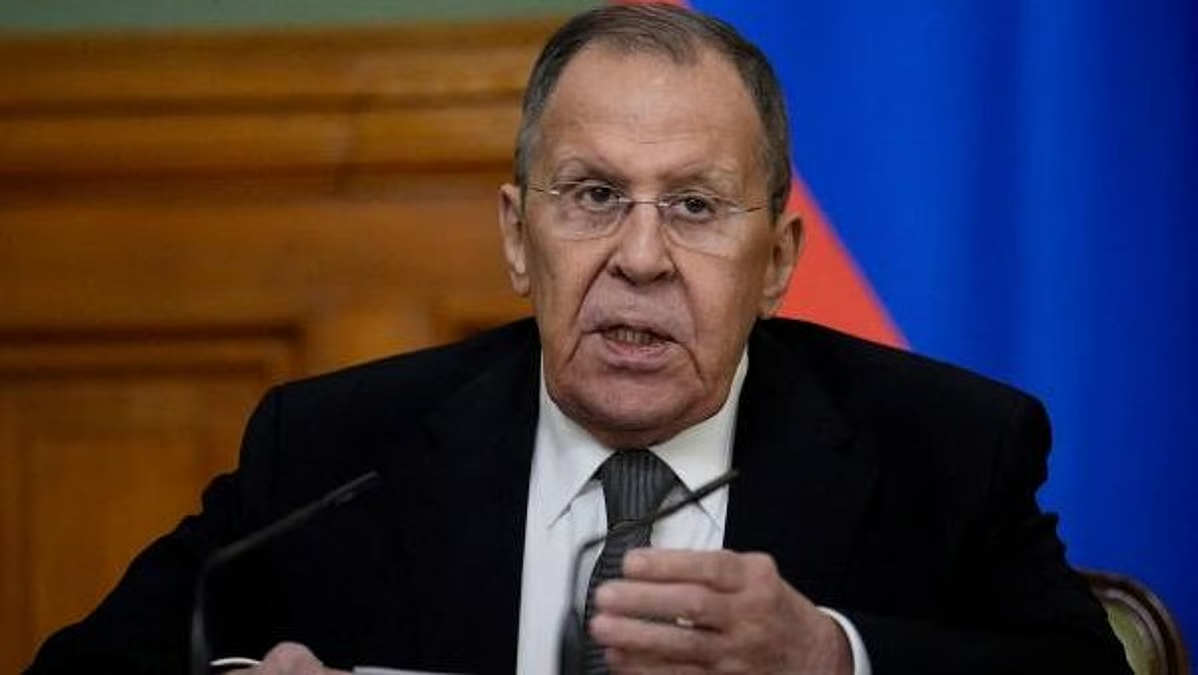
Russian Foreign Minister Sergey Lavrov has sharply criticized the United States, accusing it of pressuring countries, including India, to refrain from purchasing affordable oil from Russia. Speaking on February 9, on the occasion of Diplomatic Workers’ Day, Lavrov claimed that the US is seeking to dominate the global energy market and compel nations to buy expensive American gas instead of leveraging more cost-effective alternatives. According to Lavrov, this pressure reflects a broader US strategy to control global energy supply chains while simultaneously weaponizing the US dollar as a financial and geopolitical instrument. He emphasized that US-imposed sanctions on Russia, along with the freezing of Russian assets abroad, are tools of coercion aimed at undermining Russia’s economic independence and international trade. Lavrov argued that these measures persist despite prior commitments by former US administrations, including the Trump administration, which had spoken about ending the conflict in Ukraine, yet left sanctions in place or introduced new ones. He described these actions as part of a systematic attempt to restrict Russia’s trade, investment, and global economic engagement, while pressuring emerging economies to comply with Washington’s agenda.
US Pressure on India and BRICS Countries Amid Global Energy Rivalry
Lavrov highlighted that the United States has been exerting targeted pressure on India and other BRICS nations to distance themselves from Russia. He cited the sanctions imposed on Russian energy companies such as Lukoil and Rosneft and described attempts to restrict Russian trade and investment as unfair and unjust. According to him, the US has historically leveraged its dominance in the global economy and financial system, particularly through the use of the US dollar, to assert geopolitical control. However, Lavrov argued that this dominance is gradually eroding as nations such as China, India, and Brazil rapidly expand their economic and industrial capabilities. African nations, too, are increasingly pursuing local industrialization instead of relying solely on raw material exports. Against this backdrop, Lavrov emphasized that India’s initiatives during its BRICS presidency are aligned with contemporary global challenges, including energy security, food security, counterterrorism, and technology governance, particularly artificial intelligence. He mentioned India’s upcoming major conference on AI, in which Russia will also participate, stressing the importance of regulatory frameworks that allow countries the freedom to determine their own technological strategies without undue influence from more powerful nations.
Lavrov also contended that Western countries, particularly the US, are reluctant to relinquish their historical hold over global energy markets. He argued that the Trump administration’s policies underscored Washington’s desire for full control of energy resources and efforts to block competitors from establishing alternative supply chains. This competitive dynamic, according to Lavrov, has directly influenced Russia’s international relations, as the country faces increasing restrictions and economic pressures. He pointed out that Russian vessels are being stopped in international waters, which he claimed violates international law, and that some countries are being forced to pay tariffs to acquire Russian oil and gas. Lavrov insisted that Russia’s primary objectives remain national security and sustained progress despite these external pressures. He further warned that certain European leaders have been openly discussing hostile measures against Russia, reflecting growing geopolitical tensions.
Global Financial Systems, BRICS Expansion, and Strategic Autonomy
In addition to energy and security concerns, Lavrov highlighted broader global financial and economic dynamics, criticizing Western nations for denying emerging economies their equitable share of international institutions such as the IMF, World Bank, and WTO. He argued that Russia, along with other BRICS members, is pursuing alternative pathways to reduce dependence on Western-dominated financial systems. These include trading in national currencies, establishing new payment mechanisms, exploring innovative investment strategies, and developing independent grain and commodity markets. Lavrov emphasized that these initiatives are not designed to oppose any country but to safeguard member nations from unilateral pressure and economic coercion. He noted that with Indonesia joining BRICS, the group has become even stronger, enhancing its collective ability to assert strategic autonomy on global platforms.
Lavrov framed these developments as part of a broader shift in international power dynamics. He suggested that the world is witnessing a gradual redistribution of economic influence, where previously US-dominated systems are challenged by rapidly growing economies seeking equitable participation in decision-making and trade frameworks. Russia, he asserted, is committed to protecting its sovereignty and the security of Russian-speaking populations in Crimea, Donbass, and Novorossiya, while also engaging collaboratively with BRICS countries to ensure mutual economic development and resilience. Lavrov’s remarks underline the intersection of energy policy, financial sovereignty, and geopolitical strategy, highlighting the challenges that nations face when navigating pressures from global powers intent on controlling critical resources and economic systems.
He reiterated that the US has increasingly weaponized the dollar, using sanctions and financial restrictions to exert leverage over other nations. Russian assets frozen abroad, persistent sanctions, and restrictions on trade have collectively created an environment of economic coercion. Lavrov argued that such measures are not only harmful to Russia but also to the principles of fair international trade and sovereign decision-making. He claimed that despite political agreements regarding Ukraine, the US continues to impose restrictions, demonstrating the enduring nature of financial and geopolitical leverage as a tool of statecraft.
Lavrov further elaborated on the implications of this pressure for India and other emerging economies. He contended that nations are increasingly aware of the risks of overreliance on Western financial and energy systems and are seeking to diversify their energy sources and financial instruments. India’s leadership in areas such as energy security, technological development, and AI governance reflects a growing recognition of the need for self-determined policies that align with domestic priorities and long-term strategic interests. Russia’s collaboration with India and other BRICS members is presented as a cooperative effort to foster equitable global participation and reduce vulnerability to unilateral coercion by dominant powers.
In the context of global energy markets, Lavrov criticized the US for promoting expensive gas alternatives while restricting access to competitively priced Russian oil. He argued that this strategy distorts markets, increases costs for consumers worldwide, and reinforces dependency on US-controlled resources. Lavrov claimed that Western measures, including tariffs and sanctions, undermine the ability of nations to make independent economic choices. He emphasized that countries like Russia, India, China, and Brazil are pursuing mechanisms to counteract these pressures, including the creation of independent financial systems, payment mechanisms, and trading arrangements that prioritize mutual benefit and strategic autonomy.
Lavrov also discussed Russia’s security priorities, emphasizing that threats originating from Ukrainian territory are unacceptable for Russian national security. He highlighted Russia’s responsibility to safeguard Russian citizens and Russian-speaking populations in regions such as Crimea, Donbass, and Novorossiya. These security concerns, he suggested, are intertwined with broader geopolitical and economic pressures, illustrating the complex interplay between national security, energy independence, and international trade dynamics.
He concluded by reiterating that Russia and BRICS countries are exploring innovative strategies to reduce dependency on Western institutions while maintaining constructive engagement with the global economy. This includes developing alternative trade and investment mechanisms, conducting transactions in local currencies, and establishing markets that allow nations to trade and invest without interference from dominant powers. Lavrov framed these efforts as a necessary step to protect sovereignty, ensure fair access to global economic opportunities, and create resilient partnerships among emerging economies.
The Russian foreign minister’s remarks highlight a critical moment in global geopolitics, where energy policy, financial sovereignty, and the evolving balance of power are shaping the strategies of major economies. Lavrov’s observations underscore the challenges faced by nations navigating pressures from established powers while seeking to assert independent policy choices. His comments on US pressure, the weaponization of the dollar, and BRICS initiatives provide a comprehensive view of the strategic recalibrations underway in response to shifting global power dynamics, emphasizing the intersection of economic policy, energy security, and international relations in the contemporary world order.