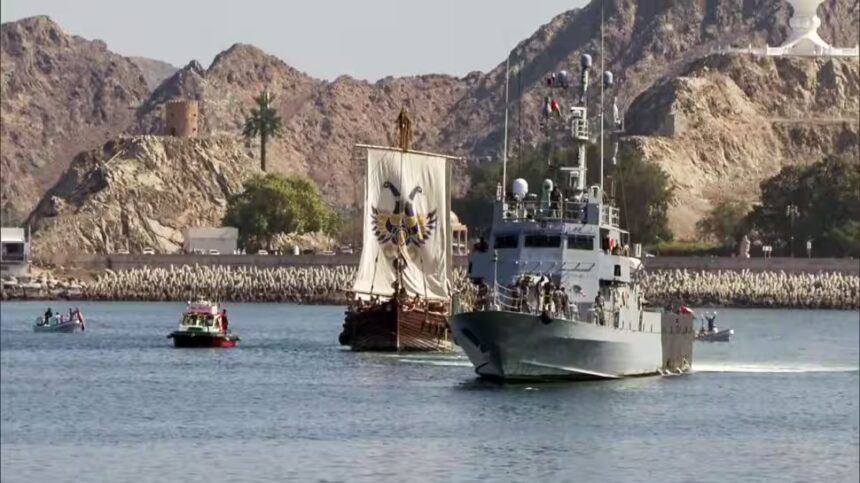
The INS Kaundinya, a unique hand-stitched vessel built by the Indian Navy, has successfully completed an extraordinary 18-day sea voyage across the waters of the Oman Sea, capturing global attention for its blend of traditional craftsmanship and modern maritime endurance. This exceptional journey highlights India’s deep-rooted maritime heritage and the evolving capabilities of its naval engineering, as sailors aboard this distinct vessel navigated challenging open sea conditions to demonstrate not only the seaworthiness of a hand-stitched ship but also the resilience, skill, and determination of its crew. In undertaking this voyage, the Indian Navy aimed to reaffirm the value of traditional shipbuilding techniques, showcase indigenous innovation, foster international goodwill, and inspire future generations in the fields of naval exploration and marine craftsmanship.
A journey of heritage, innovation and naval mastery
The INS Kaundinya stands apart from conventional naval vessels because of its unique construction methodology. Unlike standard metal-hulled ships, this remarkable vessel owes its origins to hand-stitched techniques that harken back to ancient maritime traditions. For centuries, craftsmen in various parts of the world — including the Indian subcontinent — perfected the art of building boats by manually stitching together wooden planks with cordage and fastening materials. While modern naval architecture has largely moved toward steel and advanced composites, the construction of the Kaundinya was an intentional homage to these age-old methods, infused with contemporary engineering oversight to ensure safety and functionality on long, open sea voyages.
The decision to undertake an ambitious route through the expansive waters of the Oman Sea was not taken lightly. This region, known for its unpredictable weather patterns, variable currents, and considerable swells, posed a formidable test for any vessel, let alone one built in the spirit of traditional craftsmanship. The voyage demanded rigorous preparation, meticulous planning, and unwavering teamwork. From the moment the Kaundinya set sail, its crew was keenly aware that this journey was as much about testing human resolve and seamanship as it was about validating a construction philosophy rooted in history.
Throughout the 18 days at sea, sailors aboard the Kaundinya experienced the full spectrum of maritime conditions. Calm days offered serene moments where the vessel’s handcrafted hull seemed at one with the vast blue expanse, while stormier stretches challenged the crew’s endurance and seamanship under powerful winds and rolling seas. Navigating this vessel required constant vigilance, seamless coordination among watch teams, and the application of both traditional seamanship skills and modern navigational aids. Despite the hardships, the crew’s morale remained high, driven by a sense of pride in representing their country and demonstrating a remarkable fusion of tradition and innovation.
The journey also served as a living classroom for naval trainees and seasoned sailors alike. Onboard discussions ranged from shipbuilding techniques to meteorological analysis, marine safety protocols, and strategic navigation. Every challenge encountered on the voyage became a learning opportunity, reinforcing lessons that cannot be fully replicated within the controlled environments of training docks or simulation rooms. The Kaundinya thus became more than just a vessel; it became a floating institution of naval knowledge, heritage, and experience.
At various moments during the voyage, the crew communicated with maritime authorities and support vessels, sharing updates that documented not only their location but also the conditions at sea and the performance of the hand-stitched hull. These communications underscored the success of the design, as the Kaundinya maintained structural integrity and seaworthiness across the vast distances covered. For naval engineers and maritime scholars observing from shore, these real-time updates offered invaluable data points on the practical application of traditional shipbuilding methods when adapted to meet modern safety and performance standards.
Beyond its technical significance, the voyage of the Kaundinya carried symbolic resonance. India, with its long coastline and storied history of seafaring, has for centuries been a cradle of maritime culture. From the ancient trade networks that linked Indian ports to distant lands, to the naval fleets that protected coastal kingdoms, the Indian Ocean has been at the heart of cultural exchange, economic endeavour, and strategic navigation. In this broader continuum of maritime heritage, the Kaundinya’s journey stands as a living tribute to those legacies, connecting past and present in a voyage that honours history while charting new paths for innovation.
Throughout the voyage, the crew maintained rigorous safety protocols. Even as the vessel upheld the integrity of its traditional design, contemporary safety equipment, communication systems, and emergency procedures were integrated seamlessly into daily operations. Crew members conducted drills, monitored weather forecasts, managed provisions, and ensured that every aspect of life aboard supported both the mission’s objectives and the wellbeing of those on board. This balance between tradition and modernity became a hallmark of the Kaundinya’s sea journey, illustrating that reverence for the past can coexist with the demands of present-day maritime standards.
Global maritime impact and inspiring future generations
The successful completion of the 18-day Oman Sea voyage by the INS Kaundinya resonates far beyond the immediate accomplishments of a single ship and crew. As news of the journey spread through naval circles, maritime academies, and global media, the voyage became a point of fascination and admiration within the international community. Scholars of naval history, proponents of sustainable craftsmanship, and advocates for cultural preservation all took note of how this vessel bridged a world of ancient techniques with the rigours of modern navigation.
One of the most profound impacts of this voyage lies in its potential to inspire future generations. Young people, particularly those with interests in maritime pursuits, engineering, or cultural heritage, have found in the Kaundinya’s story a narrative that transcends conventional boundaries. It serves as a reminder that innovation need not discard tradition, and that the ingenuity of past generations can still inform contemporary practice in meaningful ways. For students in coastal communities, aspiring shipbuilders, and naval cadets, the Kaundinya’s voyage represents a powerful message about courage, creativity, and the enduring relevance of traditional knowledge when merged with modern expertise.
Across international naval institutions, the voyage has sparked renewed dialogue about the value of preserving ancient techniques while embracing technological advancement. Workshops, symposiums, and virtual forums have emerged where maritime professionals share insights on how traditional craftsmanship can complement contemporary design philosophies. The story of the Kaundinya has been cited in discussions about sustainable shipbuilding, cultural heritage preservation, and the integration of historical knowledge into modern practice — not as an exercise in nostalgia, but as a substantive contribution to a more holistic understanding of maritime craft.
For the Indian Navy itself, the success of this expedition has reinforced its reputation as a force that honours both innovation and heritage. Naval leadership has emphasised that missions like the Kaundinya’s are not merely symbolic but carry real strategic value in advancing seamanship, fostering resilience among sailors, and strengthening ties with global maritime partners. The voyage has prompted discussions about how future missions might explore other elements of traditional design, cultural exchange, and international cooperation, ensuring that maritime exploration remains both forward-looking and deeply rooted in respect for history.
The reception of the Kaundinya upon its arrival back at port was met with celebration, recognition, and pride from citizens, dignitaries, and maritime enthusiasts. The arrival ceremonies honoured the crew’s achievements and acknowledged the historical significance of completing such a demanding journey aboard a handcrafted vessel. Speeches by naval officials reiterated the broader implications of the voyage for national maritime identity, while families of crew members and supporters from diverse backgrounds shared in the collective sense of accomplishment.
As discussions unfold about the legacy of the Kaundinya’s voyage, one theme remains consistent: the voyage underscores the idea that the sea, with all its challenges and mysteries, continues to be a realm where human ingenuity, bravery, and tradition can converge to produce feats of lasting significance. The success of this 18-day crossing of the Oman Sea not only demonstrates the practical seaworthiness of a hand-stitched ship but also reinforces the enduring power of human dedication, cultural heritage, and the unifying spirit of exploration.
This remarkable journey will likely be studied, celebrated, and remembered as a milestone in maritime history — a testament to what can be achieved when tradition and modernity sail together on the same tide.