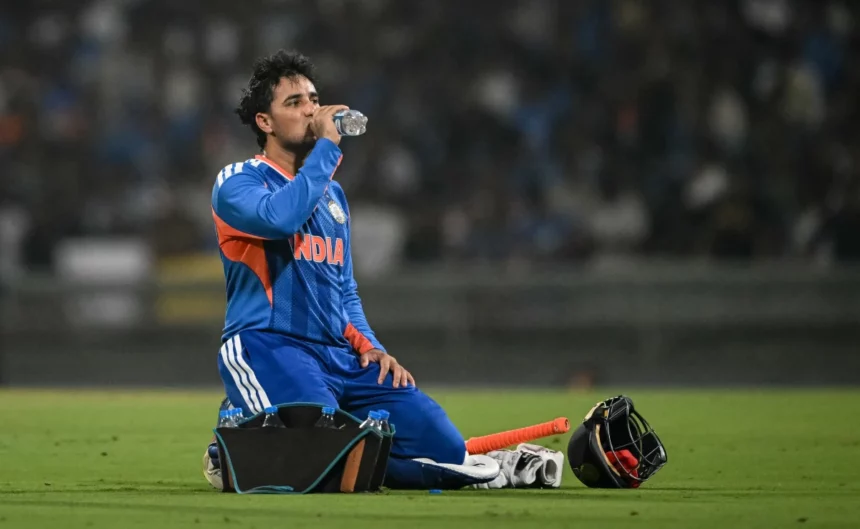
Indian cricket team opener Abhishek Sharma has been hospitalised due to a severe stomach infection, casting doubt over his availability for India’s upcoming T20 World Cup group-stage match against Namibia. Reports indicate that Sharma had been experiencing discomfort even before India’s previous game against the USA, and his condition worsened following his participation in that match. The left-handed batter was reportedly running a high temperature and required medical attention through drips for immediate relief. His inability to participate in team practice sessions at the Arun Jaitley Stadium in New Delhi has raised concerns about his readiness for the match against Namibia. Assistant coach Ryan ten Doeschate stated that while Sharma is still experiencing stomach issues, the team is hopeful that he may recover in time to take the field.
Abhishek Sharma’s Condition and Team Updates
Abhishek Sharma’s hospitalization follows a challenging performance against the USA, where he was dismissed for a golden duck and did not field during India’s bowling innings. Sanju Samson filled in for him throughout the innings, and Sharma also did not participate in the post-match handshakes, highlighting the severity of his discomfort. According to sources within the team management, Sharma was admitted to a private hospital in Delhi, where tests are being conducted to determine the precise nature and severity of his stomach infection. As of now, it remains uncertain when he will be discharged, leaving his participation in the match against Namibia in doubt. The situation has prompted the coaching staff to explore contingency plans, ensuring that the team remains prepared for any eventuality, including fielding adjustments and batting order changes if Sharma is unable to recover in time.
In addition to Sharma’s uncertain fitness, the Indian squad has welcomed Washington Sundar, who joined the team ahead of the Namibia fixture. Sundar’s inclusion strengthens the team’s options in both batting and bowling departments. Assistant coach Ryan ten Doeschate highlighted Sundar’s arrival, stating that he had joined the squad yesterday and would train with the team to integrate into match preparations. Sundar’s presence offers a potential buffer for the team in the event of Sharma’s continued unavailability, providing balance to the squad while ensuring that India maintains flexibility in strategy. Sundar’s participation is expected to be especially valuable given India’s focus on adapting to opposition strengths and exploiting opportunities against a disciplined Namibia bowling attack.
Fitness Updates and Team Morale
Beyond Sharma and Sundar, the coaching staff provided updates on key players, including Jasprit Bumrah, who has returned to bowling following a 10-day break. Doeschate noted that Bumrah is feeling significantly better, moving freely and resuming training, which should boost India’s bowling options for the upcoming fixtures. The team has been closely monitoring player fitness, balancing workload management with strategic preparation, particularly in the high-intensity T20 World Cup schedule. The management’s careful approach reflects the importance of maintaining player health while ensuring peak performance, especially when facing physically demanding matches in quick succession.
Sharma’s hospitalization has also underscored the unpredictable nature of tournament cricket, where injuries and illnesses can have immediate tactical implications. The coaching staff, along with team medical professionals, are closely evaluating his progress, employing both preventive and reactive measures to facilitate a potential recovery. The focus remains on ensuring that all players are adequately supported medically and mentally, while the squad continues to prepare collectively for the Namibia match and subsequent group-stage encounters. The uncertainty around Sharma has also highlighted the importance of squad depth, with backup players like Sundar poised to step into key roles if necessary.
Reflecting on India’s recent victory against the USA, Doeschate praised Suryakumar Yadav for his match-winning contribution, noting the impact of leadership and consistent performance. Yadav’s innings not only secured a crucial win but also reinforced the importance of experienced players in guiding the team through challenging scenarios. His ability to stabilize the innings and contribute under pressure demonstrates the value of a core group of reliable performers around whom team strategy is structured. For Sharma, the current situation emphasizes the delicate balance between individual player form, health, and the collective objectives of the squad.
The coaching staff has emphasized holistic preparation, combining fitness management, tactical planning, and mental readiness. With Sharma under medical observation and Sundar integrating into the squad, India’s approach reflects adaptability and contingency planning, key elements in navigating a tournament environment. The interplay between player availability, match readiness, and opponent assessment has become central to decision-making, as the team aims to field its strongest possible lineup while mitigating risks associated with injuries or illnesses.
In the immediate term, Sharma’s recovery will be closely monitored by team physiotherapists and medical specialists. The management is exploring treatment options, dietary adjustments, and rest protocols to optimize his chances of returning to competitive play. Meanwhile, players not affected by injury or illness continue to engage in intensive practice sessions at Arun Jaitley Stadium, focusing on refining batting techniques, bowling strategies, and fielding drills to maintain match readiness. This dual focus on affected and fit players ensures that the squad remains prepared collectively, regardless of individual player availability.
The uncertainty surrounding Sharma has also prompted strategic discussions regarding batting order flexibility. Assistant coach Doeschate has indicated that the team is considering multiple scenarios, ensuring that if Sharma is unavailable, the lineup can be adjusted without compromising overall team balance. The decision-making process encompasses analysis of opposition strengths, current player form, and historical performance data, highlighting the analytical depth involved in modern tournament preparation.
Furthermore, India’s management continues to maintain clear communication with players, emphasizing transparency regarding health updates and strategic adjustments. Sharma has received support from both teammates and staff, reinforcing morale during a potentially stressful period. The coaching staff has also been coordinating with support personnel, including nutritionists and sports psychologists, to ensure that all aspects of player well-being are addressed comprehensively.
Sundar’s arrival is particularly timely, offering both tactical versatility and depth to India’s squad. With experience in both batting and bowling, he can be deployed in various positions depending on match circumstances. His integration into training sessions allows the team to test combinations, simulate match situations, and assess player synergy, which will be crucial for optimal performance against Namibia and in subsequent group-stage matches.
As preparations continue, India’s focus remains on creating a resilient and adaptable squad capable of responding to dynamic match situations. The combination of managing player health, integrating new squad members, and refining match strategies reflects a multi-faceted approach to tournament readiness. Sharma’s medical condition serves as a reminder of the uncertainties inherent in competitive cricket and the importance of maintaining a prepared and flexible squad.
The Indian team’s approach also underscores the significance of leadership, both on and off the field. Players like Suryakumar Yadav exemplify composure and consistency, serving as role models for younger squad members. Their ability to perform under pressure, coupled with proactive coaching guidance, strengthens team cohesion and confidence. Sharma’s potential absence, while challenging, is mitigated by the preparedness and depth of the rest of the squad, ensuring that India remains competitive despite unforeseen setbacks.
Abhishek Sharma’s hospitalization ahead of the T20 World Cup match against Namibia presents both a challenge and an opportunity for India’s squad. The situation highlights the critical importance of squad depth, medical preparedness, and flexible tactical planning. With Washington Sundar joining the team, Jasprit Bumrah regaining fitness, and a focus on collective preparation, India is striving to maintain momentum and readiness for its upcoming fixtures. While uncertainty surrounds Sharma’s availability, the team’s proactive approach reflects the broader strategic mindset necessary to succeed in high-stakes international tournaments, balancing player well-being, match performance, and long-term tournament objectives.