The Delhi government has approved a sweeping reorganisation of the Capital’s administrative map, expanding the number of revenue districts from 11 to 13 in a move aimed at improving coordination, efficiency, and citizen service delivery. Cleared by the Cabinet under the chairmanship of Chief Minister Rekha Gupta, the restructuring redraws district boundaries to align, for the first time, with those of the Municipal Corporation of Delhi, while also synchronising with the New Delhi Municipal Council and the Delhi Cantonment Board. Officials have described the decision as the most significant overhaul of Delhi’s district framework in more than a decade, with wide-ranging implications for governance, planning, and everyday public services.
The reorganisation seeks to address long-standing administrative challenges caused by mismatched jurisdictions between revenue districts and civic bodies. Under the existing arrangement, several areas fell under one revenue district but were governed by a different municipal zone, leading to overlapping mandates, delays in decision-making, and confusion among officials and citizens alike. By realigning boundaries and increasing the number of districts and sub-divisions, the government aims to streamline field administration, reduce service backlogs, and bring government offices closer to residents.
New district map and alignment with municipal bodies to streamline administration
According to officials, the Cabinet decision restructures Delhi’s revenue administration into 13 districts and 39 sub-divisions, up from the current 33 sub-divisions. The new districts are South East, Old Delhi, North, New Delhi, Central, Central North, South West, Outer North, North West, North East, East, South, and West. Each district will comprise between two and four sub-divisions, designed to balance population density and administrative workload more evenly across the city.
Under the previous system, Delhi had 11 districts: North, North East, North West, West, South, South West, South East, New Delhi, Central, Shahdara, and East. As part of the reorganisation, the Shahdara district has been removed, while three new districts—Old Delhi, Central North, and Outer North—have been carved out to better reflect demographic realities and administrative needs. Officials said these changes were guided by extensive internal reviews of service demand, population growth, and the practical challenges faced by field officers.
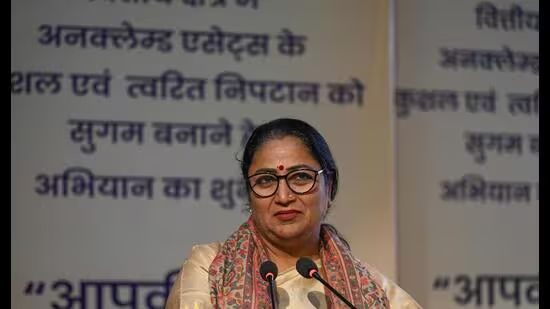
Chief Minister Rekha Gupta, addressing the decision, said the restructuring would strengthen field-level administration and eliminate functional overlaps that frequently occur across civic bodies. She described the move as a concrete example of translating the vision of simplified governance into action. According to her, aligning revenue and municipal boundaries under the principle of “One Delhi, One Boundary, One Window” would make governance more accessible and responsive for citizens while reducing friction between departments.
Officials noted that mismatched boundaries have long caused delays in routine administrative work. In many cases, revenue officials, municipal engineers, and enforcement staff operated under different jurisdictions for the same locality, complicating coordination during inspections, planning exercises, and enforcement drives. This patchwork arrangement often resulted in inconsistent responses to citizen complaints, delays in approvals such as road cutting permissions, and gaps in land-record management. The new structure, they said, is designed to eliminate these inefficiencies by ensuring that agencies work within the same geographical framework.
The government plans to issue a gazette notification through the revenue department within 15 days of the Cabinet decision. The new districts are scheduled to come into effect from January 1, with full operationalisation expected by the end of December 2025, subject to final approval from the lieutenant governor. Officials said the transition period would be closely monitored to ensure that routine services continue without disruption.
Mini secretariats, expanded sub-registrar offices, and impact on citizen services
A central feature of the reorganisation is the creation of district-level “Mini Secretariats” in each of the 13 districts. These hubs are intended to bring key revenue and administrative offices under one roof, including sub-divisional magistrates, additional district magistrates, tehsils, and sub-registrar offices. At present, citizens often have to travel between multiple offices, sometimes located in different parts of the city, to complete interlinked tasks such as property registration, affidavits, or land-record updates. The Mini Secretariats are expected to significantly reduce this burden by offering a single, consolidated point of access.
Officials said the government has allocated ₹25 crore in the current financial year for the first phase of setting up these Mini Secretariats. Beyond improving convenience for citizens, the consolidated model is expected to give district heads better oversight of operations, enhance accountability, and improve coordination among officials handling related functions. The aim, according to senior officials, is to make district administration more accessible and citizen-centric, reducing the need for repeated visits and minimizing procedural delays.
Property registration, one of the most heavily used revenue services in Delhi, is also set to see major changes under the new structure. The number of sub-registrar offices will increase from 22 to 39, with their jurisdictions fully realigned to match the new sub-division boundaries. Officials said this expansion would ease congestion at existing offices, reduce waiting times for appointments, and accelerate the digitisation of land records. Improved alignment with municipal boundaries is also expected to strengthen coordination with the Municipal Corporation of Delhi, particularly in areas such as building plan approvals and property tax administration.
The redistribution of districts and sub-divisions is expected to balance workloads more evenly, especially in high-density zones where officials have struggled with service backlogs. By reducing the administrative burden on individual district officers and creating smaller, more manageable jurisdictions, the government hopes to improve grievance redressal timelines and overall service quality. Officials also said that clearer boundaries would aid disaster-management planning and emergency response by ensuring that all relevant agencies operate within the same jurisdictional framework.
In the longer term, the government plans to gradually synchronise the boundaries of other key agencies, including the Delhi Jal Board, Delhi Police, and the Public Works Department, with the new revenue map. This phased alignment is intended to create consistency across governance layers, reducing confusion and enabling faster, more coordinated responses to civic challenges.
Officials emphasised that the restructuring is not merely a bureaucratic exercise but a foundational change aimed at improving how governance functions on the ground. By clarifying jurisdictions, consolidating offices, and aligning administrative boundaries, the government expects to deliver faster services, reduce duplication of effort, and make interactions with the state simpler for residents. The transition will be closely watched, they said, to ensure that the administrative shift strengthens, rather than disrupts, day-to-day governance in the national capital.