The controversy over the special intensive revision of electoral rolls in West Bengal has assumed national constitutional significance after Chief Minister Mamata Banerjee personally approached the Supreme Court, warning that the exercise could disenfranchise thousands of genuine voters. Taking serious note of the allegations, the top court issued notices to the Election Commission, placing the process under judicial scrutiny.
What began as an administrative exercise has now evolved into a broader debate on voter rights, inclusion and democratic fairness. The court’s intervention has elevated the issue from a state-level dispute to a question central to India’s electoral democracy.
Mamata banerjee’s direct intervention questions fairness and timing
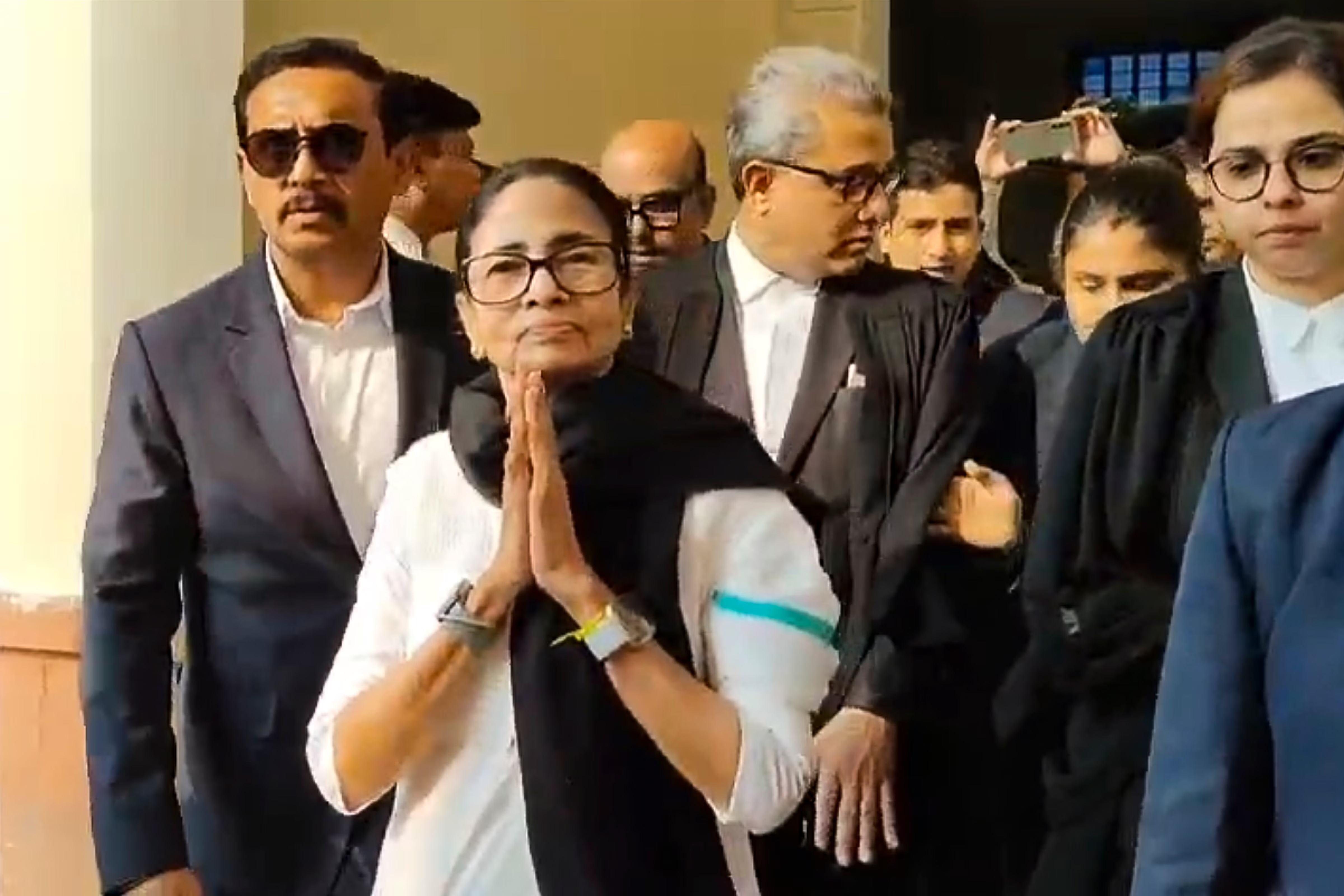
Mamata Banerjee took the unusual step of appearing personally before the Supreme Court to argue the case, describing it as a final effort to protect democratic rights. She contended that the special intensive revision was no longer a neutral technical process but one that risked excluding legitimate voters from the electoral rolls.
She argued that in a large, densely populated and socially diverse state like West Bengal, minor discrepancies in spelling, transliteration, dates of birth or addresses are common. Treating such variations as “logical discrepancies,” she said, unfairly places genuine voters under suspicion and forces them to repeatedly prove their eligibility.
The chief minister also questioned the timing of the exercise, pointing out that it coincides with festivals, agricultural activity and seasonal migration. As a result, rural residents, migrant workers, women and economically weaker sections often struggle to respond to notices or meet officials within short deadlines, effectively penalising them for circumstances beyond their control.
One of the most serious allegations involved voters being declared dead without proper verification. Banerjee told the court that complaints had emerged from individuals who were alive but marked as deceased in electoral records, forcing them to make repeated visits to offices to prove their existence, reflecting both administrative failure and erosion of dignity.
The bench led by Justice Surya Kant observed that while voter roll revision is necessary, it must be conducted with extreme sensitivity. The court stressed that the right to vote lies at the core of democracy and cannot be curtailed due to procedural rigidity or administrative haste.
Election commission’s defence and broader national implications
The Election Commission has defended the special intensive revision as a routine administrative exercise aimed at removing duplicate entries, correcting errors and ensuring electoral integrity. According to the Commission, such measures are essential to prevent fraud and maintain public confidence in elections.
Banerjee, however, questioned why such an extensive exercise was being undertaken primarily in West Bengal at this juncture. She argued that the absence of similar large-scale revisions in other states fuels perceptions of bias, particularly with crucial elections approaching.
The appointment of micro-observers also emerged as a contentious issue. The chief minister argued that their deployment lacked a clear legal basis and weakened the authority of state election officials, potentially creating fear and confusion among voters.
The Supreme Court has sought detailed responses from the Election Commission and the Chief Electoral Officer of West Bengal, indicating that it will continue to monitor the process. While emphasising respect for the Commission’s constitutional mandate, the court underlined its duty to protect citizens’ democratic rights.
Legal observers believe the case could shape future voter roll revision exercises across the country, especially in states with mobile populations and complex social realities. The debate now centres on how electoral integrity can be ensured without undermining inclusiveness and universal suffrage.