New Delhi | January 29, 2026
In a significant step towards participatory governance, Delhi Cabinet Minister for Education and Janakpuri MLA Ashish Sood on Wednesday launched the “Youth for Governance” (YFG) initiative, aimed at transforming the Janakpuri MLA office into a dedicated citizen service centre, or ‘Seva Kendra’. The initiative aligns with Prime Minister Narendra Modi’s vision of integrating one lakh youth from non-political backgrounds into governance to curb nepotism and improve transparency.

Launching the programme, Sood described Youth for Governance as an effort to redefine the role of elected representatives and government offices. He said the initiative seeks to bridge the gap between citizens and the administration by placing young professionals at the heart of governance processes. According to him, the focus is no longer on power and authority, but on service, accountability and delivery.
Sood said India is witnessing a fundamental shift in its governance mindset. Drawing parallels with symbolic changes such as the Prime Minister’s Office being described as ‘Seva Teerth’, the renaming of Race Course Road to Lok Kalyan Marg, and Rajpath becoming Kartavya Path, he said these changes reflect a deeper transformation in how governance is perceived and practiced.
“The idea of governance in India is moving away from the colonial concept of ‘Raj’ towards the idea of ‘Kartavya’,” Sood said. “An MLA or Minister’s office should not be seen as a centre of power, but as a platform for public service and citizen engagement.”
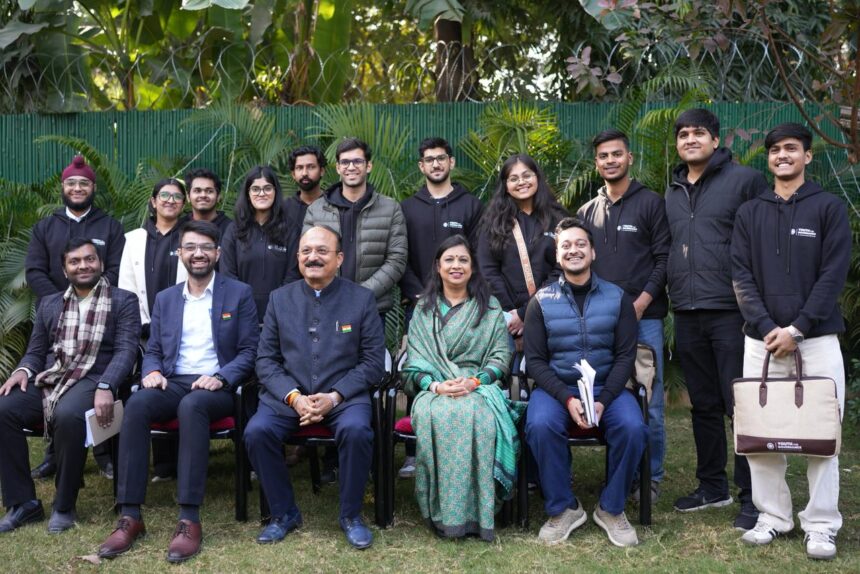
As part of the initiative, 12 fellows—referred to as the ‘Special Twelve’ or ‘Batch Zero’—have been selected from over 350 applicants through a rigorous screening process. The selected fellows come from diverse non-political backgrounds, including medical professionals and law students. Over a 12-week period, they will work closely with the Janakpuri MLA office to identify, analyse and address civic and administrative challenges.

The fellows will focus on practical, on-ground issues such as sanitation audits along Pankha Road, identification of poorly lit areas requiring street lights, mapping infrastructure gaps and assisting in grievance redressal. The emphasis, according to Sood, is on root cause analysis rather than temporary or superficial solutions.
Explaining the approach, Sood said governance often fails when authorities address symptoms instead of systemic problems. “If a water pipeline leaks repeatedly, repairing it again and again is not governance. Governance is identifying and replacing the rotten pipeline,” he said.
A key theme of the programme is what Sood described as bridging the gap between “reel life” and “real life”. While acknowledging the role of social media in communication, he stressed that real governance impact is measured on the ground. He urged the fellows to act as a human interface between citizens and the government, ensuring faster response, better coordination and measurable outcomes.
“This is not a visibility exercise,” Sood told the fellows. “It is about impact, resolution and trust. Every citizen should feel that the government is listening and responding.”
The Youth for Governance fellowship has been designed as an intensive, structured programme focusing on intelligence gathering, data-based decision-making and solution-driven governance. It is expected to serve as a model that can be replicated in other constituencies across Delhi and beyond.
Officials said the initiative aims to nurture a new generation of governance-oriented youth who understand ground realities and are committed to public service rather than political ambition. By involving young professionals directly in governance, the programme seeks to strengthen democratic participation and improve service delivery.
With the launch of Youth for Governance, the Janakpuri Assembly constituency has taken a step towards redefining the relationship between citizens and their representatives, placing service, transparency and participation at the core of governance.