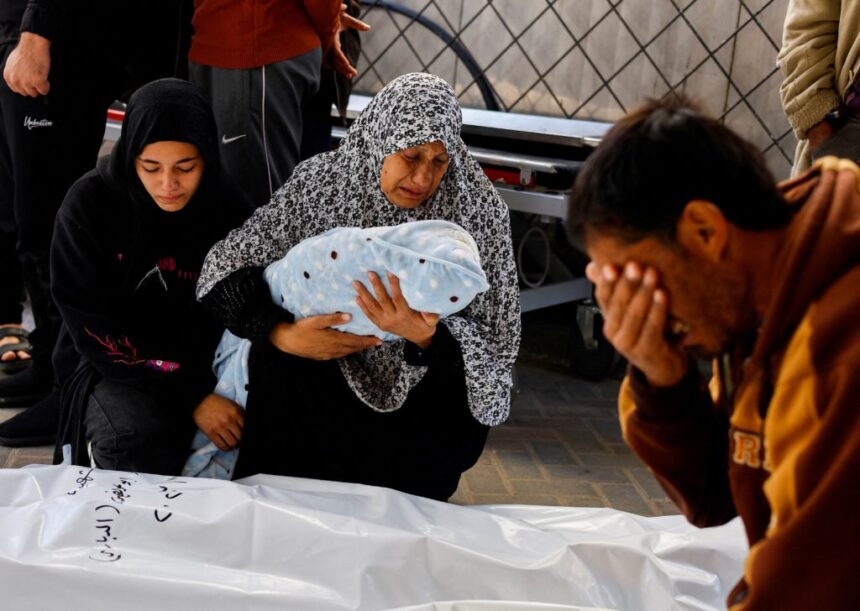
In the latest devastating round of Israeli airstrikes on Gaza, at least 49 Palestinians, including women and young children, have been killed. The tragic deaths occurred on Tuesday as part of a broader wave of violence that has claimed the lives of nearly 46,000 Palestinians since the beginning of the conflict on October 7, 2023. The strikes targeted areas where displaced families sought refuge, including tents in a designated “humanitarian safe zone” in al-Mawasi, a coastal region in southern Gaza.
According to Al Jazeera’s medical sources, Israeli bombs struck tents housing displaced families, resulting in the deaths of five children who were sheltering together. These tragic deaths have sparked outrage and calls for accountability from human rights groups and international organizations. Al-Mawasi, despite being labeled a “safe zone” by the Israeli military, has been repeatedly attacked, with the Israeli forces claiming that Hamas, the Palestinian militant group, is being targeted. However, no evidence has been provided to substantiate these claims.
Gaza’s Ministry of Health reported that in the past 24 hours alone, Israeli forces carried out three “massacres,” resulting in the deaths of 31 people and leaving 57 others wounded. The toll of death and injury continues to rise as Israel’s military operations intensify, with hospitals already overwhelmed by the sheer number of casualties. Medical workers in Gaza are warning that they are at breaking point, and humanitarian aid is increasingly becoming inaccessible as Israel restricts supplies.
At Nasser Hospital in Khan Younis, where many of the injured were brought, the heartbreaking sight of dead children, some disfigured by the violence, was a grim reminder of the toll this conflict has taken. In addition to the fatalities, many others were injured in separate attacks on cars and residential buildings in the Khan Younis area. The hospital’s morgue struggled to accommodate the bodies, which were either lying on stretchers or piled on metal shelves. A poignant image emerged of a young girl’s body, her head resting in the lap of another dead child, covered in a blanket.
The violence is compounded by a humanitarian crisis. Gaza’s hospitals are running dangerously low on supplies, especially fuel, which powers critical medical equipment. The European Hospital in Khan Younis has warned it will run out of fuel within 24 hours. Similarly, Al-Aqsa Hospital in central Gaza has announced that it will soon be forced to cut off electricity, further crippling its operations. The ongoing restrictions on fuel and supplies by Israel, along with fuel tankers being hijacked by Palestinian criminal gangs, have exacerbated the situation, with hospitals struggling to provide care to those injured in the bombings.
Meanwhile, the humanitarian situation in Gaza has worsened further as Israeli forces have been accused of targeting aid convoys. The United Nations has expressed its deep concern over these actions, with Tom Fletcher, the UN Under-Secretary-General for Humanitarian Affairs, highlighting how attempts to save lives are at risk of collapsing under the strain of deliberate disruptions. Recently, Israeli forces attacked a food distribution point operated by a partner of the UN’s World Food Programme, injuring three aid workers. In another incident, Israeli troops fired on a clearly marked UN convoy, injuring individuals who were part of the relief effort. These actions have been described as part of a dangerous pattern of sabotage against humanitarian efforts.
Human rights groups have condemned the violence and disruption, calling for a thorough investigation into these incidents. There is growing concern that aid workers and volunteers are being directly targeted, with the environment becoming increasingly unsafe for those attempting to provide much-needed assistance to the besieged population of Gaza.
The international community continues to watch with increasing alarm as Israel’s military operations in Gaza show no sign of abating. While the situation grows more dire, the humanitarian and political fallout from the ongoing violence remains unclear, with the international community urging for an immediate end to the attacks and the restoration of humanitarian aid to the region. As the death toll climbs, Gaza remains locked in a humanitarian crisis of unprecedented proportions, with no clear resolution in sight.