The Supreme Court of India has been hearing intense arguments and reviewing multiple pleas challenging the Special Intensive Revision (SIR) of electoral rolls in West Bengal, a process that has become a flashpoint of political controversy and administrative scrutiny. The legal and procedural questions surrounding the SIR have attracted national attention due to allegations of obstruction, intimidation of election officials, and claims of political interference by state authorities, including Chief Minister Mamata Banerjee. The hearings reflect the delicate balance between electoral integrity, administrative efficiency, and the rights of citizens, as well as the broader implications for democratic accountability in a politically sensitive state ahead of forthcoming elections.
Supreme Court Directives and Procedural Oversight in West Bengal SIR
During the hearings, a bench consisting of Chief Justice of India Surya Kant, Justice Joymalya Bagchi, and Justice NV Anjaria scrutinized the submissions of the Election Commission of India (ECI), state authorities, and other stakeholders involved in the SIR process. The Supreme Court passed a series of detailed directions intended to ensure that the ongoing revision exercise proceeds with transparency, fairness, and compliance with statutory obligations. The bench emphasized that the Electoral Registration Officers (EROs) and Assistant Electoral Registration Officers (AEROs) remain the ultimate authorities in decision-making regarding objections and scrutiny of documents submitted by electors. Micro-observers and state government officials were instructed to provide only assistance to the EROs and AEROs, underscoring that final authority cannot be delegated to supporting personnel or external agents.
The Court granted an extension of at least one week beyond the initially scheduled February 14 deadline to allow EROs and AEROs to complete the verification and assessment of documents. This decision was made in light of submissions that the process of scrutinizing objections and ensuring accuracy in the electoral rolls requires careful attention to prevent errors, misinterpretations, or mass exclusions of voters. The Court also addressed concerns raised about the deployment of 8,505 Group B state officers proposed to assist in the SIR process. It clarified that the officers should be trained appropriately and integrated into the process in a manner that reinforces the authority of EROs rather than superseding it.
The Court directed the West Bengal Director General of Police to file a personal affidavit addressing allegations from the ECI about the state’s failure to prevent or respond adequately to incidents of intimidation, obstruction, and interference with the SIR process. This direction aimed to ensure accountability and to assess the state’s preparedness to maintain law and order while the electoral revision is ongoing. The Supreme Court reiterated its prior order dated January 19, 2026, which had emphasized transparent verification of voters’ information, particularly in cases identified as having “logical discrepancies,” while balancing the need for procedural regularity with the protection of citizens’ rights to participate in the electoral process.
ECI Affidavit Highlights Alleged Political Interference and Obstruction
The Election Commission’s affidavit before the Supreme Court painted a stark picture of challenges encountered during the SIR exercise in West Bengal. The affidavit alleged that Chief Minister Mamata Banerjee, members of Parliament, and other political functionaries of the ruling party made public statements and delivered speeches aimed at intimidating election officials engaged in the process. The Commission emphasized that West Bengal stands out as the only state where the Central government had to intervene to provide security to the Chief Electoral Officer, a step not deemed necessary in other states undertaking similar electoral revisions.
The affidavit detailed multiple incidents of obstruction, including threats, violence, and forcible disruptions at statutory hearings. Election officials reported instances of barging into offices, destruction of official records, and burning of objection forms submitted by electors. Such actions were described as deliberate attempts to derail or frustrate the SIR process, contrary to the Court’s earlier directions. The Commission argued that these obstructions were systematic and involved complicity of state authorities, elected representatives, and party functionaries, demonstrating a coordinated effort to influence or paralyze the revision exercise.
The ECI also underscored that while the West Bengal government, in its counter affidavit, professed willingness to cooperate fully with the Commission, the ground reality was inconsistent with such assurances. The affidavit claimed repeated acts of non-cooperation and interference persisted even after the Supreme Court’s January 19 order. Specific concerns were raised about the misuse of micro-observers in the process, who were alleged to be exercising authority beyond their intended role, potentially undermining the statutory powers of EROs.
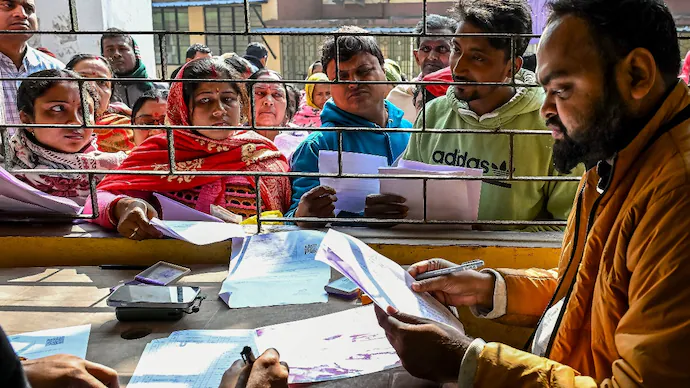
Senior counsels appearing on behalf of petitioners highlighted instances of alleged mass exclusion of voters through uniform rejection of documentation based on narrow interpretations, often disregarding legitimate proofs such as Aadhaar cards or family registers. It was argued that micro-observers were given undue influence in marking decisions, which could result in large-scale disenfranchisement if left unchecked. The Court acknowledged these submissions, emphasizing that the responsibility for final decisions must remain with the statutory authorities while micro-observers provide advisory assistance only.
The Court’s directions also addressed the logistical and procedural challenges of incorporating thousands of additional state officers into the SIR process. These officers were to be assessed for suitability, trained, and deployed under the supervision of EROs and micro-observers. The Court ensured that the process would retain transparency and accountability, particularly in scrutinizing objections raised by voters and verifying supporting documentation. This was aimed at safeguarding the electoral rights of citizens while maintaining the integrity of the SIR exercise.
The hearings also addressed technical concerns related to the software used in the SIR process, which applies restrictive criteria in sending notices to individuals with discrepancies in their details. Issues were raised about the potential for errors in age calculations, name mismatches, and assumptions regarding familial relationships. The bench noted that such tools must be applied with caution, reflecting local realities and avoiding systemic exclusion of eligible voters. Senior advocates highlighted cases where notices were erroneously sent based on automated processing, underscoring the need for careful human review and adherence to statutory principles.
The Supreme Court’s interventions have reinforced the principle that electoral processes must prioritize both procedural correctness and protection of citizen rights. The Court repeatedly emphasized that mass exclusion of voters based on rigid application of technical criteria or directives from micro-observers cannot be permitted. It underlined that any final list of voters must be the result of fair scrutiny and verification, ensuring that eligible citizens are not unjustly removed from electoral rolls.
The hearings have exposed the tension between the state government’s political stance and the Election Commission’s mandate to conduct a free, fair, and impartial revision of electoral rolls. Chief Minister Mamata Banerjee has argued that the SIR process is being used to “bulldoze” the people of West Bengal, alleging bias and selective deletions. Meanwhile, the ECI maintains that the process is conducted according to statutory norms, and any interference or obstruction undermines the principles of free and fair elections.
The Supreme Court’s engagement with the matter reflects the judiciary’s critical role in ensuring compliance with constitutional and legal obligations while safeguarding democratic processes. By scrutinizing affidavits, examining procedural irregularities, and issuing directions to maintain the authority of statutory officers, the Court seeks to prevent potential disenfranchisement and ensure that the SIR exercise is conducted transparently. The ongoing hearings underscore the complexity of electoral administration in a politically charged environment and the importance of judicial oversight in maintaining public confidence in the electoral system.
The extended timelines, clarifications on authority, and additional directives regarding the deployment of officers and micro-observers are aimed at addressing the concerns of petitioners, electors, and election authorities alike. The Supreme Court’s decisions will influence how electoral rolls are updated, the treatment of objections, and the ability of voters to participate in elections without impediment. The hearings also provide a framework for resolving disputes between state authorities and the Election Commission, highlighting the delicate balance between political considerations and statutory mandates.
As the process continues, close monitoring by the Supreme Court, coupled with detailed scrutiny of procedural compliance, aims to ensure that the Special Intensive Revision in West Bengal is completed in a manner that is both legally sound and constitutionally valid. The outcomes of the hearings have far-reaching implications for electoral integrity, governance accountability, and the protection of citizens’ democratic rights in West Bengal.