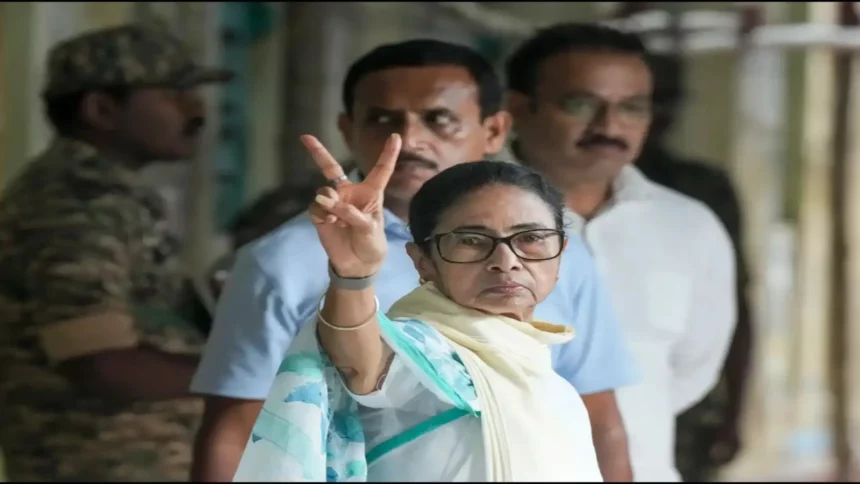
West Bengal’s high stakes Assembly election entered a dramatic and politically volatile stage as Trinamool Congress supremo and Chief Minister Mamata Banerjee personally visited the Bhabanipur counting centre in Kolkata on the eve of vote counting, raising serious concerns over alleged irregularities involving Electronic Voting Machines. The unexpected intervention by Banerjee, combined with simultaneous protests by senior TMC leaders outside multiple strongrooms, has sharply heightened tensions in one of India’s most politically significant electoral battlegrounds.
As counting preparations intensified, Kolkata witnessed scenes of extraordinary political mobilization, administrative scrutiny and growing allegations of procedural violations. Mamata Banerjee’s arrival at the Sakhawat Memorial School strongroom in Bhabanipur despite severe rainfall sent an unmistakable political signal regarding the Trinamool Congress leadership’s concerns over the integrity of stored voting machines.
Bhabanipur carries exceptional symbolic and strategic importance for Mamata Banerjee, making her direct physical presence at the strongroom highly consequential. Reports indicate that Banerjee remained within the premises alongside her designated election agent, invoking her legal rights as a candidate to inspect the secure storage facility where Electronic Voting Machines were being held before official counting.
Her visit occurred amid increasing accusations from Trinamool Congress representatives that suspicious movements and administrative irregularities had taken place inside select strongrooms across Kolkata.
In north Kolkata, another major political flashpoint emerged outside the Khudiram Anushilan Kendra strongroom where senior TMC candidates Kunal Ghosh and Shashi Panja staged an immediate sit in protest. Their demonstration followed allegations that party workers assigned to monitor strongroom security had been instructed to vacate the premises earlier in the day, only to later learn through email communication that the strongroom would be reopened at 4 pm.
This sequence of events triggered alarm within the Trinamool Congress, with leaders questioning why all political stakeholders were not formally informed before any reopening of highly sensitive electoral facilities.
Kunal Ghosh publicly alleged discrepancies, claiming that visual evidence suggested movement of ballot related materials within the premises while party representatives were denied access. He accused authorities of failing to provide clear explanations regarding these activities and questioned whether procedural transparency had been compromised.
Shashi Panja similarly emphasized that strongrooms housing Electronic Voting Machines represent one of the most sensitive components of democratic infrastructure and argued that any procedural activity without universal political notification was unacceptable.
The protests quickly escalated into a politically charged confrontation as security personnel reportedly prevented certain party representatives from entering restricted areas while maintaining strict control over access.
Kolkata Mayor and TMC candidate Firhad Hakim also reached the Bhabanipur counting centre following reports of Banerjee’s presence. However, Hakim later stated that he was unable to directly assess internal developments due to security restrictions, further contributing to uncertainty.
These developments have significantly intensified political suspense across West Bengal ahead of vote counting.
The state’s electoral politics have long been characterized by fierce competition, ideological polarization and emotionally charged voter mobilization. However, allegations surrounding Electronic Voting Machine security elevate the stakes considerably because they directly impact public trust in democratic institutions.
For the Trinamool Congress, raising concerns over strongroom integrity serves multiple strategic purposes. It projects vigilance, mobilizes party workers, reassures supporters and publicly challenges the Election Commission to maintain full transparency.
For Mamata Banerjee personally, the decision to physically inspect the strongroom reinforces her image as an actively engaged leader unwilling to delegate matters of electoral security.
The Bharatiya Janata Party, as the principal opposition force, may interpret TMC’s actions differently, potentially viewing them either as legitimate democratic oversight or as preemptive political positioning.
Regardless of partisan interpretations, the Election Commission and associated administrative bodies now face extraordinary pressure to preserve institutional credibility through impeccable procedural management.
Strongrooms storing Electronic Voting Machines are governed by strict security frameworks that typically include sealed access points, round the clock surveillance, candidate representative oversight and highly regulated administrative protocols.
Any perception of deviation from these standards can rapidly generate widespread controversy.
The broader implications extend well beyond West Bengal’s immediate electoral outcome. Public confidence in election integrity is foundational to democratic legitimacy.
Allegations of irregularities, whether substantiated or not, possess the power to influence political narratives, voter trust and post election stability.
As counting day approaches, security deployment around strongrooms has reportedly been intensified to prevent escalation and maintain order.
Political analysts note that such protests also carry symbolic significance. By publicly demonstrating vigilance outside strongrooms, political parties shape public discourse, reinforce accountability narratives and potentially influence perceptions of institutional transparency.
West Bengal’s elections often serve as a microcosm of broader democratic dynamics within India, where electoral competition is both intensely local and nationally significant.
The events unfolding in Kolkata highlight how electoral administration, political strategy and democratic legitimacy increasingly intersect under conditions of heightened polarization.
If counting proceeds smoothly under transparent conditions, authorities may succeed in containing the controversy.
However, any procedural ambiguity or disputed result could significantly amplify tensions.
For Mamata Banerjee and the Trinamool Congress, the stakes remain exceptionally high as electoral performance will influence both state governance and broader national political positioning.
For voters, these developments underscore the importance of institutional trust and electoral safeguards.
As one of the world’s largest democracies, India’s electoral systems rely heavily on public confidence, administrative rigor and political accountability.
West Bengal’s current election drama serves as a potent reminder that democratic processes require not only voting but also transparent stewardship of every stage thereafter.
The dramatic scenes surrounding Kolkata’s strongrooms have already become defining moments of the 2026 West Bengal Assembly elections.
They represent the collision of political ambition, democratic vigilance and institutional responsibility at a critical historical moment.
As counting begins, the state remains under intense national scrutiny.
Whether these allegations evolve into deeper institutional controversy or are resolved through transparent procedures will shape both immediate political outcomes and broader perceptions of democratic resilience in India.
For now, West Bengal stands at the center of a deeply consequential political chapter where every administrative action, security protocol and political response may influence the course of one of India’s most significant state elections.