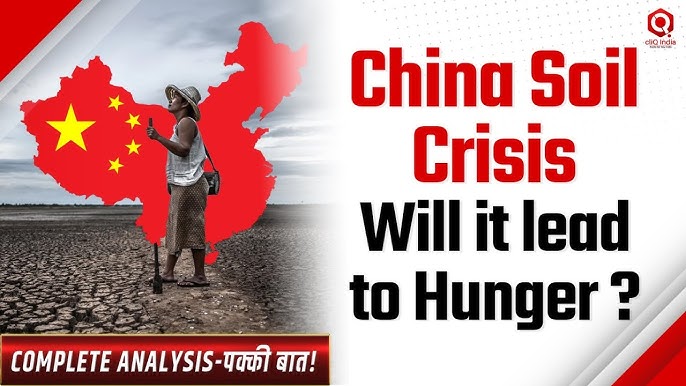
China, the world’s largest manufacturing hub, now faces an alarming soil degradation crisis, threatening its agricultural output and food security. With over 78% of its farmland degraded, the country is struggling to meet its self-sufficiency goals and feed its massive population. Experts fear this could lead to a ripple effect on global food prices.
The Policy Failures Behind the Crisis
China’s soil crisis isn’t merely a natural disaster—it’s a consequence of flawed policies and poor planning.
- Urbanization Over Farmland:
Urban expansion grew by over 500% between 1998 and 2024, often swallowing fertile farmland for industrial and residential development. - Unregulated Industrialization:
Factories near farming areas contaminated the soil with heavy metals, rendering 19.4% of farmland unfit for agriculture. - Overuse of Fertilizers:
Heavy subsidies for chemical fertilizers led to their overuse, which depleted soil fertility and caused acidification. - Sustainability Neglected:
Programs like Grain-for-Green, initially designed to combat soil erosion, fell victim to poor execution and short-term planning. - Lack of Monitoring:
With no strong mechanism to monitor soil health, up to 70% of soil degradation reports were suppressed by the government to avoid public panic.
Ghostly Farmlands: The Current State of Agriculture
China’s farmlands are under severe stress.
- Extent of Damage:
Nearly 78% of farmland and 90% of grasslands are affected by erosion, pollution, and overuse of chemicals. - Soil Pollution:
Over 16% of agricultural land surpasses pollution safety limits, creating health hazards through contaminated crops. - Unsustainable Practices:
Excessive nitrogen-based fertilizers have acidified the soil, making it unproductive.
Farmers, already burdened by debt, are left with barren lands and reduced yields, further jeopardizing their livelihoods.
The Hidden Link: Ghost Cities and Soil Degradation
China’s infamous “ghost cities” play a key role in its soil crisis.
- Construction Over Farmland:
Urbanization projects like Ordos and Tianducheng were built over fertile farmlands, leaving millions of homes vacant but the land unusable. - Water Mismanagement:
Urban development diverted water away from agriculture, increasing salinity levels in northern farmlands.
This development-at-any-cost approach has accelerated environmental destruction, turning agricultural resources into wastelands.
The Global Consequences of Soil Degradation
The impact of China’s soil crisis stretches beyond its borders.
- Food Security at Risk:
China’s target of achieving 92% self-sufficiency in food production by 2033 now seems unattainable. - Economic Fallout:
Farmers face declining incomes and rising debt, while developers like Evergrande are grappling with land-related financial crises. - Global Ripple Effects:
As the world’s largest agricultural importer, China’s inability to stabilize its soil health could lead to global food price hikes, affecting millions worldwide.
Solutions: The Way Forward
China must act swiftly to address its soil degradation crisis.
- Policy Reforms:
Revisit agricultural subsidies and urbanization policies, following sustainable models like Europe’s Common Agricultural Policy. - Technological Innovations:
Use AI-driven sensors and satellite imaging to monitor and improve soil health. - Public-Private Collaboration:
Industries must adopt sustainable practices to manage pollutants, while supporting farming communities. - Global Lessons:
India’s Soil Health Card Scheme is an example of proactive measures that ensure soil fertility and sustainability.
A Global Warning
China’s soil crisis is a wake-up call for the world, emphasizing the need to balance development with sustainability. If left unaddressed, this issue could disrupt not only China’s food supply but also the global food chain.
The question is no longer just about China—it’s about whether the world is prepared to heed this warning and act.
Watch full video here: https://www.youtube.com/watch?v=9LUjqT2Xn3Y