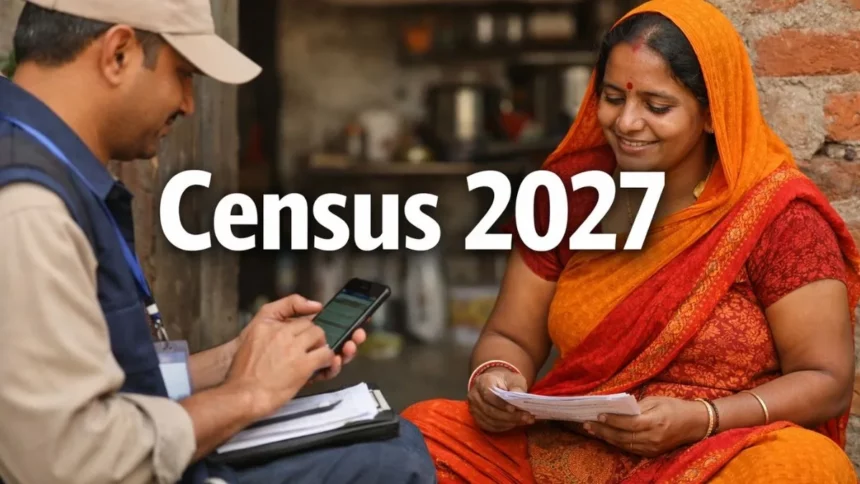
Rajasthan has officially launched the first phase of Census 2027 from May 1, 2026, marking the beginning of one of India’s most significant demographic data collection exercises. The process introduces a hybrid model that combines digital self enumeration with traditional door-to-door household verification, aiming to improve accuracy, transparency and citizen participation in the nationwide census framework.
The initiative represents a major shift in India’s census methodology, integrating technology-driven data submission with field-level validation. Under this system, residents of Rajasthan will be able to voluntarily submit their household information online through an official census portal from May 1 to May 15, 2026. This will be followed by physical verification conducted by trained enumerators between May 16 and June 14, 2026.
The Census 2027 exercise is not limited to population counting. It is a comprehensive socio-economic data collection process that will play a crucial role in shaping future policy decisions, welfare distribution, infrastructure planning, and resource allocation at both state and national levels.
Officials have highlighted that accurate census data is essential for understanding demographic patterns, housing conditions, education levels, employment structures, migration trends, and access to essential public services. The integration of digital self enumeration is expected to modernize this process while reducing data gaps and improving efficiency.
Digital self enumeration marks shift toward citizen-driven data collection
For the first time on such a scale, Rajasthan residents will be able to directly participate in the census through a digital self enumeration system. Using smartphones, tablets, or computers, households can submit detailed information regarding their living conditions, household composition, housing structure, and access to basic amenities.
The system is designed to make participation more convenient while allowing individuals to review and verify their own information before submission. Once the data is submitted successfully, each household will receive a unique reference identification number, which will later be used by census officials during field verification.
This approach is expected to reduce dependency on manual data entry at the initial stage and improve overall data accuracy. Authorities believe that when citizens themselves provide verified inputs, the likelihood of errors and omissions decreases significantly.
However, officials have also clarified that digital submission does not replace physical verification. Door-to-door enumeration remains a mandatory part of the process to ensure complete coverage, particularly in rural areas, remote regions, and among populations with limited digital access.
From May 16 onward, nearly 1.60 lakh enumerators and supervisors will be deployed across Rajasthan to conduct household surveys. These field workers will use mobile-based applications and digital tools to collect and verify data, ensuring real-time updating and minimizing manual errors.
Large-scale field survey to strengthen data accuracy and governance planning
The second phase of the census involves an extensive door-to-door survey, where enumerators will physically visit households across urban, rural, tribal, and desert regions of Rajasthan. Given the state’s geographical diversity and population distribution, this phase plays a critical role in ensuring that no household is excluded from the national dataset.
Enumerators will collect detailed information on housing conditions, household size, access to water and sanitation, electricity usage, fuel sources, digital connectivity, and other infrastructure-related indicators. This data will help build a comprehensive picture of living standards across the state.
Such information is vital for government planning and policymaking. It directly influences decisions related to housing schemes, healthcare infrastructure, education facilities, urban development projects, and social welfare programs. Accurate census data ensures that government resources are distributed more equitably and targeted toward regions with greater developmental needs.
Rajasthan’s unique demographic structure, which includes densely populated urban centers, remote rural villages, tribal regions, and desert settlements, makes this exercise particularly significant. The data collected will help identify regional disparities and support more balanced development strategies.
State authorities have urged citizens to actively participate in both phases of the census. Public awareness campaigns have been launched to encourage households to complete self enumeration accurately and cooperate fully with field officials during verification.
Officials have also emphasized that participation in the census is a civic responsibility. The data collected will directly influence future governance decisions, including infrastructure development, welfare distribution, and policy formulation.
Residents have been cautioned to remain vigilant against fraud or misinformation during the digital process. Authorities have clearly stated that census participation is free of cost and no payments are required at any stage. Citizens have been advised to use only official government platforms for self enumeration.
Beyond its administrative function, Census 2027 carries significant national importance. Census data forms the foundation for multiple governance and policy frameworks in India, including welfare scheme design, infrastructure allocation, political representation, delimitation processes, economic planning, and public health strategies.
In Rajasthan, where socio-economic conditions vary widely across districts, updated census data will play a key role in identifying development gaps and guiding targeted interventions. It will also help improve the efficiency of government programs by ensuring better targeting of beneficiaries.
The introduction of digital self enumeration reflects India’s broader transition toward technology-driven governance. By incorporating online data submission, mobile-based verification tools, and digital databases, the census process is becoming more efficient, transparent, and participatory.
Experts believe that this hybrid model of digital and physical data collection represents the future of large-scale administrative exercises in India. It combines the speed and convenience of technology with the reliability of field verification.
For citizens, the census is more than just a data collection exercise. It ensures that households are accurately represented in official records, which can influence access to government schemes, local development projects, and resource allocation decisions in the future.
Reliable census data is also essential for long-term planning. It helps policymakers understand migration trends, urbanization patterns, literacy rates, employment structures, and social inequalities. This information is critical for designing sustainable development policies.
As Rajasthan begins this ambitious exercise, the state is positioning itself at the forefront of India’s digital governance transformation. If successfully implemented, the model could serve as a reference for other states in future census operations.
The success of Census 2027 will depend on a combination of factors, including public participation, administrative efficiency, digital accessibility, and field-level coordination. Strong execution will ensure that the final dataset is accurate, inclusive, and representative of the state’s entire population.
The launch of the first phase on May 1 marks an important milestone in India’s demographic planning system. It reflects a broader shift toward modern, data-driven governance where citizen participation and technology work together to improve accuracy and efficiency.
As the process unfolds over the coming weeks, Rajasthan’s experience will likely play a significant role in shaping the future direction of India’s census methodology and its approach to large-scale national data collection.