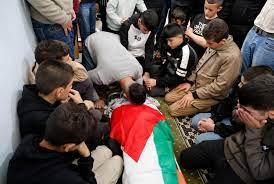
Israeli forces killed two Palestinian teenagers during an overnight raid near Ramallah, adding to a surge of violence across the Israeli-occupied West Bank in recent weeks. The killings occurred despite the ceasefire that halted the Gaza war on 10 October, highlighting the widening unrest in the territory where Palestinians face tightening restrictions, escalating settler attacks and increasing military operations. The deaths of the two boys, both under 18, underscore the growing fragility of the situation and the deepening tensions between Israeli forces, settlers and Palestinian communities.
Overnight raid in Kfar Aqab leaves two teenagers dead as Israeli forces cite immediate threat amid disputed accounts
Residents of Kfar Aqab, a town near Ramallah, said that Israeli forces entered the area overnight, stationing troops on streets and rooftops before opening fire. Sixteen-year-old Sami Ibrahim Mashaikha and eighteen-year-old Amr Khaled al-Marboua later died of their wounds, according to the Palestinian health ministry of the Palestinian Authority. Witnesses described the raid as intense and sudden, with troops firing heavily as they moved through the neighbourhood.
Israeli police said in a statement that officers fired at four individuals who they claimed posed an immediate threat during the operation. Medical teams, they said, evacuated all four people from the scene. According to police, the operation targeted “hostile elements seeking to harm security forces and provoke violent disorder” in the area. They reported coming under attack from stone-throwing and fireworks, which they said escalated the situation. Heavy gunfire was also heard, though Israeli authorities did not identify its source.
The Palestinian WAFA news agency reported that Israeli units had surrounded buildings and positioned snipers atop structures as they moved into Kfar Aqab. Residents said that the boys were shot at close range, though these accounts could not be independently verified. Tension in the area was already high as the town has seen repeated raids in recent months.
The violence in Kfar Aqab comes at a time when the West Bank is experiencing one of its most unstable periods in years. Although the Gaza fighting has subsided following the ceasefire, the West Bank continues to witness regular raids, arrests and deadly confrontations between Israeli forces and local Palestinian youths. Israeli restrictions have intensified over the past two years, severely limiting Palestinian movement and increasing friction across the territory.
Recent weeks have also seen a rise in settler attacks on Palestinian villages. Overnight, according to residents, Israeli settlers targeted communities near Nablus, setting fire to properties in Huwara and Abu Falah. These attacks have become more frequent, emboldened by the security environment and the political climate. Videos circulating online show groups of settlers, some armed with clubs and firearms, attacking Palestinian homes and cars with little intervention from security forces.
The Israeli military said its soldiers responded to reports that Israeli civilians were throwing stones at Palestinian vehicles and setting property ablaze in the Huwara area. Troops searched the area overnight but found no suspects, the military said. The statement did not explain how widespread the attacks were or whether soldiers attempted to stop settlers involved in the violence.
Israel’s Prime Minister Benjamin Netanyahu said earlier in the week that he would meet cabinet ministers to ensure accountability for Israelis who carry out attacks against Palestinians. He described those responsible as a “small, extremist group” whose actions undermine the rule of law. However, critics argue that settler violence has increased in scale and coordination, and that statements from officials have not been matched with meaningful prosecutions.
Escalating casualties raise concerns as minors increasingly caught in violence and tensions surge despite Gaza ceasefire
The deaths of Sami Mashaikha and Amr al-Marboua add to a growing number of Palestinian minors killed by Israeli forces in the West Bank this month. According to compiled figures, at least six Palestinians under the age of eighteen have been killed so far in November. Military officials say the youths were involved in confrontations or attacks, while Palestinian communities say that many minors are victims of indiscriminate or excessive force.
In one recent incident near Ramallah, Israeli forces shot two sixteen-year-olds who, according to the military, had thrown petrol bombs at a civilian road. The military released a nine-second grainy video that it said showed the teenagers throwing the bombs. It did not provide the full footage or explain why soldiers chose to open fire rather than make arrests. Reuters was unable to verify the military’s claims from the short video.
Earlier this week, West Bank tensions increased further when Palestinian attackers killed an Israeli man and injured three others in a car-ramming and stabbing attack before being shot dead by Israeli forces. The attack added to fears that violence from the Gaza conflict could spill over into the West Bank and ignite a broader wave of unrest.
The West Bank has long been at the heart of tensions between Palestinians and Israeli authorities, but conditions have worsened significantly in the past two years. Palestinian residents report tightened checkpoints, more road closures, increased raids and growing settler aggression. Combined, these pressures have severely restricted movement, disrupted livelihoods and led to almost daily clashes.
Meanwhile, families of the two boys killed in Kfar Aqab are preparing for funerals amid rising grief and anger. Images from Ramallah showed relatives mourning over bodies wrapped for burial, a stark reminder of the toll the conflict continues to take on young Palestinians. Community leaders say the deaths reflect the broader escalation and warn that continued violence will fuel further despair and instability.
The surge in violence comes despite international calls for de-escalation following the October ceasefire. Aid organisations and rights groups note that while the bombs may have stopped falling in Gaza, the situation in the West Bank remains volatile. They warn that without meaningful steps to reduce tensions, improve civilian protection and halt settler attacks, the region risks entering a prolonged cycle of bloodshed.
Throughout the territory, fear and uncertainty are pervasive. Many Palestinians say they feel trapped between militarised settlers and increasingly aggressive Israeli operations. With no political horizon in sight and community tensions rising, the deaths of teenagers like Sami and Amr highlight a deeply troubling trend and a dangerous moment for the region.