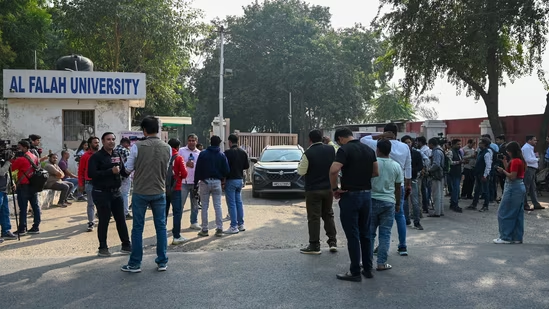
The investigation into last week’s devastating blast near Delhi’s Red Fort has widened dramatically, placing Faridabad-based Al Falah University under intense national scrutiny. What began as a terror probe into the deadly explosion that claimed more than ten lives has evolved into a multi-layered investigation exposing intersections between extremist networks, academic institutions, financial irregularities and a network of suspects linked through their association with Al Falah’s medical faculty. The Enforcement Directorate’s arrest of the university’s chairman, Jawad Ahmad Siddiqui, in an ongoing money-laundering probe has further deepened concerns about the university’s management, its accreditation practices and the role of individuals connected to it who are now under investigation for their alleged involvement in the Delhi blast conspiracy.
The overlapping investigations—covering terrorism, academic fraud, financial misappropriation and misuse of accreditation claims—have raised difficult questions about institutional oversight, governance structures and the vulnerabilities that may have allowed radicalised individuals to operate within spaces expected to nurture professional talent. What appeared, on the surface, to be unrelated developments—the recovery of explosives in Faridabad, the Red Fort blast and financial scrutiny of the university—now seem increasingly connected through a web of individuals whose academic, professional or administrative ties link back to the university’s internal network.
A Growing Web of Links Between Suspected Blast Perpetrators and Al Falah University
As multiple agencies dissect the chain of events leading to the Red Fort explosion, one institution repeatedly appears at the centre of the narrative: Al Falah University, a private educational establishment that includes a medical college where several of the arrested doctors worked or studied. The turning point in the investigation came when authorities discovered a major explosives haul at the rented residence of Dr Muzammil Shakil in Faridabad’s Dauj village. Muzammil, originally from Kashmir, had been teaching at Al Falah University, raising early questions about whether the campus environment had been exploited by individuals with extremist inclinations.
Soon after, the identity of the Red Fort suicide bomber was confirmed as Dr Umar Un Nabi, another medical professional associated with the university. Nabi, who drove the explosives-laden Hyundai i20 into the vicinity of the Red Fort, died in the blast. Forensic examination of DNA samples recovered from the site matched with those collected from his family, establishing his presence beyond dispute. The confirmation triggered a cascade of detentions, raids and interrogations across multiple states, as investigators pieced together how young medical professionals, all linked through Al Falah University, had come to be involved in a plot reminiscent of the Pulwama-style vehicle-borne suicide attack of 2019.
Umar, Muzammil and several others who have now been detained form part of what officials are calling a “white-collar terror module” made up of educated individuals with stable professional backgrounds. Their involvement challenges dominant perceptions about recruitment patterns in extremist networks and highlights the potential impact of ideological indoctrination within environments that have traditionally been considered insulated from such influences.
Investigators have revealed that several doctors connected to the blast suspects either studied or taught at Al Falah University. Apart from Muzammil and Umar, two other individuals—Dr Shaheen Shahid and Dr Adeel Rather—have been arrested for their suspected role in the conspiracy. Another doctor, identified as Dr Muzaffar Rather, brother of Adeel, is believed to be in Afghanistan and is suspected of playing a larger coordinating role within the extremist network.
One more individual who remains missing is Dr Nissar ul-Hassan, who reportedly worked with several of the arrested doctors at the university’s medical college. His disappearance has intensified suspicions that this group may have been operating with substantial ideological alignment and possibly external direction. Investigators believe Hassan may possess information about the formative stages of the network, including potential handlers, funding sources and the ideological content that shaped the group’s activities.
These interconnected arrests reveal an alarming pattern: the university’s medical ecosystem appears to have been used, knowingly or unknowingly, as a space where radicalised young professionals interacted, planned and supported logistical elements of the terror plot. This nexus of academic affiliation and extremist activity has placed the institution at the heart of the expanding investigation.
Financial Irregularities, NAAC Accreditation Fraud and the Arrest of Chairman Jawad Ahmad Siddiqui
While the terror probe was accelerating, the Enforcement Directorate was simultaneously conducting a separate investigation into Al Falah University’s financial practices. What began as a routine examination of institutional claims soon escalated into a full-scale money-laundering probe under the Prevention of Money Laundering Act (PMLA), culminating in the arrest of the university’s chairman, Jawad Ahmad Siddiqui.
The ED’s probe was initiated after two FIRs by the Delhi Police’s Crime Branch accused the university of making fraudulent and misleading claims about having earned the prestigious NAAC accreditation. Investigators allege that these claims were used to mislead students, parents and other stakeholders into believing the university met nationally mandated quality standards, thereby enabling the institution to attract larger admissions and financial inflows.
The ED stated that its financial investigation revealed “large amounts of proceeds of crime” being generated through the alleged fraudulent accreditation practices. Officials claim crores of rupees were diverted from the university’s trust to family-owned entities operated by Siddiqui’s wife and children. The funds, according to the agency, were moved through a network of companies that displayed “classic red flags of shell entities,” including common addresses, overlapping directors, negligible operations and suspicious financial flows.
During searches conducted across multiple premises linked to the Al Falah group, the ED seized ₹48 lakh in cash, digital devices, financial records and a host of documents believed to demonstrate detailed financial diversion. Investigators noted that several construction, catering and service contracts were repeatedly awarded to entities connected to Siddiqui’s immediate family members, despite their limited operational capacities.
A senior ED official informed investigators that the Al-Falah Trust, established in 1995, expanded rapidly under Siddiqui’s control. However, discrepancies in financial records suggest that the institution’s income and expenditure statements do not align with the scale of its growth, prompting deeper questions about how funds were mobilised and where they were ultimately routed.
The ED is now examining nine linked companies, all registered to a single address, which appear central to the alleged financial misappropriation. These companies, investigators say, had minimal staff, negligible utility consumption, identical contact details and no physical operations, characteristics commonly associated with shell firms used to launder money.
In addition, the absence of payroll records, employee provident fund contributions and statutory compliance filings further reinforced the ED’s suspicion that salary payments and other operational expenses were artificially manipulated to mask the outflow of diverted funds.
The convergence of these financial findings with the parallel terror probe has deepened the complexity of the investigation. Though officials have not publicly established a direct financial link between the alleged terror module and the university’s irregularities, the overlapping networks of individuals and the discovery of explosives tied to university staff have raised serious concerns about the governance failures that may have enabled such developments.
As the ED continues its financial scrutiny and the NIA, Delhi Police and other agencies advance their investigation into the Red Fort blast, Al Falah University faces a deepening crisis. It now stands at the intersection of one of the most significant terror investigations of recent years and a widening probe into institutional malpractice, raising broader questions about regulatory mechanisms, campus oversight and the potential exploitation of academic spaces by radicalised individuals.