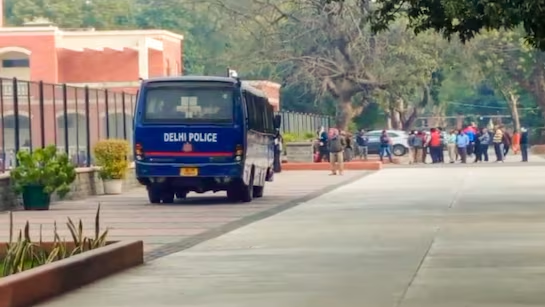
In a chilling reminder of the fragile sense of security in the nation’s capital, over 50 schools across Delhi were thrown into panic on Friday morning after receiving bomb threat emails, triggering massive searches and evacuations. Parents rushed to pick up their children, streets near schools were choked with anxious families, and children were seen waiting outside buildings as bomb squads and sniffer dogs combed through classrooms and libraries. This was not an isolated incident; it followed a disturbing pattern of similar threats over the week, with hoax mails sent to schools and even colleges, igniting concerns about the safety protocols in the capital and the emotional trauma inflicted upon children, parents, and staff.
Hoax Emails Spark Chaos Across Schools
According to officials familiar with the matter, several prominent schools including St Xavier’s in Civil Lines, Richmond Global School in Paschim Vihar, Abhinav Public School in Rohini, and The Sovereign School in Rohini were among those to receive threat emails. These emails, often vague but menacing, claimed that bombs had been planted on campuses and would be detonated within hours, prompting immediate search operations by the Delhi Police and bomb disposal squads.
The Friday scare was the latest in a series of bomb threats that have gripped the capital this week. On Wednesday, at least seven schools received similar emails, marking the third consecutive day of such hoaxes. A day earlier, two of Delhi’s prominent institutions, St Stephen’s College in North Campus and St Thomas School in Dwarka, were targeted with threat emails, prompting intense security checks and partial evacuations.
In the email received by St Stephen’s College on Tuesday around 7:15 am, the sender claimed that four improvised explosive devices (IEDs) and two packets of RDX were planted in different areas on the campus, including the library, with a warning that the bombs would explode by 2 pm. Police teams immediately cordoned off the area, conducted searches with sniffer dogs, and thoroughly scanned the premises, but no explosives were found.
Authorities confirmed that similar bomb threats sent to three other schools on Monday also turned out to be hoaxes, but each incident caused disruption, panic, and fear among students and parents, with many hesitant to send their children back to schools the following days.
12-Year-Old Traced in Earlier Threat
In a significant development, Delhi Police on Wednesday traced one of the threat emails to a 12-year-old boy from south Delhi. Investigators revealed that the boy, a student of a private school, had used his personal mobile phone to send the hoax email as a prank. “He was questioned, counselled, and sent home. The boy said it was a prank, and he is undergoing treatment for a mental health condition,” a senior police officer stated, underlining the complexity of handling such threats when minors are involved.
While this case was identified and defused, it raised critical questions about online safety, digital supervision of children, and the need for robust cyber vigilance in educational environments, especially as children increasingly access technology unsupervised.
Political Blame Game Over Security Lapses
The repeated incidents have led to sharp political criticism, with former Delhi chief minister and AAP leader Atishi attacking the Bharatiya Janata Party (BJP) government over its handling of security in the national capital. “More than 20 schools have received bomb threats today! Think of the trauma that children, parents, and teachers would be going through. BJP controls all four engines of governance in Delhi, and yet it is not able to provide any safety or security to our children! Shocking!” she posted on social media, reflecting the frustration of many parents in the city.
The BJP has yet to issue a detailed statement on the multiple hoax threats, but police sources indicated that cyber units have been roped in to trace the origin of the recent wave of emails to determine whether these are isolated pranks or part of a coordinated attempt to disrupt educational institutions.
Meanwhile, security at schools has been stepped up, with principals and staff receiving advisories on vigilance and emergency response protocols to minimize panic and maintain order if further threats occur.
Schools Grapple With Uncertainty
Beyond the immediate fear of the threats, the week’s events have deeply unsettled parents and students, with many parents expressing concern over the emotional toll these repeated hoaxes are taking on children. Several parents reported that their children were scared to return to school, while teachers highlighted the challenges of maintaining a sense of normalcy amid sudden evacuations and police searches.
Security experts have emphasized the need for a clear communication strategy in schools, ensuring that children are informed in age-appropriate language while maintaining calm during such emergencies. Simultaneously, they stressed the importance of cyber monitoring to detect and prevent such hoax emails at the earliest to avoid mass disruptions.
Amid the continuing investigation, the repeated incidents have highlighted the vulnerabilities in Delhi’s preparedness to handle such threats, the gaps in cyber monitoring of digital communication systems, and the need to balance security with sensitivity in educational spaces that are meant to remain sanctuaries for learning.