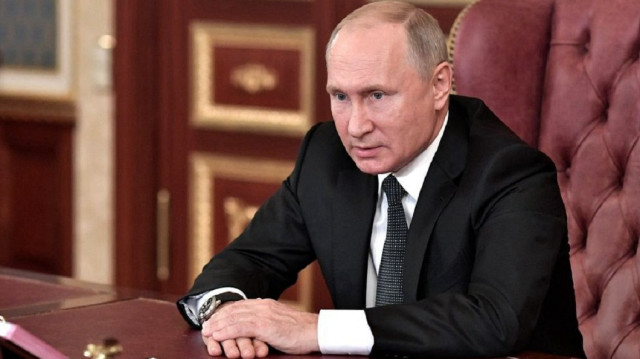
The global political landscape is once again in the spotlight after Russian President Vladimir Putin delivered a pointed message during his latest public address following a state visit to China. Speaking to journalists after a four-day trip, Vladimir Putin called for the dismantling of what he described as an “outdated and unfair unipolar world order,” insisting that international politics and security can no longer be shaped by the dominance of a single nation. Instead, he emphasised that the future lies in a multipolar system, where emerging economic powers such as India and China, along with Russia, play an equally important role in shaping the rules of global engagement. His remarks, which carried undertones of criticism towards Western nations and in particular the United States under President Donald Trump, also touched on the economic uncertainties faced by countries like India as a result of Washington’s tariff and sanction policies.
Vladimir Putin calls for an end to unipolarity and rise of multipolar equality
In his address, Vladimir Putin asserted that the notion of a unipolar world, long dominated by the influence of the United States since the end of the Cold War, has lost legitimacy in the twenty-first century. He noted that major economies such as India, China, and Russia have grown in strength, both in terms of purchasing power parity and political influence, and therefore can no longer be sidelined in shaping the global order. “Everyone has equal rights in this multipolar world,” Vladimir Putin declared, pointing out that the mere presence of large economies should not translate into political dominance or an attempt to dictate terms in matters of global security. He specifically underlined that equality in international relations requires not just the recognition of economic clout but also respect for sovereignty and diversity of interests.
The Russian President was particularly blunt in his critique of the “unipolar model,” describing it as both unfair and outdated. “A unipolar world is unfair. It’s obvious. The world must be multipolar, which means all actors in international relations must be equal, and there must be no one more equal than the others,” he said. These remarks, although general in tone, carried a strong undercurrent of disapproval directed at the West, which Moscow accuses of using sanctions, tariffs, and military alliances as tools of control. Vladimir Putin’s comments also resonated with broader conversations taking place within international forums such as BRICS and the Shanghai Cooperation Organisation, which have consistently pitched themselves as platforms advocating fairness, cooperation, and resistance to unilateral dominance.
By framing his argument around multipolarity, Vladimir Putin sought to present Russia not merely as a challenger to Western power but as a partner in building a more equitable international system. He stressed that such a system must avoid replacing one hegemony with another. “This new multipolar world should not have any hegemons. No one is speaking about this, not in BRICS, not in the SCO,” he said, underlining that the intent is to build balance rather than perpetuate hierarchy.
His comments reflected both strategic calculation and political messaging. For Moscow, which has faced mounting Western sanctions since its invasion of Ukraine, the promotion of multipolarity is not only a matter of principle but also a practical necessity. With Western markets and financial systems largely closed to Russian businesses, partnerships with countries like China and India have become lifelines. By elevating them in his speech as “giants” of the global economy, Vladimir Putin was also signalling his commitment to strengthening these relationships as part of Russia’s long-term pivot to Asia.
India, China, and Russia in focus amid US tariffs and global tensions
Vladimir Putin’s comments arrive at a time of deepening economic friction between Washington and New Delhi, further complicating the triangular relations involving Russia, India, and the United States. The Russian leader specifically mentioned India as a rising giant in the global economy, highlighting its expanding role in purchasing power parity rankings, where it now stands alongside China and Russia in the top four. By referencing India, Vladimir Putin not only acknowledged its growing global weight but also positioned it as a key partner in countering unilateral tendencies from Western powers.
India’s own economic position has been complicated in recent months by the tariff measures imposed by the Donald Trump administration. Washington’s decision to levy a fifty per cent tariff on Indian imports, alongside an additional twenty-five per cent linked to New Delhi’s continued purchase of Russian crude oil, has created new uncertainties for the Indian economy. For a country already navigating inflationary pressures and currency volatility, such steep tariff barriers present both political and economic challenges. Vladimir Putin’s remarks about equality in the multipolar order can therefore be read as an implicit reassurance to New Delhi, offering Russia’s support in opposing the unilateral dictates of Washington.
China, meanwhile, was the immediate backdrop for Vladimir Putin’s speech. His four-day visit to the country was described as “very positive” by the Russian President, with agreements signed between Moscow and Beijing characterised as “forward-looking.” The symbolism of delivering his multipolar message after such a trip cannot be ignored. Russia and China, though historically cautious of one another, have found renewed strategic alignment in recent years, particularly in their shared opposition to Western dominance in global institutions, finance, and security frameworks. Beijing has long pushed for a world order that recognises multiple centres of power, and Vladimir Putin’s speech from Chinese soil effectively reinforced this narrative, presenting Moscow and Beijing as aligned in principle and policy.
The emphasis on India, however, shows Moscow’s intent to keep its ties with New Delhi strong, even as New Delhi balances its relationships with the West. Vladimir Putin recalled his informal conversation with Indian Prime Minister Narendra Modi during their car ride from the Shanghai Cooperation Organisation summit venue to a bilateral meeting hotel, suggesting that candid discussions between the two leaders continue despite the complex geopolitical environment. “Well, it’s not a secret. To him, I told about the negotiations in Alaska,” Vladimir Putin revealed, referring to his recent talks with President Donald Trump. The remark, delivered with characteristic casualness, underscored both the closeness and the strategic importance of the Russia-India dialogue at a time of shifting alignments.
Vladimir Putin’s veiled critique of Donald Trump’s policies was particularly significant. His call for the end of unipolarity was not just a theoretical discussion on international law or fairness; it was a direct response to the way American tariffs and sanctions have impacted economies like India’s, strained relations with China, and deepened Moscow’s isolation. By positioning multipolarity as the inevitable trajectory of global politics, Vladimir Putin was making the case that Washington’s strategy is ultimately unsustainable. In this framing, the United States, by overusing its leverage, is accelerating the rise of alternatives that seek to redistribute global influence more evenly.
For countries like India, caught between the pull of American partnerships and the reality of energy ties with Russia, Vladimir Putin’s speech presented both an opportunity and a challenge. On one hand, New Delhi benefits from being recognised as a global giant alongside China and Russia, enhancing its diplomatic stature. On the other hand, the tariffs imposed by Donald Trump illustrate the risks of relying too heavily on a single partner, pushing India to diversify its alliances and assert greater independence.
By anchoring his message in the principles of equality, sovereignty, and fairness, Vladimir Putin framed the debate in a way designed to appeal beyond Moscow’s immediate allies. It was a call to all nations who feel constrained by the existing order to envision an alternative in which their voices matter. And while the speech was couched in diplomatic terms, its implications were unmistakably directed at the United States, both in terms of its policies under Donald Trump and its longer-term role as the central pillar of the unipolar system.