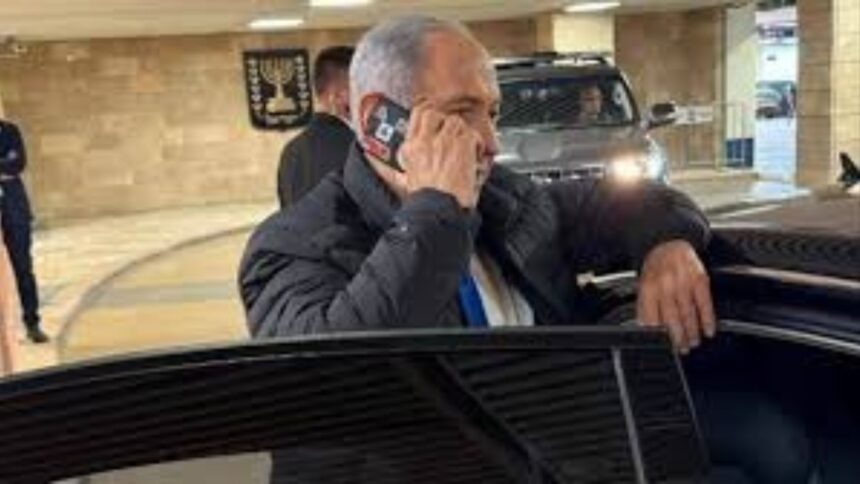
A single photograph of Israeli Prime Minister Benjamin Netanyahu has ignited a wide-ranging discussion on social media, shifting attention from geopolitics to personal cybersecurity practices. The image, showing Netanyahu speaking on his mobile phone beside a black car, drew intense scrutiny after users noticed that the phone’s camera appeared to be covered with tape or a sticker. What began as casual curiosity quickly evolved into a global conversation about surveillance fears, technology choices of world leaders, and the unseen security routines that shape their everyday lives.
How a viral image triggered speculation and online debate
The photograph gained traction after it was shared online by business influencer and podcast host Mario Nawfal, who posted the image and asked his followers why the Israeli prime minister might have chosen to cover his phone camera. The question resonated widely, prompting users to zoom in on the image, analyze the device’s design, and speculate about the model Netanyahu was using. Some argued that the phone looked like an iPhone, while others suggested it resembled a Samsung device, though no definitive conclusion could be drawn from the image alone.
Beyond identifying the phone brand, the discussion quickly expanded into assumptions about what Netanyahu would avoid using. Many social media users confidently claimed that the prime minister would not use Chinese-made phones or applications, citing Israel’s long-standing concerns about foreign surveillance, hacking risks, and technological espionage. These claims, while unverified, reflected broader public awareness of Israel’s strict approach to national security and digital defense.
The debate intensified when Nawfal took the discussion a step further by posing the question to an artificial intelligence chatbot integrated into the social media platform X. The AI’s response suggested that the tape over the camera could be part of standard Israeli security protocol, particularly in sensitive or classified environments. According to the explanation, tamper-evident stickers are sometimes used to block phone lenses to prevent accidental or malicious image capture in secure areas. Screenshots of this response were widely shared, adding another layer of perceived authority to the speculation.
As the image circulated, reactions varied sharply. Some users expressed surprise, viewing the taped camera as an extreme or paranoid measure. Others praised the practice as a sensible precaution in an era when smartphones are often described as potential surveillance tools. The viral nature of the discussion highlighted how even mundane details in a leader’s daily routine can be magnified and interpreted in countless ways once exposed to the public eye.
What cybersecurity experts say about taped cameras and political caution
Cybersecurity experts and intelligence analysts have largely responded to the controversy with calm explanations, noting that covering phone cameras is neither unusual nor new among high-ranking officials. According to experts, politicians, military leaders, and intelligence officers across the world often adopt strict personal security habits that may seem excessive to ordinary users but are considered prudent given their risk profiles.
Modern smartphones are powerful devices equipped with cameras, microphones, and multiple sensors that can theoretically be exploited if compromised. While such attacks typically require advanced capabilities, high-value targets like heads of government are more likely to be targeted by hostile actors. As a result, simple physical measures such as taping over cameras are viewed as an effective, low-cost safeguard against unlikely but potentially severe threats.
Experts emphasize that the concern extends beyond photography. There have been documented cases globally where malware or spyware was used to activate microphones or cameras without a user’s knowledge. In sensitive settings, even the smallest risk of unintended recording can have serious implications. For this reason, phones are often restricted, modified, or excluded entirely from classified environments, and when they are allowed, physical barriers such as stickers or tape are sometimes employed.
The image of Benjamin Netanyahu therefore aligns with a broader culture of caution rather than representing an extraordinary or suspicious act. Security professionals note that similar practices are followed in government offices, military installations, and intelligence agencies worldwide, regardless of the specific brand or operating system of the device being used.
The viral reaction to the photo also underscores how public perceptions of technology differ from the realities faced by those in power. For everyday users, smartphones are tools of convenience and connection. For political leaders, the same devices can represent potential vulnerabilities that require constant management. The taped camera, in this sense, becomes a symbol of the invisible security considerations that accompany positions of authority.
At a broader level, the episode illustrates how social media can transform a minor visual detail into a global talking point. In an age of instant sharing and constant analysis, even small personal habits of world leaders can be dissected, debated, and imbued with meaning far beyond their original context. While the taped camera on Netanyahu’s phone may not reveal any classified practice or hidden agenda, it has opened a window into the cautious mindset that often defines life at the highest levels of political power.