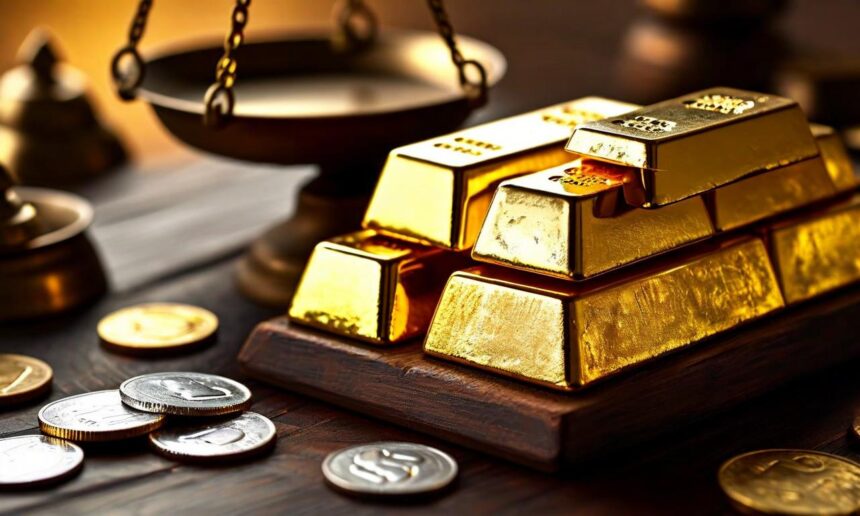
India’s long-standing emotional and economic relationship with gold has reached an unprecedented milestone, with the total value of gold owned by Indian households now exceeding the country’s gross domestic product. A sharp rally in bullion prices has pushed gold and silver to record highs, underscoring not only strong global demand but also the deep-rooted role of precious metals in India’s financial psychology. The surge has renewed debate on wealth, savings behaviour, and the challenge of converting household gold into productive economic assets.
On December 29, gold and silver prices climbed for the fifth consecutive trading day, reflecting sustained momentum in domestic and international markets. According to data from the India Bullion and Jewellers Association, the price of gold rose by ₹205 to ₹1,38,161 per 10 grams, while silver saw an extraordinary single-day jump of more than ₹15,000 per kilogram, reaching ₹2,43,483. This marked the first time silver crossed the ₹2.43 lakh level, adding to the sense that precious metals are entering a new price regime.
The rally has dramatically inflated the value of gold stored in Indian homes. Estimates suggest that Indian families collectively hold gold worth more than $5 trillion, or roughly ₹450 lakh crore, a figure that now surpasses India’s estimated GDP of $4.1 trillion. This comparison has captured attention not only because of its scale, but also because it highlights how a traditional store of wealth has outpaced the value of the entire economy’s annual output.
Gold, gdp and the scale of india’s household wealth
The calculation behind this striking comparison rests on both the volume of gold owned by Indian households and the steep rise in global prices. According to a report by Morgan Stanley, Indian households collectively possess around 34,600 tonnes of gold, making them one of the largest private holders of the metal in the world. With international gold prices trading above $4,500 per ounce, the total valuation of this stockpile has soared.
By contrast, India’s GDP, as estimated by the International Monetary Fund, stands at around $4.1 trillion, or approximately ₹370 lakh crore. While GDP measures the annual flow of economic activity, gold holdings represent a stock accumulated over generations. Economists caution that the two figures are not directly comparable, yet the contrast is still revealing.
M. Sharma, chief economist at Infomerics Valuation and Ratings, has described the comparison as symbolically powerful. He notes that GDP is a dynamic flow variable, constantly changing with production and consumption, whereas gold holdings are a static stock built over time. The fact that the value of this stock now exceeds GDP reflects more than price movements; it illustrates the cultural, financial and psychological trust that Indians place in gold.
Gold’s appeal in India extends beyond investment returns. It is widely viewed as security against uncertainty, inflation and geopolitical instability. In times of war, financial crisis or currency volatility, Indian households traditionally turn to gold and the US dollar as the most reliable stores of value. This instinctive preference has been reinforced by recent global developments, including inflationary pressures, interest rate uncertainty and geopolitical tensions.
The surge in prices during 2025 has been particularly dramatic. Over the course of the year, gold prices in India have risen by nearly ₹62,000 per 10 grams, while silver prices have increased by more than ₹1.57 lakh per kilogram. Such gains have significantly boosted household balance sheets on paper, even if they have not translated into higher spending.
Demand dynamics, central bank buying and the challenge of idle gold
Despite the sharp rise in prices, the so-called wealth effect from gold appears limited. Economic theory suggests that when asset values increase, owners feel wealthier and may spend more, stimulating consumption. However, evidence from India suggests that this effect is muted in the case of gold. A report by MK Global points out that 75 to 80 per cent of gold owned by Indian households is in the form of jewellery, which is rarely sold and is often passed down across generations. As a result, higher prices do not significantly alter daily consumption behaviour.
India remains one of the world’s largest consumers of gold, accounting for about 26 per cent of global demand, according to the World Gold Council. Only China, with a 28 per cent share, consumes more. In recent years, India has also seen rising demand for coins and bars, with retail purchases increasing from 23.9 per cent to 32 per cent of total demand by mid-2025. This indicates growing interest not only in jewellery but also in gold as an investment product.
Institutional demand has also played a crucial role in pushing prices higher. Central banks around the world have been aggressively increasing their gold reserves as part of a broader strategy to diversify away from the US dollar and reduce exposure to geopolitical risks. The People’s Bank of China has been one of the most active buyers, contributing to sustained upward pressure on global prices.
India’s own central bank has followed a similar path. The Reserve Bank of India has added around 75 tonnes of gold to its reserves since 2024, taking total official holdings to about 880 tonnes. Gold now accounts for roughly 14 per cent of India’s foreign exchange reserves, reflecting a strategic shift toward greater diversification and stability.
While rising prices have enriched households on paper, economists continue to grapple with a long-standing challenge: much of India’s gold is effectively an idle asset. Unlike equities, bonds or productive real estate, gold stored in homes does not generate income or directly contribute to economic growth. Successive governments have tried to address this through schemes such as Sovereign Gold Bonds, gold exchange-traded funds and digital gold platforms, all designed to encourage financial rather than physical ownership.
These initiatives aim to mobilise household savings and channel them into the formal financial system. However, their success has been limited. The emotional attachment to physical gold, especially jewellery, remains strong. For many families, gold represents not just wealth but identity, tradition and social security. Weddings, festivals and religious occasions continue to drive demand, reinforcing gold’s role as a cultural asset rather than a purely financial one.
The current price surge has therefore sharpened a familiar paradox. On one hand, Indian households are sitting on an enormous store of wealth that now exceeds the value of the nation’s annual economic output. On the other hand, this wealth remains largely locked away, offering security but little direct stimulus to growth or consumption. As global uncertainties persist and precious metals continue to attract buyers, this tension between tradition and economic efficiency is likely to remain at the heart of India’s relationship with gold.