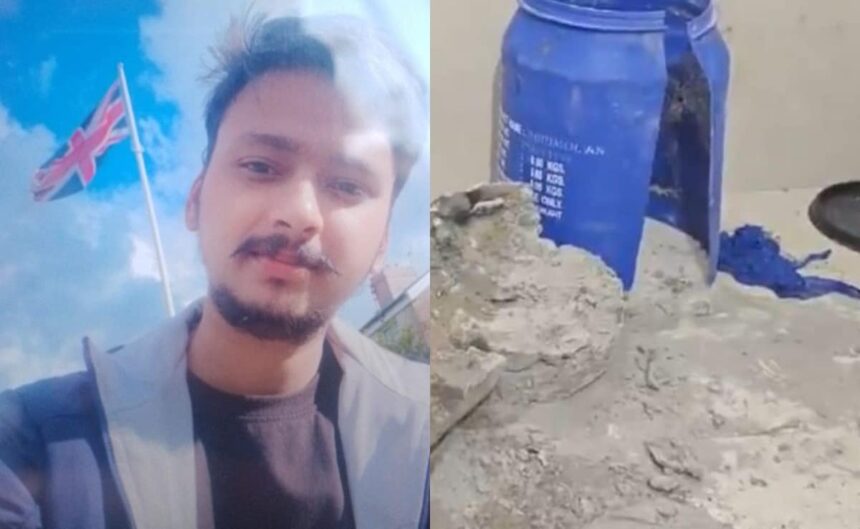
The blue drum case returns as a docu-series, examining crime, relationships, and hidden violence within ordinary marriages.
One of india’s most disturbing true-crime stories is returning to public attention, this time through a streaming platform. The infamous saurabh rajput murder case from meerut, widely known as the blue drum case, has been adapted into a five-episode docu-series titled honeymoon se hatya, set to premiere on ZEE5 on january 9, 2026. The series revisits the brutal killing that shocked the country in 2022, blending interviews, investigation footage, and dramatic re-enactments to explore not just the crime, but the complex emotional and psychological layers behind it.
The release of the first poster has already reignited public debate. Featuring the now-notorious blue plastic drum with fragments of cement and a human hand emerging from it, the visual captures the horror that once dominated news cycles. Marketed under the subtitle why women kill, the series positions itself as more than a crime retelling, promising a deeper exploration into relationships that appear normal on the surface but conceal extreme violence underneath.
from marriage to murder: the making of the blue drum case
The murder at the centre of the series involves Saurabh Rajput, a merchant navy professional who was largely based in london, and his wife Muskan Rastogi. Their relationship began in 2016 in meerut, where the two reportedly met and grew close despite resistance from both families. Drawn to saurabh’s overseas job and lifestyle, muskan continued the relationship in secret. When the couple decided to marry, family opposition intensified, leading them to cut ties with relatives and move into a rented house in indranagar along with their young daughter, pihu.
For a brief period, the marriage appeared stable, but extended separations due to saurabh’s work began to take a toll. In 2019, muskan met Sahil Shukla near her daughter’s play school. What started as casual interaction reportedly turned into a romantic and physical relationship. With saurabh frequently abroad, sahil became a constant presence in muskan’s life, gradually exerting greater influence over her decisions.
By early 2022, the relationship between muskan and sahil had reportedly reached a breaking point. According to later police statements, sahil allegedly pressured muskan to divorce her husband and start a new life together. Investigators say the two discussed ways to remove saurabh from the picture permanently, eventually settling on murder disguised as disappearance.
On the night of march 3, 2022, saurabh was killed inside the rented house in meerut. The crime did not end with the murder itself. The body was dismembered into four parts, wrapped in a pillow cover, and placed inside a large blue plastic drum. Cement slurry was poured over the remains in an attempt to conceal evidence and suppress odour. The plan, police later said, was to dispose of the drum, but its weight made transport impossible.
What shocked investigators and the public alike was what followed. The next morning, muskan and sahil purchased cement, a knife, and other supplies, then hired a cab and went on a holiday across himachal pradesh and uttarakhand. Over nearly two weeks, they visited manali, shimla, and kasol, drinking beer, playing in the snow, and posing for photographs, while saurabh’s body remained hidden inside the drum back home.
The turning point came on march 17, when muskan confessed the crime to her mother, kavita. Her father, pramod, informed the police, leading to the arrest of both muskan and sahil. The drum was recovered from the house, confirming the gruesome details. The accused were produced in court on march 19 and sent to judicial custody. Later, while incarcerated, muskan gave birth to a daughter on november 24, a date that coincidentally matched saurabh’s birthday, adding another unsettling layer to the narrative.
crime, psychology, and storytelling in the streaming age
honeymoon se hatya uses the saurabh rajput case as one of its central narratives while placing it within a broader thematic frame of women committing spousal हत्या. According to the makers, the series does not aim to sensationalise violence but to examine the emotional, social, and psychological triggers that lead to such extreme acts. Through interviews with investigators, family members, and legal experts, alongside re-enactments, the series attempts to contextualise the crime rather than reduce it to shock value alone.
The timing of the release reflects the growing appetite for true-crime content on indian streaming platforms. High-profile cases, especially those involving domestic relationships and unexpected brutality, have increasingly found space in docu-series formats. The blue drum case, already etched into public memory, offers a narrative that combines betrayal, secrecy, and violence in a way that continues to disturb audiences years later.
The series also raises uncomfortable questions about how society perceives marriage, gender roles, and agency. By framing the narrative under why women kill, it seeks to provoke discussion on whether crimes like these stem purely from individual pathology or from deeper relational and social pressures. At the same time, critics have cautioned that such framing risks oversimplifying complex crimes or unintentionally creating stereotypes if not handled with care.
For zEE5, the series adds to its expanding catalogue of crime-based original content, positioning the platform as a major player in the true-crime genre. The use of stark imagery, such as the blue drum itself, signals an intent to confront viewers with the rawness of the crime rather than soften its impact. The five-episode structure allows the story to unfold gradually, tracing the relationship’s evolution, the planning of the crime, the aftermath, and the ongoing legal process.
The continued public fascination with the saurabh rajput case highlights how certain crimes transcend their immediate context to become cultural reference points. Even years later, the blue drum remains a symbol of hidden violence within domestic spaces. By revisiting the case through a docu-series, honeymoon se hatya ensures that the discussion around the crime, its causes, and its consequences remains alive, inviting audiences to reflect not just on what happened, but on how and why such tragedies unfold behind closed doors.