Lucknow:
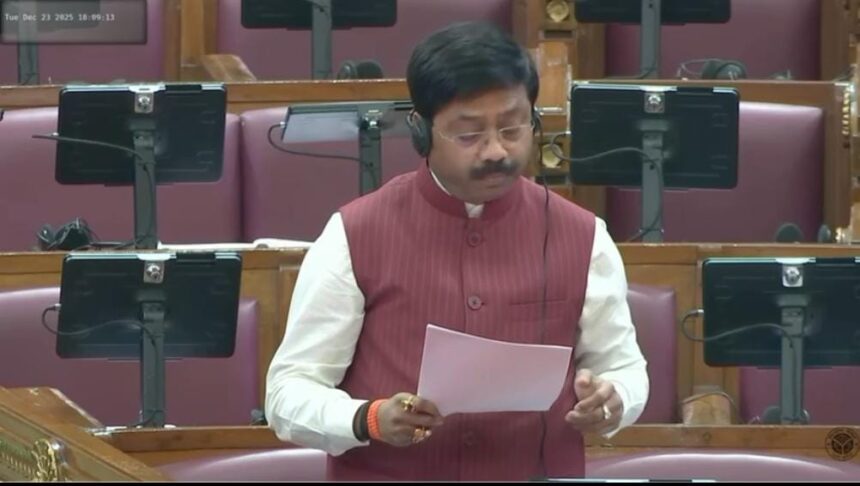
The Uttar Pradesh Legislative Assembly has approved the Uttar Pradesh Sugamya Vyapar (Amendment of Provisions) Act, 2025, marking a significant step towards simplifying business regulations and strengthening investor confidence in the state. The legislation, aimed at promoting ease of doing business and creating an industry-friendly ecosystem, was introduced by Industrial Development Minister Nand Gopal Gupta Nandi and passed after detailed deliberations in the House.
The move aligns with the broader vision of the state government to transform Uttar Pradesh into a preferred investment destination under the guidance of Prime Minister Narendra Modi and the leadership of Chief Minister Yogi Adityanath. The amendment focuses on simplifying rules, decriminalising minor business-related offences and reducing regulatory burdens on entrepreneurs.

Addressing the Assembly during the discussion on the Bill, Industrial Development Minister Nand Gopal Gupta Nandi said that from the very first day, promoting ease of doing business and building an industry-friendly ecosystem has remained a core commitment of the state government. He stated that the double-engine government has taken several concrete and effective decisions over the years, which have yielded visible and measurable outcomes.
The minister described the Sugamya Vyapar (Amendment of Provisions) Act, 2025 as a historic step towards accelerating industrial development and encouraging investment in Uttar Pradesh. He said the amendments would provide a strong boost to investor confidence by making the regulatory framework more transparent, practical and trust-based.
Under the new Act, reforms have been introduced in 10 state-listed laws, covering more than 39 provisions across 10 different departments. A key feature of the legislation is the decriminalisation of minor and procedural offences. Provisions related to imprisonment have been retained only for serious offences that cause physical harm, endanger human life, involve fraud or create significant negative externalities. Other violations, such as procedural lapses, documentation errors or routine non-compliance, have been removed from the criminal category and will now attract only monetary penalties.
The minister said that under Chief Minister Yogi Adityanath’s leadership, the government has consciously moved away from punitive governance for minor errors and has focused on making administration more just, rational and business-friendly. He added that the Act not only strengthens ease of doing business but also contributes to ease of living by reducing unnecessary harassment of citizens and entrepreneurs.
Highlighting broader reform measures, Nandi said the state government has worked consistently to dismantle red tape and curb inspector raj by incorporating feedback from entrepreneurs. He listed key reforms undertaken by the government, including simplified business entry processes, labour regulation reforms, the introduction of an online single-window clearance system, improvements in land administration, faster construction permissions and streamlined mechanisms for commercial dispute resolution.
As a result of these sustained reforms, Uttar Pradesh has recorded significant improvement in national ease of doing business rankings. The state moved from the 12th position in the Business Reform Action Plan 2017–18 to the second position in 2019. In 2022, Uttar Pradesh was recognised as a “Top Achiever,” and the state repeated this achievement in 2024, reflecting consistency and continuity in reform implementation.
The minister also informed the Assembly that Uttar Pradesh had promulgated the Uttar Pradesh Sugamya Vyapar Ordinance, 2025 in November 2025, which has now been enacted into law. The ordinance and the subsequent Act decriminalise minor compliances under multiple laws and replace imprisonment provisions with financial penalties for such offences. According to the government, this approach promotes a trust-based regulatory ecosystem and encourages entrepreneurship without compromising public safety or accountability.
The passage of the Act is being seen as a major policy signal to investors and industry stakeholders that Uttar Pradesh is committed to becoming a truly industry-friendly state. Government officials believe the reforms will lead to increased industrial investment, job creation and sustained economic growth, further strengthening Uttar Pradesh’s position as one of India’s leading investment destinations.