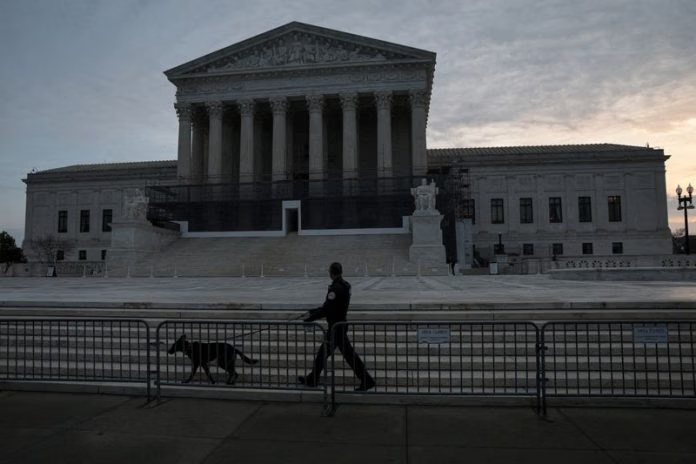
The Supreme Court of the United States is preparing to release a new set of decisions on January 20, placing renewed focus on a term marked by high-stakes constitutional questions and unresolved economic disputes. Among the most closely watched issues is the continued delay in ruling on the legality of global tariffs imposed during the presidency of Donald Trump, a case that has wide implications for trade policy, executive authority, and international markets. As anticipation builds around the court’s next opinion day, uncertainty remains over whether the justices will finally address the tariff challenge or defer it yet again, keeping governments, businesses, and investors in suspense.
Tariff case remains pending as court signals more rulings ahead
The upcoming January 20 session is part of the Supreme Court’s regular schedule for issuing opinions, yet the court has not disclosed which cases will be decided. This silence has intensified attention on the Trump-era tariff dispute, which has lingered without resolution despite repeated expectations of an imminent ruling. The case centres on whether the former president lawfully relied on emergency powers to impose sweeping tariffs on a broad range of imported goods, a move that reshaped global trade flows and triggered retaliatory measures from multiple countries.
At the heart of the legal challenge is the scope of authority granted to the executive branch under existing federal statutes. Lower courts have questioned whether the president exceeded his powers by invoking national emergency provisions to justify tariffs without direct congressional approval. These rulings have created a legal backdrop that now awaits final clarification from the Supreme Court. By postponing its decision so far, the court has effectively allowed uncertainty to persist, leaving the tariff framework in a state of legal limbo.
Observers note that the delay may reflect the complexity of the questions before the justices. The case does not simply involve trade policy; it probes deeper constitutional issues related to the separation of powers between Congress and the presidency. A ruling either way would establish an important precedent, influencing how future administrations might deploy emergency powers in economic matters. This weight has likely contributed to the court’s cautious approach, as any decision could reshape the balance of authority for decades.
The tariff issue has also carried real-world consequences during its unresolved status. Businesses affected by higher import costs have faced challenges in planning supply chains and pricing strategies, while foreign governments have calibrated their trade policies around the possibility that the tariffs could be struck down or upheld. Financial markets, sensitive to shifts in trade rules, have reacted repeatedly to speculation surrounding the case, underscoring its economic significance.
While the tariff dispute has drawn the most attention, the January 20 opinion day is expected to include rulings on a range of other matters spanning civil rights, regulatory authority, and federal governance. The court’s docket this term reflects a broader pattern of cases testing the limits of executive action, a theme that aligns closely with the unresolved tariff controversy. Together, these cases signal a period of judicial scrutiny over how power is exercised at the highest levels of government.
Broader implications for executive power, trade policy, and global confidence
The eventual outcome of the tariff case will extend far beyond the immediate question of import duties. If the Supreme Court upholds the tariffs, it would effectively endorse a broad interpretation of presidential authority in economic emergencies, potentially empowering future presidents to act unilaterally in trade and financial matters. Such a ruling could alter how Congress and the executive branch interact on economic policy, shifting the balance toward greater presidential discretion.
Conversely, a decision limiting or overturning the tariffs would reinforce congressional authority over trade, reaffirming the legislature’s central role in setting economic policy. This outcome could constrain future administrations, requiring clearer legislative backing for major trade interventions. Legal scholars suggest that such a ruling would serve as a reminder that emergency powers are not unlimited and must be exercised within defined statutory boundaries.
The international dimension of the case further amplifies its importance. Trade partners of the United States have closely followed the proceedings, aware that the ruling could influence not only existing tariff regimes but also future negotiations. An affirmation of broad tariff authority might embolden the use of trade measures as negotiating tools, while a restrictive ruling could encourage more multilateral and rules-based approaches to resolving trade disputes.
Beyond trade, the case fits into a wider global conversation about democratic accountability and the concentration of power. In recent years, courts around the world have increasingly been called upon to arbitrate disputes involving executive authority, particularly during periods of crisis. The US Supreme Court’s handling of the tariff challenge will therefore be studied internationally as an indicator of how constitutional systems can respond to expansive interpretations of executive power.
As January 20 approaches, anticipation remains high but clarity elusive. The court’s decision to include or exclude the tariff case from its upcoming rulings will itself send a signal, either suggesting readiness to resolve the matter or indicating continued deliberation. For now, businesses, policymakers, and global observers remain in a holding pattern, waiting for judicial guidance that could redefine trade policy and presidential power in the United States.
The significance of the moment lies not only in the content of any eventual ruling, but in its timing. With geopolitical tensions and trade uncertainties already shaping the global economic environment, the Supreme Court’s choices this term will resonate well beyond the courtroom, influencing confidence, diplomacy, and governance at a critical juncture.