Two Democratic US senators have issued a stark warning following their recent fact-finding mission to the Middle East, asserting that Israel is systematically targeting Palestinians in Gaza for ethnic cleansing and that the United States bears a level of complicity in this strategy. Senators Chris Van Hollen of Maryland and Jeff Merkley of Oregon, both members of the Senate Foreign Relations Committee, returned from visits to Israel, the occupied West Bank, Egypt, and Jordan, presenting a detailed report that underscores not only the scale of destruction in Gaza but also the deliberate measures implemented to restrict humanitarian aid. Their findings indicate that the devastation witnessed goes far beyond the conflict with Hamas, pointing to an orchestrated effort to displace Palestinians from their homes, denying them essential resources and access to survival, effectively weaponizing basic human necessities.
Systematic Destruction and Ethnic Cleansing Strategy in Gaza
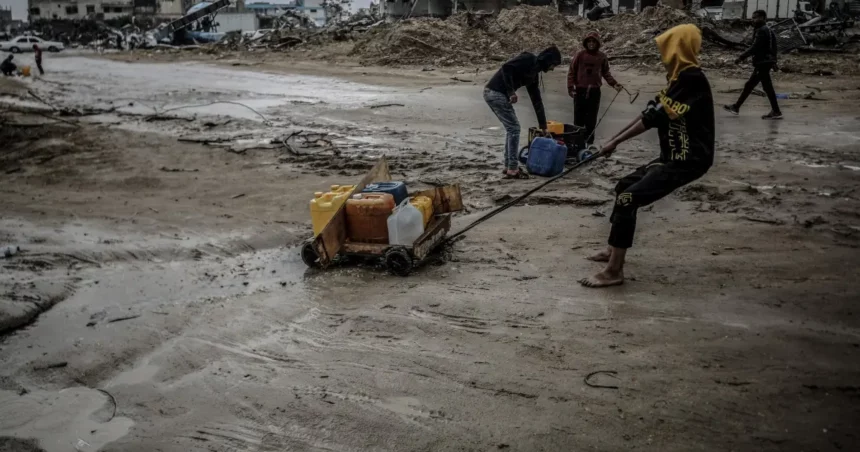
Van Hollen and Merkley described the harrowing scenes they encountered on the ground, emphasizing that the Israeli government’s actions extend far beyond military targeting of Hamas operatives. In particular, they observed the near-total destruction of Rafah, a southern Gaza city that previously housed approximately 270,000 Palestinians. The senators reported climbing an outside fire escape on the Egyptian border to obtain a clear view of the ruins, witnessing firsthand the widespread devastation that had turned homes, schools, and community infrastructure into rubble. Their report asserts that this destruction is not incidental collateral damage of war but rather a deliberate component of a strategy to force Palestinians to abandon their homeland.
Former Israeli Defense Forces personnel corroborated these observations, recounting participation in what they described as systematic destruction of civilian infrastructure, including entire city blocks, residential buildings, schools, and other public facilities. The senators’ report frames this as part of an intentional pattern designed to prevent the return of displaced Palestinians while simultaneously instilling fear and chaos. According to Van Hollen, the Netanyahu government is engaging in a broader punitive policy, imposing collective punishment on Gaza’s civilian population, rather than limiting military action to Hamas targets. This strategy, the senators note, reflects a coordinated approach to achieve political objectives through the displacement and marginalization of Gaza’s residents.
Merkley outlined the dual components of this approach: the deliberate demolition of homes to prevent residents from returning, and the deprivation of essentials, including food, water, and medicine, which are critical for survival. The deliberate targeting of basic human necessities represents what the senators describe as a “weaponization of food” and a calculated method to increase pressure on the local population, ensuring that civilians face insurmountable obstacles to sustenance and safety.
Humanitarian Crisis and US Complicity
The report details severe restrictions on humanitarian aid, which have resulted in widespread famine and suffering. United Nations data indicate that at least 100 individuals have already died from starvation in Gaza, with aid convoys operating at roughly 10 percent of capacity due to Israeli-imposed constraints. Jordanian officials informed the senators that even minor items such as peanut butter, honey, and dates had been arbitrarily banned, resulting in entire convoys being turned away. Additional measures include new \$400 customs processing fees for each truck, and repeated payments are required if a convoy fails to pass inspections, further delaying aid delivery.
At the Egyptian border, the senators observed UN vehicles and equipment sustaining severe damage due to Israeli fire, which has become a regular occurrence for relief convoys. They toured warehouses managed by the Egyptian Red Crescent and the UN World Food Programme, noting that critical supplies including solar-powered water pumps, tents, wheelchairs, and truck spare parts were prohibited under “dual-use” restrictions, severely limiting operational capacity. At Israel’s Ashdod port, officials reported 2,200 containers of food, sufficient to feed Gaza for three weeks, remain delayed due to mandatory pallet inspections, highlighting the systemic hurdles obstructing humanitarian relief.
Van Hollen and Merkley emphasize that the United States is complicit in these outcomes by either enabling or failing to prevent policies that facilitate the displacement of Palestinians. The senators challenge the characterization by Israel and the US government that the population movement in Gaza constitutes a “voluntary exodus,” calling it a misleading narrative that ignores the structural coercion faced by residents. They stress that no one would leave voluntarily when their homes have been destroyed, fields rendered inaccessible, and essential resources cut off. This depiction of consent, they argue, is not only fraudulent but conceals the reality of forced displacement that forms the core of the alleged ethnic cleansing.
The senators’ observations included visits to multiple aid distribution points, where they saw firsthand the human toll of the restrictions. Only four aid points were functional for a population of two million, with three concentrated in southern Gaza. Families, including malnourished mothers carrying children, were forced to travel long distances to access relief supplies, lifting heavy boxes that far exceeded reasonable physical limits. From May 22 to July 31, 1,373 people were reportedly killed near these distribution sites, highlighting the ongoing danger for civilians seeking basic sustenance.
The systematic deprivation of essential goods and the disruption of aid supply chains, the senators note, represent a deliberate extension of Israel’s broader strategic objective to displace the population. The report emphasizes that this strategy is supported by a range of administrative controls and operational decisions designed to maximize civilian suffering, effectively using starvation, deprivation, and destruction as instruments of coercion.
Moreover, the senators argue that the US role, whether through tacit approval, material support, or political backing, contributes to enabling Israel’s campaign. By maintaining military and diplomatic support without holding Israel accountable for actions affecting civilians, the United States, according to Van Hollen and Merkley, bears partial responsibility for the resulting humanitarian crisis. Their report calls for international attention and intervention, highlighting that the global community must address both the direct actions of Israel and the indirect complicity of allied states, including the US.
In addition to structural impediments to aid, the senators highlight the impact of arbitrary enforcement and regulatory barriers. Trucks carrying humanitarian supplies are subject to unpredictable inspections, denials, and fines that hinder timely delivery. Restrictions on seemingly minor items further exacerbate scarcity, while infrastructure damage impedes distribution networks and slows recovery. The senators note that even UN convoys have come under fire, demonstrating the precarious and dangerous conditions in which aid organizations must operate. These findings underscore the depth of the crisis and reinforce the argument that Israel’s policies are deliberately designed to create untenable conditions for the civilian population.
The report also documents the experiences of refugees and displaced individuals who recount the destruction of homes, the inability to access farmland, and the daily challenges of survival under conditions of extreme scarcity. These personal accounts reinforce the senators’ conclusion that the situation in Gaza is not an incidental consequence of conflict but a deliberate policy with explicit objectives targeting civilian life and livelihoods. The testimony of former IDF personnel further corroborates these observations, emphasizing the strategic planning involved in the demolition of civilian infrastructure.
Van Hollen and Merkley’s findings emphasize that the ongoing crisis in Gaza must be understood not only through the lens of military engagement but also in terms of broader strategies of control, displacement, and coercion. By combining targeted infrastructure destruction with severe restrictions on aid, the report contends, Israel’s policies constitute a form of systematic ethnic cleansing, designed to restructure the demographic composition of Gaza and diminish Palestinian presence over time.
The senators’ report is a call to action for the international community, urging both the United States and other nations to recognize their potential complicity and to take steps to mitigate civilian suffering. The documentation of restricted aid, delayed shipments, destruction of essential services, and direct targeting of humanitarian convoys presents compelling evidence that the crisis in Gaza extends far beyond conventional warfare. By highlighting these conditions, the senators aim to elevate global awareness, mobilize political pressure, and ensure that international norms regarding civilian protection are upheld.
As the conflict continues, the report underscores that without meaningful intervention and accountability, the systematic deprivation and forced displacement of Palestinian civilians is likely to persist. The senators stress the urgency of addressing both the immediate humanitarian needs and the underlying strategic objectives driving these policies. The combination of detailed firsthand observations, corroborating testimonies, and extensive documentation forms a powerful indictment of both Israel’s operational approach and the United States’ role in enabling or failing to constrain these actions.
In sum, Van Hollen and Merkley’s report presents a comprehensive, data-driven, and human-centered account of the unfolding crisis in Gaza. By documenting the destruction of civilian infrastructure, restrictions on humanitarian aid, and the deliberate strategies to displace Palestinians, the senators highlight both the human suffering and the strategic implications of these policies. Their findings challenge the international community to reassess responses, scrutinize the role of powerful allies, and act to prevent further escalation of humanitarian harm while promoting accountability, justice, and the protection of civilians in conflict zones.
This investigation sheds light on the complex interplay of military operations, administrative policy, and international diplomacy, revealing how structural measures can compound civilian suffering and contribute to the systemic displacement of an entire population. The report’s detailed evidence, supported by first-hand accounts, presents a compelling case for urgent intervention and highlights the moral, legal, and political dimensions of the crisis in Gaza.
The senators conclude that the ongoing destruction, deprivation, and forced displacement observed in Gaza constitute not only a humanitarian emergency but also a deliberate, systematic policy of ethnic cleansing, facilitated and partially enabled by the United States. By providing a thorough record of these findings, Van Hollen and Merkley aim to hold both Israel and the US accountable while urging the global community to respond decisively to prevent further civilian suffering.
The report calls attention to the ethical responsibilities of states in conflict, emphasizing that military objectives cannot justify policies that systematically target civilians, restrict aid, and engineer displacement. The senators’ findings serve as a critical reminder of the human cost of strategic decisions and underscore the need for transparency, oversight, and accountability in international relations.
The comprehensive investigation undertaken by Senators Van Hollen and Merkley provides a rare and important window into conditions on the ground in Gaza, revealing the scope of destruction, the intentional nature of population displacement, and the severe constraints placed on humanitarian assistance. Their work contributes to global discourse on human rights, ethical foreign policy, and the responsibilities of states to protect civilians in conflict-affected regions.
Through their report, the senators aim to ensure that the plight of Gaza’s civilian population is recognized, documented, and acted upon, offering a critical perspective on the intersection of conflict, humanitarian aid, and international complicity. The findings underscore that without immediate and concerted action, the ongoing policies in Gaza will continue to inflict widespread suffering and destabilize the region further, reinforcing the urgent need for global attention and intervention.