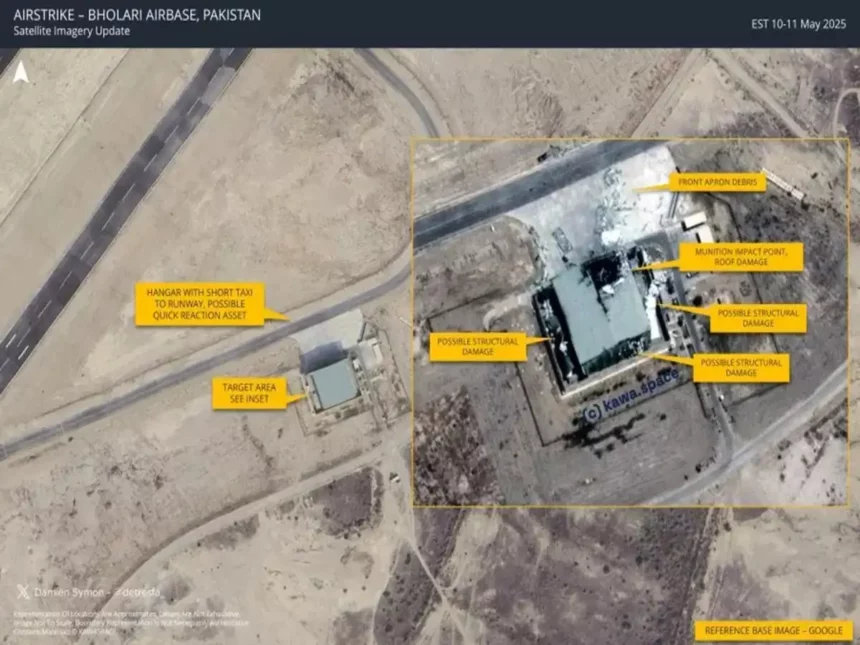
Satellite images released after the May 10 cross-border escalation between India and Pakistan have confirmed extensive damage to key Pakistani military facilities, revealing the precision and scale of Indian airstrikes. Hours before both sides agreed to halt hostilities, India launched retaliatory attacks on eight Pakistani airbases using long-range weapons. The strikes followed Pakistan’s attempted assault on 26 Indian military installations earlier that day.
Evidence of targeted strikes emerges from satellite data
Geo-intelligence researcher Damien Symon from The Intel Lab, who analysed the imagery provided by India’s defence ministry and commercial satellite providers, confirmed that the Indian Air Force carried out coordinated and surgical strikes. According to Symon, these airstrikes were designed to neutralise specific military infrastructure while carefully avoiding civilian or collateral damage.
The images showed significant impact on several Pakistani airbases. At Nur Khan airbase in Rawalpindi, a building related to operations and several vehicles were destroyed. At the airbase in Sargodha, Punjab province, two sections of the runway were hit, likely grounding air operations until major repairs are completed. Jacobabad’s Shahbaz airbase suffered damage to a hangar located next to the air traffic control tower, although the tower itself remained intact.
High-impact damage reported across multiple bases
One of the most heavily hit was the Rahim Yar Khan base in Punjab province, where the runway suffered extensive destruction. Symon noted that the structural layers underneath were exposed, pointing to long-term operational disruption. At Sukkur airbase in Sindh, a depot storing unmanned aerial vehicles (UAVs) was visibly damaged, with its roof destroyed and debris scattered.
In southern Sindh’s Bholari airbase, a hangar believed to be used for early warning systems or maintenance activities also sustained major structural damage. Debris was seen spread across the area, confirming the severity of the strike.
In addition to the eight bases, Indian forces appeared to have targeted radar systems associated with Pakistan’s surveillance and early warning capabilities. According to the analysis, these systems were likely integral to the Pakistan Air Force’s monitoring operations, and their destruction could hinder Pakistan’s air defence readiness.
Officials familiar with the situation said the strikes demonstrated a significant technological edge in favour of India, reflecting not just superior military planning but also a vast capability gap between the two countries’ armed forces. The swift and focused retaliation by India, captured clearly in satellite visuals, offered a stark message of deterrence and operational readiness.