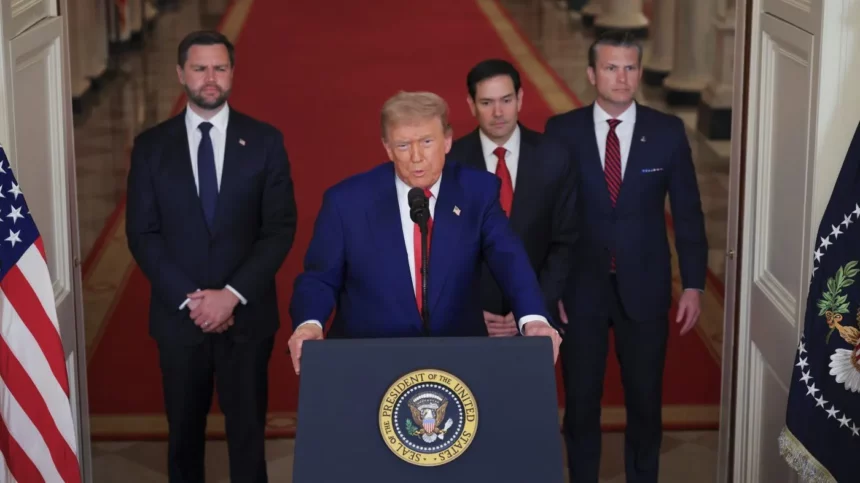
In a dramatic turn of events that has drawn sharp global attention, US President Donald Trump has declared that American airstrikes caused “monumental damage” to Iran’s nuclear infrastructure. In a bold statement on social media, Donald Trump claimed that the strikes obliterated key underground nuclear facilities, leaving Iran’s nuclear ambitions in tatters. As tensions between the US, Iran, and Israel escalate, reactions have ranged from condemnation by global powers to threats of retaliation by Iranian leadership, further intensifying fears of a wider conflict in the Middle East.
Donald Trump Declares Victory After Precision Airstrikes
On Sunday, Donald Trump took to his Truth Social platform to announce what he called a “very successful” mission targeting three major Iranian nuclear sites—Fordow, Natanz, and Esfahan. He described the impact in vivid terms: “Monumental damage was done to all nuclear sites in Iran… Obliteration is an accurate term.” Donald Trump also stated that the heaviest damage occurred “far below the ground level” and described the operation as a “Bullseye!”
According to military sources, the United States dropped six GBU-57 Massive Ordnance Penetrator (MOP) bombs—bunker-busting munitions—on the Fordow site, located deep within a mountain. This strike followed more than a week of Israeli military operations targeting Iran’s missile systems and air defences, creating the backdrop for the US offensive aimed at crippling Tehran’s nuclear capabilities.
Later, US Secretary of Defence Pete Hegseth echoed Donald Trump’s claims during a press briefing, calling the airstrikes a “huge success” and asserting that Iran’s nuclear program had been “devastated and obliterated.”
Iran Vows Retaliation as Global Concerns Rise
Iranian leaders were quick to respond. Supreme Leader Ayatollah Ali Khamenei issued a stern warning, vowing severe punishment against the United States and Israel. “The punishment continues. The Zionist enemy has made a big mistake… it is being punished right now,” Khamenei posted on social media. This came shortly after Iran launched a barrage of missiles into Israeli territory in response to the US-led attack.
Iranian President Masoud Pezeshkian also condemned the strikes, saying the United States “must receive a response.” He called the attacks the most serious act of Western military aggression since Iran’s 1979 Islamic Revolution. Simultaneously, Iran’s UN Ambassador Amir Saeid Iravani accused the US and Israel of sabotaging diplomacy, and of manipulating the nuclear non-proliferation treaty for political purposes. Iran formally requested an emergency meeting of the United Nations Security Council to discuss the escalating situation.
International reactions have been sharply divided. While Israeli Prime Minister Benjamin Netanyahu welcomed the US offensive, countries like Russia, China, and Saudi Arabia criticized the strikes, warning that they risk triggering a wider regional war.
In India, Prime Minister Narendra Modi expressed deep concern over the developments. In a phone call with Iranian President Pezeshkian, Modi urged all parties to exercise restraint and de-escalate tensions, warning that any further conflict could destabilize the entire Middle East and have serious global ramifications.
As the dust settles over the most aggressive Western military action against Iran in decades, the world watches closely, bracing for what could follow in the days ahead.