US President Donald Trump has embarked on a significant four-day visit to the Middle East, with a primary focus on securing economic deals and strengthening strategic ties with key Gulf nations — Saudi Arabia, the United Arab Emirates (UAE), and Qatar. His trip aims to balance the pursuit of large-scale investments in the US with managing complex geopolitical relationships shaped by regional conflicts and economic interests. Accompanied by senior advisors including Elon Musk and top defense officials, Donald Trump’s visit underscores America’s intent to deepen partnerships in a region critical to global energy and security dynamics.
Saudi Arabia’s Strategic Expectations
Donald Trump’s arrival in Riyadh, Saudi Arabia’s capital, was met by Crown Prince Mohammed bin Salman, reflecting the close ties between the two nations. Saudi Arabia seeks to finalize a long-discussed arms deal reportedly worth over $100 billion, part of a broader effort to enhance defense and economic cooperation. Riyadh also hopes for US support in developing its civil nuclear program, despite US concerns over uranium enrichment and regional proliferation risks. The kingdom’s desire to diversify its economy away from oil revenues hinges partly on these partnerships. However, Trump’s preference for lower oil prices creates a subtle tension with Saudi interests. During his first term, Trump secured a landmark $110 billion arms agreement and a $350 billion economic package, focusing on defense, energy, and infrastructure. The kingdom also continues to invest heavily in the US economy, including major commitments to infrastructure and technology funds.
UAE and Qatar’s Economic and Security Priorities
The UAE, with its ambitious $1.4 trillion investment plan over ten years, prioritizes advanced technology sectors such as artificial intelligence, semiconductors, and manufacturing. Abu Dhabi’s goal to become a global AI leader by 2031 depends heavily on access to US technology and chips. The historic Abraham Accords, brokered during Donald Trump’s administration, have solidified UAE’s strategic alignment with the US and Israel, marking a diplomatic milestone. Close cooperation continues with UAE’s Crown Prince Mohammed bin Zayed, especially on countering Iran’s influence and combating terrorism.
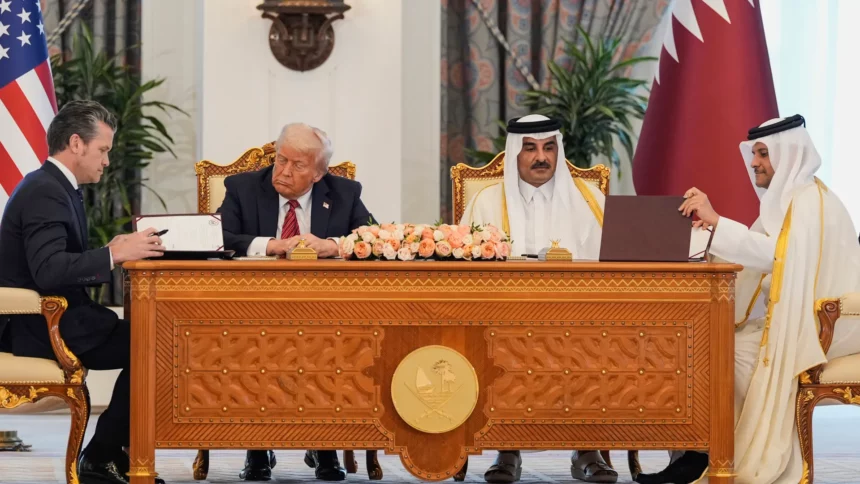
Qatar, home to the largest US military base in the Middle East at Al Udeid Air Base, plays a crucial role in regional security operations. Its diplomatic efforts in mediating conflicts, including in Gaza and Afghanistan, help maintain its relevance in Washington. While Donald Trump’s relationship with Qatar was initially strained during the 2017 Gulf crisis—where he criticized Qatar’s alleged support for terrorism—he later adopted a more conciliatory approach, mediating tensions and acknowledging Qatar’s counterterrorism efforts. This shift helped restore cooperative ties by the end of his first term.