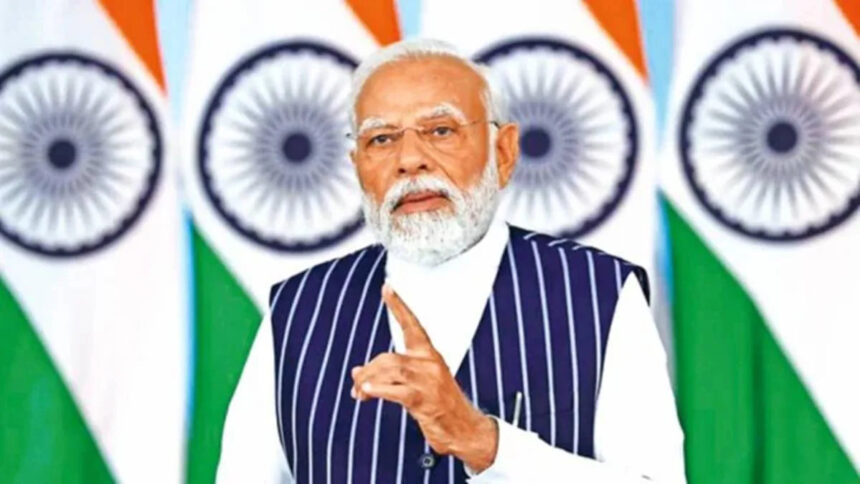
Prime Minister Narendra Modi inaugurated the Safran Aircraft Engine Services India (SAESI) facility at Hyderabad, marking a historic milestone for India’s rapidly growing aviation sector. This state-of-the-art Maintenance, Repair, and Overhaul (MRO) facility, established with a significant investment, is expected to propel India towards becoming a global MRO hub. With the aviation industry witnessing unprecedented expansion and rising domestic air travel demand, the facility symbolizes India’s ambition to integrate cutting-edge aerospace technology with local talent and enterprise. The initiative is poised to generate employment opportunities, foster skill development, and strengthen India’s position on the global aviation map while contributing to economic growth and self-reliance.
Transforming India into a Global Aviation and MRO Hub
The inauguration of the SAESI facility is not just an industrial milestone but a transformative step in India’s aviation journey. Prime Minister Modi emphasized that from this day forward, India’s aviation sector is taking a new flight, both metaphorically and literally. With Safran establishing its deep-level servicing capabilities for LEAP engines in the country, India now hosts a facility capable of servicing some of the world’s most advanced aircraft propulsion systems. This is the first time a global Original Equipment Manufacturer (OEM) has established such an operation in India, underlining the nation’s growing stature as a preferred destination for high-technology aviation investments.
The Prime Minister highlighted the unprecedented pace at which India’s aviation sector has expanded over recent years. Today, India ranks among the fastest-growing domestic aviation markets globally and stands as the third-largest in terms of domestic air traffic. Rising aspirations, a growing middle class, and increasing connectivity have fueled demand for air travel, prompting Indian airlines to expand fleets and place orders for over 1,500 new aircraft. With this surge, the requirement for advanced MRO facilities has become critical, as nearly 85 percent of India’s MRO work had previously been conducted abroad, resulting in higher costs, longer turnaround times, and grounded aircraft. The establishment of SAESI addresses these challenges, reducing dependence on foreign facilities and strengthening the domestic aviation ecosystem.
Prime Minister Modi emphasized that the SAESI facility will also serve as a catalyst for creating high-quality jobs and skill development opportunities for Indian youth, particularly in South India. The integration of global knowledge transfer, training programs, and collaboration with Indian institutions will nurture a workforce capable of leading India’s MRO sector and expanding it to other areas such as shipping and aerospace component design. By leveraging India’s vast MSME network and the talent of young engineers, Safran’s operations are expected to stimulate domestic innovation and enhance the country’s capacity in advanced propulsion systems.
India’s approach to aviation MRO reflects a broader vision of self-reliance and technological leadership. By developing indigenous capabilities, the country aims to reduce foreign exchange outflows, create high-value employment, and enhance supply chain resilience. The government’s proactive policy measures—including MRO guidelines, GST reforms, and simplification of tax structures—have made it easier for both domestic and global players to invest in India’s aerospace sector. The establishment of SAESI represents the culmination of these efforts and demonstrates India’s capacity to combine policy reforms with industrial ambition, positioning the country as a trusted global partner.
Investment, Innovation, and India’s Growth Trajectory
Prime Minister Modi’s address underlined India’s commitment to fostering investment and innovation across sectors. In the context of aviation, the SAESI facility exemplifies the nation’s approach to welcoming global partners as co-creators rather than mere investors. India’s policy reforms, including the liberalization of foreign direct investment (FDI) and the emphasis on ease of doing business, have created an environment conducive to technological collaboration, knowledge sharing, and sustainable industrial growth. The Prime Minister reiterated that India is not only dreaming big but also taking bold actions to achieve world-class outcomes, reinforcing the nation’s credibility as a hub for innovation and advanced manufacturing.
He highlighted the importance of integrating global expertise with India’s local strengths. Safran’s presence in India is expected to accelerate the design and manufacturing of aircraft engines and components, fostering indigenous research and development capabilities. India’s young talent pool, extensive MSME network, and growing ecosystem of technical institutions provide a strong foundation for such high-end industrial ventures. By combining these resources with strategic investments from global companies, India is creating a sustainable model of collaborative industrial growth, where technology transfer, skill development, and innovation go hand in hand.
The Prime Minister also reflected on India’s broader economic reforms over the past decade. Initiatives such as decriminalization of business provisions, simplification of GST, faceless tax assessments, labour code reforms, and the Insolvency and Bankruptcy Code have created a transparent and predictable business environment. By reducing regulatory burdens and establishing the National Single Window System for approvals, India has significantly improved operational ease for domestic and foreign investors alike. These measures have contributed to positioning India as a global hub for manufacturing, trade, and innovation, making it an attractive destination for high-value investments like the SAESI facility.
India’s strategy extends beyond aviation. The Prime Minister pointed out that sectors previously inaccessible to private investment, such as defence and space, now offer substantial opportunities, with automatic FDI approvals of up to 74 percent in certain areas. Production Linked Incentive (PLI) schemes have further encouraged global manufacturers to invest in Make in India initiatives, creating synergies between global technology and local enterprise. This holistic approach ensures that India’s growth is both inclusive and sustainable, with investments generating employment, technological capacity, and infrastructure development across multiple sectors.
Prime Minister Modi underscored that the SAESI facility is a model example of the government’s vision translating into tangible industrial outcomes. Spread over 45,000 square meters within the GMR Aerospace and Industrial Park – SEZ at Rajiv Gandhi International Airport in Hyderabad, the facility has been developed with an initial investment of around ₹1,300 crore. Designed to service up to 300 LEAP engines annually, it is expected to employ over 1,000 highly skilled Indian technicians and engineers at full operational capacity by 2035. Advanced process equipment and rigorous global standards will ensure that the facility delivers world-class engine maintenance and repair services, reinforcing India’s competitiveness on the global aviation stage.
The Prime Minister emphasized that India’s rapid aviation growth, stable governance, reform-oriented policies, and vast domestic market make the country a reliable and attractive partner for global industries. By treating investors as co-creators, India is fostering a sense of shared purpose, encouraging companies to participate in the nation’s growth story actively. This approach not only benefits industrial partners but also accelerates India’s journey toward becoming a developed nation, where innovation, employment, and high-quality infrastructure are integrated into a cohesive growth strategy.
The SAESI facility also aligns with India’s vision of expanding the MRO ecosystem to other sectors, including shipping and aerospace component design, while promoting “Design in India” initiatives across industries. By combining global expertise with domestic innovation, the facility sets a benchmark for technological collaboration and skill enhancement. Young Indian engineers and technicians will gain exposure to cutting-edge practices, knowledge transfer, and advanced operational standards, preparing them to lead India’s aviation and aerospace industries in the coming decades.
The Prime Minister highlighted that this development is a clear illustration of India’s broader economic philosophy: dreaming big, taking bold actions, and delivering the best. By reducing regulatory burdens, promoting ease of doing business, encouraging innovation, and creating globally competitive infrastructure, India is demonstrating that investments in the country are strategically sound and commercially rewarding. The SAESI facility, therefore, is both a symbol and a practical embodiment of India’s emergence as a high-tech industrial hub, capable of competing on a global scale while generating domestic value, employment, and expertise.