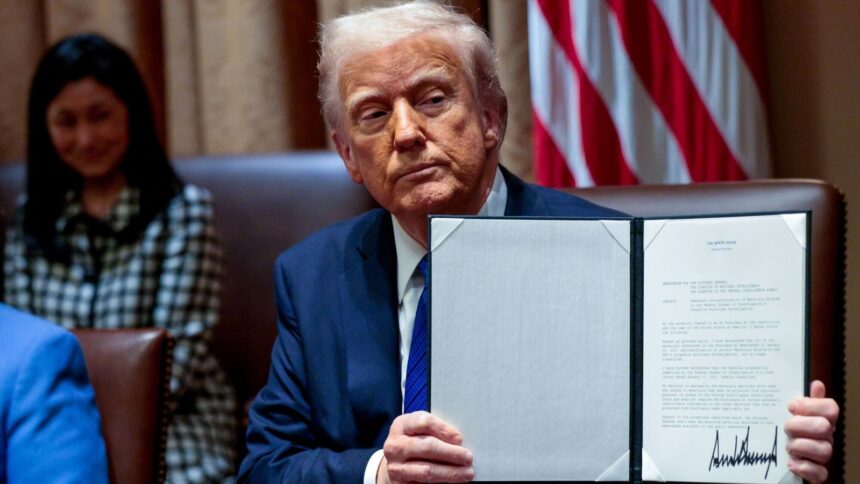
US President Donald Trump has signed an executive order introducing sweeping changes to the country’s election system, emphasizing stricter voter identification measures and new voting regulations. The order, which aims to bolster election integrity, mandates documentary proof of citizenship for voter registration in federal elections and requires all ballots to be received by Election Day. Donald Trump’s move is expected to face significant legal scrutiny, as election laws are traditionally governed by individual states.
Stricter Election Regulations and Federal Compliance
The executive order underscores what Donald Trump describes as the failure of the US to enforce “basic and necessary election protections.” It directs state governments to coordinate with federal agencies in sharing voter lists and prosecuting election-related crimes. Additionally, the order warns states that failure to comply with these measures could result in the loss of federal funding.
One of the key provisions of the order requires that votes be “cast and received” by Election Day, eliminating the extended counting periods that have been a subject of contention in past elections. This directive is expected to generate legal challenges, as US election laws are typically under state jurisdiction, and enforcing federal oversight could be seen as unconstitutional.
Election Assistance Commission’s Role and Foreign Influence Restrictions
The order also directs the Election Assistance Commission to amend its voting system guidelines to “protect election integrity.” It explicitly bans foreign nationals from contributing or donating in US elections, citing concerns over foreign interference.
“Foreign nationals and non-governmental organizations have exploited loopholes in the law’s interpretation, funneling millions of dollars through conduit contributions and ballot-initiative expenditures,” the order states. Donald Trump argues that such foreign influence undermines the fundamental democratic rights of American citizens.
India Cited as an Example of Strong Election Practices
Donald Trump referenced India and other countries as models for election security, arguing that the US lacks robust verification mechanisms. He pointed out that India and Brazil link voter identification to biometric databases, ensuring a more secure and verifiable voting process. In contrast, he noted that the US largely relies on self-attestation for citizenship verification.
Additionally, he highlighted that Germany and Canada use paper ballots for vote tabulation, ensuring a reliable and transparent process. He criticized the US for employing a fragmented system with varying state-level protocols, some of which, he argued, do not adhere to basic chain-of-custody protections.
Legal Challenges and Political Reactions
The executive order is likely to face pushback from various state governments and legal experts, who argue that election oversight falls within state jurisdiction. Critics also contend that the proposed measures could disproportionately affect voter participation, particularly among marginalized communities.
Despite the anticipated legal hurdles, Donald Trump’s order signals his continued focus on election security and his belief that federal oversight is necessary to standardize voting processes across the nation. The move is expected to become a focal point in upcoming political debates, particularly as the country prepares for future elections.