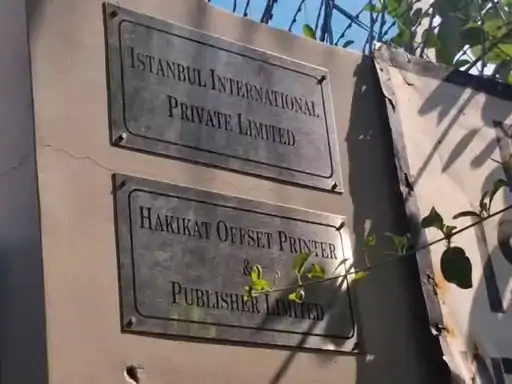
Local law‑enforcement in Noida is once again under the spotlight as the Uttar Pradesh Anti‑Terrorist Squad (ATS) carried out a major raid on the Istanbul International complex, pursuing investigations into suspected terror‑funding networks. Authorities reportedly sifted through voluminous records, financial documents, and other incriminating materials, raising the stakes in a growing probe that has already drawn significant media and public attention. This second raid underscores the ATS’s determination to crack down on suspected funding channels allegedly supporting extremist activities, and the outcome could have profound implications for anti-terrorism enforcement in the region.
Unfolding the Noida Terror‑Funding Probe and Istanbul International’s Role
The Noida-based terror-funding investigation has rapidly escalated into one of the most sensitive and high-profile probes in recent years in Uttar Pradesh. Istanbul International, a business complex known to house multiple commercial offices, has now come under repeated scrutiny by the ATS. According to well-placed sources within the agency, the second raid was significantly larger in scope than the first, with investigators combing through accounting ledgers, bank statements, client logs, and other critical documentation believed to shed light on suspected financial channels used to funnel money toward illegal or extremist causes.
In recent months, the ATS initiated its investigation after receiving intelligence inputs about suspicious monetary movements involving businesses in Noida. These inputs suggested that certain shell companies or lightly regulated enterprises were being used to disguise the origin and destination of funds. The first raid at Istanbul International reportedly yielded preliminary financial data, but investigators felt that they had not yet obtained a full picture. This prompted the second, more intensive operation.
During the recent raid, ATS officers worked methodically, dividing into teams that each focused on specific floors of the complex. Some officers were seen carrying boxes of financial files, while others used forensic experts to examine computers and digital storage devices on site. Investigators have said that much of their attention was directed toward identifying ledgers and transaction records that could connect local businesses with broader networks—both domestic and international—that might be involved in illicit funding.
Sources within the ATS claim that the raid was timed to coincide with business hours so as to maximize the chances of finding operational documentation. Employees and managers at Istanbul International were reportedly instructed to cooperate, and many staff members were interviewed to reconstruct the financial operations carried out under their roofs. The ATS is keen to build a prosecutable case, and the records seized during this raid could prove foundational in mapping out a detailed funding trail.
Legal, Security, and Political Implications of the Ongoing Investigation
The implications of this raid extend well beyond Noida’s city limits, raising critical security and legal questions for the state and national agencies. Should ATS investigators establish key links between local business fronts and terror financing, this case could set a precedent for how terror funds are tracked and prosecuted in India’s urban commercial centers. The scale of the operation suggests that law enforcement is no longer only targeting small-scale donors or grassroots operatives, but possibly sophisticated financial nodes embedded in legitimate businesses.
Politically, the investigation also carries weight. Funding terror activities is not only a crime but a national security challenge. Proving that commercial real estate was used to launder money or move funds illicitly would deepen concerns around regulatory oversight of business complexes and financial transactions. It may lead to stricter laws and more robust compliance requirements, particularly for businesses in high-risk regions or those whose owners have opaque financial histories.
Moreover, the raid places pressure on local governance and regulatory bodies responsible for property, taxation, and compliance. If Appalachian International (the building’s managing authority) or its tenants are implicated, there could be serious legal consequences, including seizures, fines, or even disqualification of business permits. This could ripple out into debates around urban planning policy, property registration, and corporate accountability in the context of national security.
Internationally, the case may attract attention as well. Terror funding investigations are always closely watched by global intelligence agencies and multilateral organizations. If the ATS can demonstrate that funds from Noida were channeled across national borders or to known extremist groups, it would strengthen arguments for tighter financial intelligence-sharing protocols and cross-border cooperation in counterterror financing.
At the same time, the raid raises due process concerns. Defense lawyers and civil society voices may question whether the investigation is proceeding with full transparency and fairness. Will the accused businesses have the opportunity to defend themselves? Are the raids being conducted with judicial oversight, and will the seized documents be handled in a way that respects legal rights while serving security needs? These are vital questions because, in counterterror operations, striking a balance between civil liberties and national security is always delicate.
Investigators have indicated that they plan to build a strong evidentiary base before filing formal charges. While the ATS has not commented publicly on all details, insiders suggest that the next phase of the investigation could involve financial forensics, bank-tracing operations, and possibly collaboration with central agencies like India’s Financial Intelligence Unit (FIU) or Enforcement Directorate (ED). Such collaboration could elevate the case from a regional probe to a national-level financial crime and terrorism case.
Additionally, this operation could influence how urban business spaces are perceived in anti-terror investigations. Commercial complexes, especially those with international branding or multinational tenants, might come under increased scrutiny in the future. Law enforcement may push for greater transparency of tenant ownership, financial audits, and mandatory reporting of unusual transaction patterns.
Finally, for the broader public, the raid underscores a growing reality: modern terror financing does not always operate in dark alleys or remote safe houses. It can run through legitimate business channels, large office buildings, and seemingly innocuous commercial ventures. The success or failure of this investigation could reshape public understanding of how deeply financial systems and terror networks can be intertwined—and how law enforcement must evolve to address these hidden, corporate-financed threats.