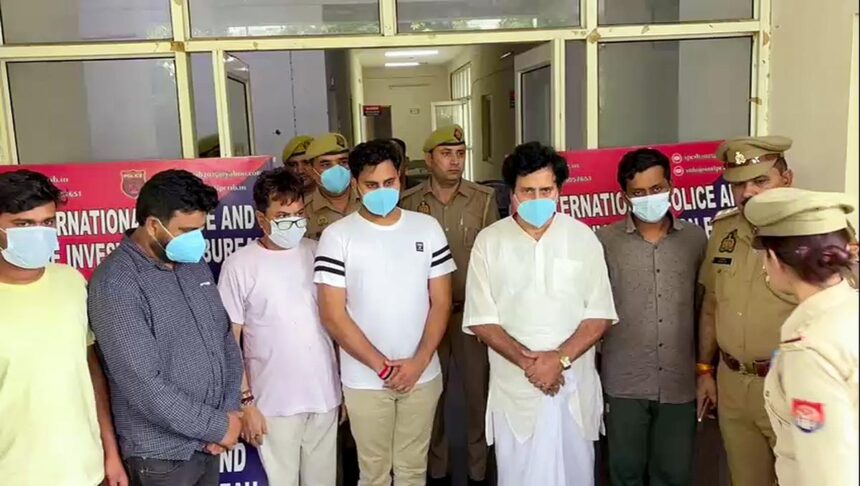
The arrest of a man impersonating a senior officer of India’s external intelligence agency has triggered widespread attention across Noida and Delhi-NCR, after police sources claimed that his laptop contained several videos suspected to be associated with the ongoing investigations into the recent Delhi blast case. The suspect, who had been posing as a Major-ranked operative connected to the Research and Analysis Wing, had been living in Noida for several days while allegedly presenting himself as an intelligence professional involved in high-level security assignments. His dramatic arrest—carried out by the police as he was taken away barefoot from a residential area—has raised questions about his background, intentions, and whether he had any deeper links with the material reportedly recovered from his electronic devices.
The Arrest in Noida and the Trail of Deception
According to early information shared by investigating officers, the suspect had constructed an elaborate identity to gain trust within the local community. He reportedly introduced himself as a Major working with India’s external intelligence unit and claimed that he had been stationed on confidential assignments related to national security. This fabricated identity helped him move with an air of authority, allowing him to reside in a Noida locality without drawing suspicion from common residents for several days. What ultimately led to his arrest were inconsistencies in his behavior and the growing doubts of those who interacted with him, including hotel staff and residents who noticed gaps in his statements and conduct.
The arrest took place following complaints and a subsequent verification attempt initiated by the authorities. Once confronted, the man failed to provide authentic identification or any documents that could verify his claims of belonging to the Research and Analysis Wing or holding the rank of Major. Eyewitnesses described the moment of arrest as dramatic and unexpected; officers were seen escorting him out of the premises without shoes, prompting curiosity and concern among local residents who gathered around to witness the unfolding situation.
When the police began examining his belongings, they discovered multiple forged identification cards and documents. These included IDs that falsely portrayed him as a member of sensitive government departments. The presence of fabricated credentials added to the gravity of the case, forcing investigators to consider whether the impersonation was carried out merely for personal benefits or for motives centered around deeper criminal intentions. His laptop, which was seized shortly after, became a focal point of the investigation due to the nature of the files stored inside.
Authorities analyzing the device reportedly found several videos that appeared to be connected to the Delhi blast case, a development that instantly intensified the case’s seriousness. While officials have not fully disclosed the details of these videos due to the sensitive nature of the content, preliminary observations suggested that the material included recordings, security footage, or digitally circulated clips that have been circulating in connection with the blast’s aftermath. Whether the suspect had obtained these videos from open sources, social media, or undisclosed channels is still being investigated.
Initial reports indicate that the man had been consuming a significant amount of high-profile national security content online, raising concerns about whether he had been deliberately curating such material or had access to it through contacts. Investigators are trying to determine whether the presence of the Delhi blast videos signals a planned attempt to exploit or misuse such sensitive content. Another possibility being explored is whether he was attempting to use intelligence-related visuals to reinforce his fake identity among locals, giving the impression that he was engaged in ongoing counterterror operations.
Investigation Deepens as Police Study His Digital Footprints and Personal History*
As the investigation progresses, law enforcement agencies are meticulously tracing the suspect’s digital footprints, personal connections, and previous movements. His mobile phone, laptop, and other electronic devices are undergoing forensic examination to reconstruct his online behavior and identify who he communicated with and what networks he accessed. Investigators are particularly interested in understanding whether he operated alone or was encouraged by other individuals who may have provided him with the fake identity documents or directed him to gather sensitive information.
The man’s personal history is also being closely scrutinized. Police are looking into his background to determine whether he has a criminal record in other states or was previously involved in similar acts of impersonation. Early interviews suggest that he had been traveling frequently and had switched locations multiple times, raising concerns that he might have constructed similar identities elsewhere in the past. The authorities are also examining whether he had been living beyond his financial means while presenting himself as a government officer, which may indicate the possibility of fraud or extortion attempts.
Investigators believe that his impersonation may have been motivated by a desire to gain social status, financial advantages, or access to restricted spaces. Pretending to be a member of a high-ranking intelligence unit would have allowed him to command respect from hotel staff, residents, and even vulnerable individuals who might be intimidated by someone claiming national security authority. Several people who interacted with him stated that he spoke confidently about surveillance operations, security threats, and classified missions, suggesting that he had studied enough publicly available information to convincingly play the role.
As for the Delhi blast videos discovered on his laptop, forensic experts are cross-checking their timestamps, source paths, and metadata to determine whether they were downloaded, transferred via external devices, or shared from encrypted applications. If the videos were acquired through unconventional channels, law enforcement agencies may broaden the investigation to explore potential contacts or online groups from which he might have accessed the files. Authorities are particularly cautious because the Delhi blast case is under active investigation, and any unauthorized possession of related material could raise red flags.
Another important part of the investigation revolves around the suspect’s financial transactions. Police are examining bank account records, credit card usage, and mobile payment histories to find whether he received money from suspicious sources or used financial platforms to deceive people. Impersonators often use the guise of government roles to extort individuals, run scams, or influence vulnerable people into handing over money in the promise of government benefits, protection, or confidential assistance. Whether this man engaged in similar activities is still a subject of inquiry.
Multiple agencies, including cybercrime units and intelligence personnel, have joined hands with the local police to understand if there are any national security implications. While early indications suggest that he might not have formal connections to terrorist groups or organized crime networks, investigators are not ruling out any possibilities until the digital analysis is complete. The presence of the Delhi blast videos remains the strongest reason for authorities to continue probing deeper, even though it is still unclear whether he collected those videos out of curiosity, psychological fascination, or some deliberate agenda.
Residents of the area where he was arrested have expressed shock at discovering the truth about him. Many said that he carried himself with authority and maintained a demeanor that easily convinced others of his fake credentials. Some people said he would speak about his involvement in dangerous missions, claim that he worked undercover, or suggest that he had access to confidential information that could not be discussed publicly. His fabricated identity had been constructed with considerable effort and attention to detail, which is why it took time before suspicion grew strong enough for authorities to act.
The police continue to gather statements from those who interacted with him during his stay in Noida. These testimonies may help clarify whether he attempted to influence or manipulate individuals using his false identity and whether he displayed any specific interest in local facilities, law enforcement activities, or sensitive areas. Surveillance footage from nearby locations is being reviewed to track his movements throughout the days leading up to his arrest.