A United Nations Security Council resolution proposing the establishment of an international stabilisation force in Gaza is expected to be finalised within two weeks, although significant disagreements over the force’s mandate, leadership structure, and the timeline for Israel’s withdrawal could delay its introduction. The proposal, seen as a potential breakthrough in bringing lasting stability to Gaza, has ignited complex discussions among regional and international stakeholders about the mission’s scope, the involvement of the United States, and the degree of cooperation with the Palestinian authorities.
Debate Over Mandate, Leadership, and Timetable for Israeli Withdrawal
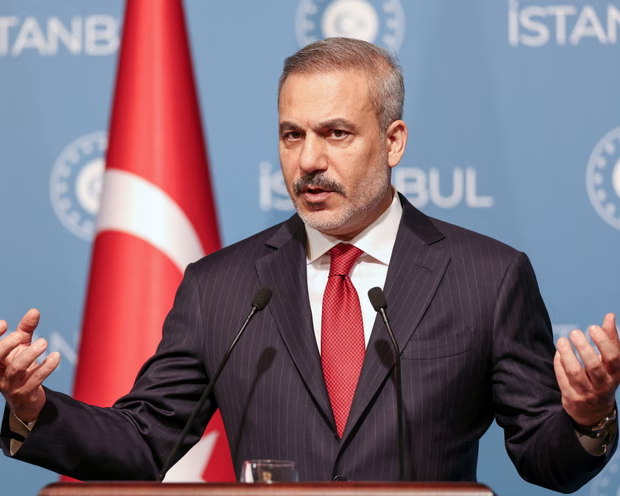
At a high-level meeting in Istanbul on Monday, foreign ministers from several Muslim-majority countries, including Turkey, Indonesia, Pakistan, Saudi Arabia, and Jordan, convened to discuss the prospect of contributing troops to the stabilisation force. Turkish Foreign Minister Hakan Fidan reaffirmed Turkey’s willingness to participate, reiterating that Ankara’s final decision would depend on the mission’s structure and alignment with its national principles. He warned that if the mission’s objectives conflicted with the political or moral stance of participating nations, it would be difficult for them to commit troops.
Fidan’s remarks underscored the ongoing uncertainty surrounding the mission’s framework. Central to the discussions are key issues such as whether the United States should play a leadership role, how disputes with Israel will be managed through a deconfliction mechanism, and whether Israel’s full withdrawal from Gaza should occur on a fixed schedule or only after the complete disarmament of Hamas.
Turkey has maintained that it is ready to contribute a contingent of troops, a proposal Israel has rejected due to Ankara’s vocal support for Hamas. Other nations attending the meeting, including representatives from the United Arab Emirates and Qatar, discussed potential contributions and logistical coordination. Notably, Egypt—often viewed as a potential regional leader in such initiatives—was absent from the meeting.
Jordan, while declining to commit combat troops, offered to train a vetted Palestinian police force responsible for maintaining internal order in Gaza. However, this has prompted further questions about how the Palestinian police would interact with the international stabilisation force and where the lines of authority between the two entities would be drawn. The issue has become a central sticking point in the broader conversation about sovereignty and governance in post-conflict Gaza.
Western diplomats involved in the discussions suggested that most countries would only participate if the United States assumed a strong leadership role, even without deploying troops on the ground. One diplomat noted that without substantial U.S. involvement, there would be widespread skepticism about the mission’s capacity to constrain Israeli military actions. Muslim countries, meanwhile, have made clear they do not want their forces to appear as a “peace enforcement” mission, preferring instead a traditional “peacekeeping” framework that focuses on maintaining order rather than engaging in combat.
The resolution’s details are also expected to address coordination between the stabilisation force and the newly established U.S. Civil-Military Coordination Centre, which oversees humanitarian operations in Gaza. However, officials have indicated that the stabilisation force would likely function independently from the U.S.-led humanitarian initiative to prevent operational overlap and political tension.
Fragile Truce and Escalating Humanitarian Concerns in Gaza
As diplomatic efforts progress, the situation on the ground in Gaza remains dire. Despite a ceasefire agreement in effect since October 10, violence has continued to erupt across the territory. On Tuesday, reports indicated that 115 people were killed and 352 injured—the deadliest day since the truce began—raising fears that the fragile peace could collapse. Turkish Foreign Minister Fidan accused Israel of systematically violating the ceasefire and obstructing the delivery of essential humanitarian aid, warning that the situation had reached a “critical stage.”
Meanwhile, international figures are growing increasingly concerned about the deteriorating humanitarian situation. Over the weekend, German Foreign Minister Johann Wadephul urged rapid progress, warning that “time is running out” to stabilise Gaza. He emphasised that while the ceasefire had been essential in halting immediate hostilities and allowing aid to enter, the absence of an effective governance and security structure risked plunging the region back into chaos.
Arab nations have echoed similar sentiments, stressing the urgency of establishing a clear timeline for Israel’s withdrawal from Gaza. Jordanian Foreign Minister Ayman Safadi stated that Israel’s continued occupation of more than half of the Gaza Strip was incompatible with any credible peace effort. “Israel cannot remain in 53 percent of Gaza and expect security to be achieved,” he said, urging the creation of a deconfliction mechanism to manage potential disputes between the stabilisation force, Israel, and local Palestinian authorities.
Safadi also underscored that the proposed technocratic committee—intended to oversee Gaza’s administrative functions—must remain linked to the Palestinian Authority to ensure that Gaza remains an integral part of the occupied Palestinian territories. He noted that disconnecting Gaza’s governance from the broader Palestinian political structure could further fragment the national cause and undermine prospects for long-term peace.
Diplomatic sources revealed that potential members of this technocratic committee had already been identified and were undergoing vetting to ensure their credibility within Gaza’s civil society. The committee is expected to comprise non-partisan professionals tasked with managing essential services and rebuilding administrative institutions destroyed during the conflict. However, questions persist about the extent of its authority and how it will coordinate with both the stabilisation force and the Palestinian Authority.
Another unresolved issue is the disarmament of Hamas. Western diplomats acknowledged that the group has refused to lay down arms under conditions where its members would remain vulnerable to Israeli attacks. “The only stipulation Hamas has made clear is that it will not disarm in circumstances where they would be killed by the Israelis,” one diplomat stated. This impasse has made it difficult for negotiators to design a credible security framework that satisfies all parties.
U.S. officials have also dismissed Israel’s claims that Hamas is deliberately delaying the return of Israeli bodies from Gaza. They suggested that many of the missing individuals might never be recovered due to the extensive destruction across the enclave. The issue remains sensitive, particularly as the families of those killed continue to demand accountability and closure.
Rising Regional Pressure and Uncertain Prospects for Peace
Pressure to move forward with the stabilisation plan is mounting among Arab states anxious about a potential security vacuum in Gaza. The absence of a functioning administrative and policing structure, combined with ongoing violence, has fueled fears of further instability spilling across borders. While the ceasefire has provided temporary relief, the long-term viability of peace depends heavily on the successful establishment of the stabilisation force and the reintroduction of Palestinian self-governance mechanisms.
Western diplomats have expressed cautious optimism about the progress being made, though many acknowledge that the plan faces significant challenges. “Most people do not give this a huge chance of success, to be honest,” one diplomat admitted. “But things are moving along much better than anticipated.”
The key to success, according to multiple officials, lies in balancing international oversight with Palestinian autonomy. Local residents, they noted, are deeply wary of a scenario in which Gaza is effectively administered by foreign powers. “What Gazans want is an international element supporting a Palestinian government in Gaza, not one replacing it,” said another diplomat. “But without some international role in both security and governance, Israel will never take the process seriously, and Gaza will never have the space it needs to rebuild.”
Regional actors, including Jordan and Qatar, have been pushing for the swift establishment of a governance structure that can deliver tangible improvements to daily life. However, the continued blockade, damaged infrastructure, and pervasive poverty have made this a daunting task. International humanitarian organisations have warned that without immediate progress in reconstruction, Gaza’s civilian population could face worsening shortages of food, water, and medical supplies.
The ongoing debate over the stabilisation force reflects broader geopolitical tensions between regional and global powers. For the United States, leading the initiative offers a chance to assert diplomatic influence and stabilise a conflict zone that has repeatedly undermined regional peace efforts. For Muslim nations, participation carries both risks and opportunities—allowing them to shape the post-conflict order in Gaza while navigating domestic sensitivities regarding military engagement in Palestinian territories.
Despite these complexities, the growing consensus among diplomats is that inaction is no longer an option. The ceasefire, while fragile, has provided a window of opportunity that may not remain open for long. With violence continuing to erupt and humanitarian conditions deteriorating rapidly, the push to finalise the UN resolution within the next two weeks has taken on a new sense of urgency.
The outcome of these deliberations will determine not only the future of Gaza but also the broader trajectory of peace and stability across the Middle East. As nations weigh their commitments and conditions, the question remains whether political will and international cooperation can overcome decades of mistrust and conflict—or whether Gaza will once again be left suspended between promises of peace and the grim reality of perpetual instability.