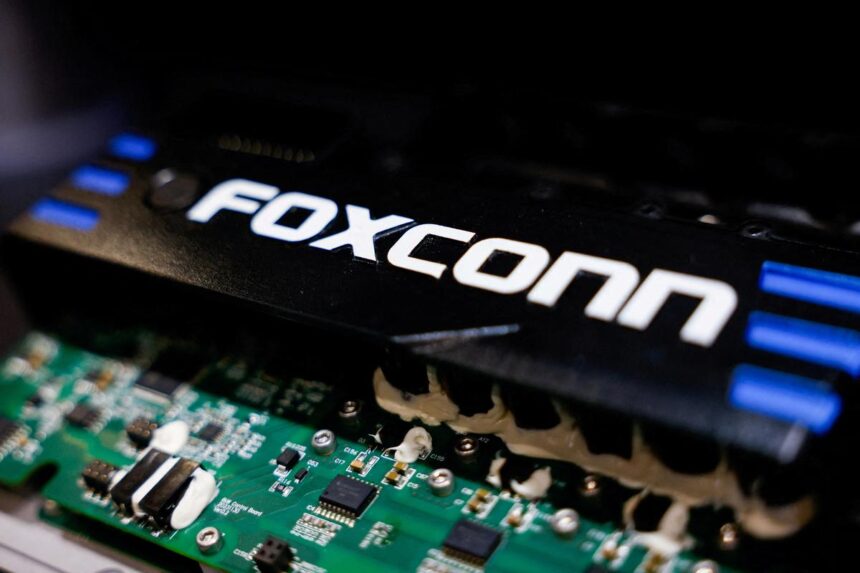
In a major move signaling its growing ambitions in artificial intelligence and high-performance computing, Taiwan’s Foxconn has announced plans to invest up to $1.37 billion (NT$42 billion) in developing an AI compute cluster and a state-of-the-art supercomputing centre. The investment, set to be executed between December 2025 and December 2026, aims to expand the company’s cloud computing service platform and strengthen its position in the global AI infrastructure landscape. The decision, approved by Foxconn’s board of directors, marks one of the company’s largest technology investments to date and reflects its ongoing transformation from a traditional electronics manufacturer to a technology-driven enterprise focused on the next wave of innovation.
According to the company’s filing published late Monday, the entire investment will be funded internally, demonstrating Foxconn’s robust financial health and strategic commitment to AI-driven growth. Although the company did not disclose the exact location of the new facilities, a source familiar with the matter confirmed that the project will be based in Taiwan. The move underlines Foxconn’s determination to strengthen its domestic technological base while building advanced infrastructure that supports its global business objectives.
The investment also comes at a time when global demand for artificial intelligence computing power is soaring, with corporations and governments alike racing to develop data-driven ecosystems. By expanding its cloud and AI capabilities, Foxconn aims to position itself as a key player in the world’s rapidly evolving technological landscape, leveraging its expertise, scale, and manufacturing prowess to deliver advanced computing solutions.
Expanding AI and Cloud Capabilities for Future Growth
Foxconn, also known globally as Hon Hai Precision Industry Co. Ltd, is widely recognized as the world’s largest contract electronics manufacturer and a key assembler for companies like Apple. However, in recent years, it has been diversifying aggressively to reduce its dependency on smartphone and consumer electronics manufacturing. With the artificial intelligence revolution reshaping industries, Foxconn is realigning its long-term strategy toward AI, cloud infrastructure, data centers, and smart technology platforms.
In its filing, Foxconn said that the purpose of this investment plan is to “expand the cloud compute service platform and accelerate the development of the Group’s three smart platforms.” Although it did not elaborate on these platforms, industry analysts interpret them as key areas where the company is building long-term capabilities — smart manufacturing, smart EV mobility, and smart living ecosystems. Together, these three pillars are expected to drive Foxconn’s next phase of growth as it moves beyond being a manufacturing contractor to becoming an integrated technology solutions provider.
The new AI compute cluster and supercomputing centre will likely serve as the backbone of these initiatives, providing the computational power needed for machine learning, deep learning, and advanced data analytics. By building an internal infrastructure capable of supporting large-scale AI workloads, Foxconn is not only enhancing its own research and development capabilities but also creating opportunities to offer cloud-based AI services to other enterprises.
Industry experts believe that Foxconn’s move aligns with global trends where tech giants are investing billions into AI computing and data center infrastructure. Companies like Amazon, Microsoft, and Google are already leveraging their own supercomputing networks to power AI-driven services, and Foxconn’s decision indicates its readiness to join this race at an industrial level. The company’s vast experience in hardware production gives it a unique advantage, allowing it to integrate hardware design, production, and software optimization in a single ecosystem.
Strengthening AI Collaboration and Global Infrastructure Partnerships
Foxconn’s increasing focus on artificial intelligence has been evident through a series of strategic collaborations and announcements made throughout 2024 and 2025. In May, the company revealed that it would partner with U.S. semiconductor giant Nvidia to build an advanced AI center in Taiwan. This facility is expected to operate with 100 megawatts of power, representing one of the most significant AI infrastructure projects in the region. The collaboration with Nvidia is aimed at combining Foxconn’s large-scale manufacturing expertise with Nvidia’s leadership in GPU-based AI computing, enabling the creation of a next-generation computing ecosystem capable of supporting complex AI models and autonomous technologies.
In another major development, Foxconn announced in August that it would begin manufacturing data center equipment in collaboration with Japan’s SoftBank. This initiative, part of the Stargate project, is based at Foxconn’s former electric vehicle factory in Ohio, USA, and is designed to enhance America’s AI infrastructure capabilities. By entering the data center hardware space, Foxconn is extending its reach into one of the most rapidly expanding technology markets, where the demand for AI-ready infrastructure is expected to multiply in the coming decade.
These partnerships reflect Foxconn’s broader strategy of building a global AI and cloud computing network that bridges Asia and North America. The company’s collaboration with both Nvidia and SoftBank showcases its intention to play a critical role in the AI supply chain — from hardware production to infrastructure deployment. Analysts suggest that such moves are positioning Foxconn as a foundational player in the AI-driven digital economy, capable of serving clients in sectors ranging from manufacturing to telecommunications and from automotive to smart cities.
Foxconn’s chairman, Young Liu, has repeatedly emphasized the company’s ambition to transform itself into a leading force in “smart manufacturing” and “smart technology integration.” Under his leadership, the company has been focusing on expanding its ecosystem to include electric vehicles, semiconductors, and now artificial intelligence. Liu’s vision centers on leveraging Foxconn’s global network, manufacturing capacity, and financial strength to build scalable and sustainable technologies that drive the digital transformation of industries worldwide.
The latest investment into AI compute clusters and a supercomputing center underscores this strategic direction. It indicates that Foxconn intends not only to support its internal digitalization goals but also to develop services that can cater to the broader technology community. The move also helps the company align with Taiwan’s growing ambitions to become a regional leader in semiconductor and AI innovation. Taiwan, home to major semiconductor manufacturers such as TSMC, is already a global hub for advanced technology production, and Foxconn’s investment adds further momentum to this ecosystem.
Industry observers note that such an initiative will require significant infrastructure, energy, and resource commitments. The planned NT$42 billion investment over a year-long period will likely be allocated toward the purchase of advanced computing hardware, AI accelerators, networking systems, and cooling technologies — all essential for large-scale data centers. Additionally, the development of such a facility will create new employment opportunities in fields like data science, AI engineering, and system management.
Foxconn’s push into supercomputing also represents an effort to future-proof its business against global market volatility. As smartphone demand plateaus and competition in consumer electronics intensifies, the company’s long-term survival depends on how well it can diversify into high-value technology sectors. By entering the AI and data infrastructure market, Foxconn is ensuring that it remains relevant in an era increasingly defined by digital intelligence, automation, and connected ecosystems.
The timing of this investment is also significant. Across the world, corporations and governments are competing to build their own AI compute clusters to support emerging applications such as generative AI, autonomous vehicles, predictive analytics, and biotechnology. The growing need for AI computational power has created a surge in demand for high-performance chips, advanced networking, and cloud-based compute services. By establishing its own supercomputing capabilities, Foxconn can tap into this demand not only to improve its operational efficiency but also to supply enterprise clients seeking scalable AI solutions.
Moreover, the company’s commitment to use internal funds for the investment reflects its financial confidence and long-term strategic clarity. As of recent quarters, Foxconn’s financial statements have shown strong cash reserves, driven by its diversified manufacturing operations and efficient cost management. This allows the company to reinvest heavily into future technologies without depending on external financing.
Foxconn’s evolving role as a technology enabler rather than just a manufacturer could reshape the company’s global image. Its entry into AI compute infrastructure signals a broader shift in the industrial landscape, where traditional manufacturers are becoming integral to digital transformation. Through sustained investments in AI, cloud, and data centers, Foxconn is not only enhancing its competitive edge but also contributing to the larger digital economy that is reshaping global industries.
As the AI revolution accelerates, Foxconn’s strategy places it in direct competition with major tech infrastructure players while simultaneously complementing the ambitions of its long-term clients, including global technology brands. With AI now at the core of innovation across every sector, the company’s investment in compute clusters and supercomputing infrastructure positions it as a powerful force in the next generation of global technology evolution.
Foxconn’s billion-dollar bet on AI is, therefore, more than just a technological upgrade—it represents a strategic transformation of the company’s identity, priorities, and future direction. The decision to build these facilities in Taiwan highlights both national pride and industrial foresight, reinforcing Taiwan’s position as a leading center for innovation and technology. As Foxconn builds this powerful foundation, it prepares to not only redefine its own operations but also influence the trajectory of AI-driven development across the world.