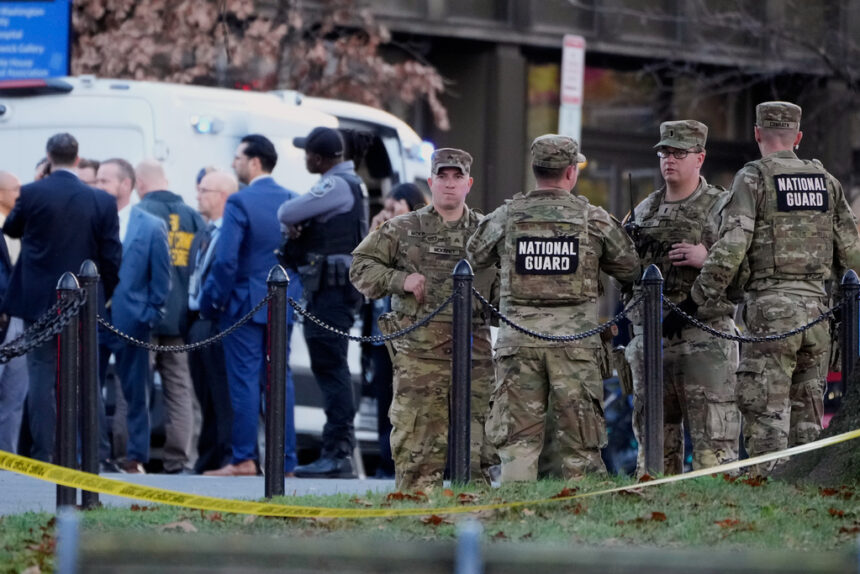
A shocking act of violence unfolded in Washington, D.C., on Wednesday when two West Virginia National Guardsmen were critically injured in a shooting just blocks from the White House. The incident, described by officials as a “targeted shooting,” has raised serious security concerns in the nation’s capital. Both Guardsmen were deployed as part of ongoing National Guard operations in Washington and were immediately hospitalized in critical condition. The suspect involved in the attack was taken into custody and also sustained non-life-threatening injuries. Federal and local law enforcement agencies, including the Metropolitan Police, the Secret Service, and the FBI, have launched a thorough investigation to determine the circumstances and motive behind the brazen attack.
Details of the Shooting and Immediate Response
The shooting occurred roughly two blocks northwest of the White House in a heavily trafficked area of the capital. Initial reports indicated that the suspect approached the Guardsmen and opened fire. Law enforcement officials, speaking on condition of anonymity, confirmed that at least one of the Guardsmen returned fire. Surveillance video from the scene was being reviewed by authorities to piece together the sequence of events. Emergency responders were quickly on site, administering CPR to one of the Guardsmen while attending to the other, who was conscious but severely injured. Social media footage captured the chaotic scene, showing first responders working to stabilize the victims as law enforcement officers restrained the suspect nearby.
FBI Director Kash Patel and Washington Mayor Muriel Bowser confirmed that the Guardsmen were in critical condition at local hospitals. Mayor Bowser described the shooting as a deliberate and targeted attack, highlighting the risks faced by security personnel stationed in high-profile areas. West Virginia Governor Patrick Morrisey initially reported that the soldiers had died but later clarified that conflicting reports were being received, leaving the troops’ status uncertain at that time. Local authorities worked in coordination with federal agencies to secure the area, which was cordoned off with police tape and observed by National Guard units. Helicopters hovered overhead, and law enforcement vehicles from multiple agencies, including the Bureau of Alcohol, Tobacco, Firearms and Explosives, were deployed to support the investigation.
Eyewitnesses at the scene described hearing gunfire followed by immediate panic. Stacy Walters, who was near the area in her car, recounted hearing two distinct gunshots and seeing people running for cover. Law enforcement rapidly converged on the location, evacuating civilians and providing medical aid to the victims. Emergency medical services transported the two Guardsmen and the injured suspect to hospitals, where their conditions were being closely monitored. The rapid response underscored the readiness of first responders in high-threat scenarios, while simultaneously drawing attention to the vulnerability of National Guard members performing security duties in public spaces.
Security Concerns and Broader Implications
The presence of National Guard troops in Washington has been a focal point of political and public debate for months. Over 300 West Virginia National Guard members were deployed to the capital in August to assist with security operations, including neighborhood patrols, train station oversight, highway checkpoints, and even non-traditional assignments such as trash collection and event security. Recently, approximately 160 of these troops volunteered to extend their deployment through the end of the year, demonstrating their continued commitment to maintaining safety in the city.
The shooting has sparked concerns over the safety of Guardsmen and other security personnel in areas of high public visibility. Investigators are working to determine the shooter’s motive, including whether the attack specifically targeted the deployed troops. Federal authorities are reviewing all evidence, including video surveillance, witness accounts, and forensic analysis, to reconstruct the incident accurately. President Donald Trump, who was in Florida at the time for Thanksgiving, condemned the attack on social media, calling the suspect an “animal” and warning that they would face severe consequences. Trump also praised the National Guard and military personnel, expressing solidarity with the victims and emphasizing their role as protectors of the nation.
Vice President JD Vance, addressing troops in Fort Campbell, Kentucky, urged citizens to pray for the wounded Guardsmen and highlighted the importance of military service. He reminded the public of the critical role of soldiers, whether active-duty, reserve, or National Guard, as the “sword and shield” of the United States. Mayor Muriel Bowser’s office confirmed that local leaders were closely monitoring the situation, emphasizing the need for coordination between city, federal, and law enforcement agencies.
The deployment of National Guard personnel to Washington has been a contentious issue, particularly under the Trump administration. An emergency order in August federalized the local police force and brought in troops from eight states and the District of Columbia. While the order officially expired a month later, the troops remained in place to maintain security. A recent federal court order instructed the cessation of this deployment, but the ruling was temporarily stayed to allow administrative review and potential appeal. The incident has further intensified discussions about the balance between public safety, military involvement in domestic operations, and civil oversight.
The shooting also underscores the complex challenges faced by National Guard personnel performing routine security duties in urban environments. While their presence is intended to bolster public safety and provide support during periods of heightened concern, it exposes them to targeted acts of violence. The law enforcement response involved multiple agencies, coordinated communications, and rapid deployment of resources to contain the situation, provide medical care, and ensure public safety. Helicopters were deployed to monitor the area, while officers secured perimeters and conducted immediate investigations to apprehend the suspect.
Officials have noted that the suspect sustained injuries that were not considered life-threatening, and further questioning will aim to determine whether the attack was premeditated, politically motivated, or influenced by other factors. The FBI and local authorities are closely coordinating to ensure that all leads are thoroughly investigated. The White House and other federal agencies have also been apprised, given the proximity of the incident to the nation’s most sensitive federal locations.
The incident has generated nationwide attention and public concern regarding the safety of National Guard personnel, law enforcement officers, and federal security operations. Social media reactions have amplified awareness of the incident, with videos and firsthand accounts providing a stark view of the dangers faced by security personnel. The shooting took place during a period of heightened deployment in Washington, reflecting ongoing public safety concerns and the government’s reliance on National Guard forces for urban security.
The ongoing investigation is expected to examine the sequence of events leading to the shooting, the potential motives of the suspect, and any lapses in security that could have contributed to the incident. Law enforcement agencies have emphasized the importance of community cooperation, witness testimony, and forensic evidence in understanding and resolving the case. Given the high-profile nature of the location and the victims involved, federal, state, and local agencies are likely to continue working in close coordination to ensure a comprehensive response.
As the investigation continues, attention remains focused on the well-being of the two National Guardsmen, who are being treated in critical condition, and the broader implications for security protocols in Washington, D.C. The incident has prompted renewed discussions regarding the role of military personnel in domestic operations, the risks associated with high-visibility deployments, and the measures necessary to protect those tasked with safeguarding the public.